




NEM: A market-friendly affirmative action
The government has pledged to take a market-based approach to affirmative action in launching the New Economic Model but touched very little on the current practice of racial quotas.
The government has pledged to take a market-based approach to affirmative action in launching the New Economic Model but touched very little on the current practice of racial quotas.
Prime Minister Najib Abdul Razak told the Invest Malaysia conference that the affirmative action policies shall remain.
"Affirmative action programmes and institutions will continue in the NEM but, in line with views of the main stakeholders, will be revamped to remove the rent-seeking and market-distorting features which have blemished the effectiveness of the programme."
In striking a balance between the special position of the bumiputera and legitimate interests of different groups, he said government will help all poor Malaysians regardless of race.
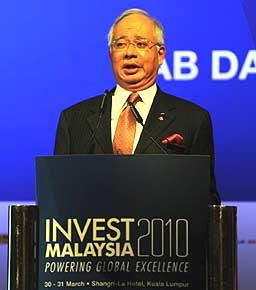 "Affirmative action will consider all ethnic groups fairly and equally as long as they are in the low income 40% of households."
Under the New Economic Policy, introduced by Najib’s father Abdul Razak, the affirmative action policies are bolstered by a litany of racial quotas involving university entrance, education scholarships, business licenses, investments, government contracts and many more.
"Quotas have been used extensively in the past. The streamlining of quotas will require a re-examination of how quotas have been applied, their transparency and effectiveness.
The NEM report says that racial quotas should be slowly phased out as its excessive use had resulted in the use of less-qualified recipients and bred inefficiency.
"The NEM recommends the shifting of affirmative action programmes to emphasise opportunities rather than outcomes. The remaining quotas should be progressively phased out."
As for university enrolment, the NEM suggests a hybrid approach - the use of racial quota but taking into account the need and merit of the applicants.
"If quotas are to be progressively phased out, their continued used in the interim should be targeted at the bottom 40% low-income group."
Slashing of subsidies
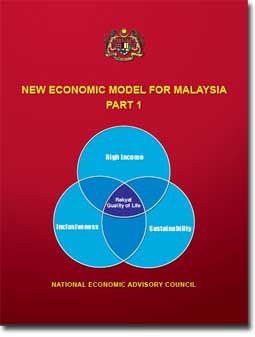 Najib's NEM launch is accompanied by the release of a report 'New Economic Model for Malaysia, Part 1'.
He will be announcing the second part of NEM during the announcement of the 10th Malaysia Plan in June.
The NEM report also highlights the need to slash the current subsidy regime in order to reduce “serious leakages”.
It says the federal subsidy bill accounts or a fifth of the country's operating expenditure with a large part used for fuel and petroleum products.
“Some estimates indicate that more than 70% of the beneficiary of the subsidies for fuel products has been enjoyed by the higher income groups.”
Plans to streamline petrol subsidy through a tiered system earlier this year was scrapped due to public outcry.
The government currently subsidies a host of products including sugar, flour and rice.
The NEM also addresses the thorny issue of government procurement, through the introduction of a more open tender system, in the place of direct negotiated tenders.
The report says government procurement accounts for 17% of the federal government expenditure including spending on supplies and services such as repair and maintenance, professional
and other services, communication and utilities, supplies and rentals.
In his speech today, Najib announced that parcels of government owned-land in prime areas including along Jalan Ampang and Jalan Stonor will be tendered out for development by the private sector.
Three key goals
Najib lamented that "excessive focus on ethnicity-based distribution of resources has contributed to growing separateness and dissension".
He announced that an "Equal Opportunities Commission will be
established to ensure fairness and address undue discrimination when occasional abuses by dominant groups are encountered".
In taking a leaf out of opposition Pakatan Rakyat’s manifesto, Najib said that the government’s inclusive approach “based on needs, not race” will translate into greater support for the bumiputera.
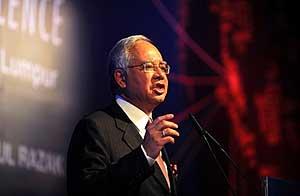 "The bumiputera segment still forms the majority in the vulnerable groups by any measure," he stressed.
He also said that instead of concentrated on target setting, the government will now focus on “structured and dedicated capacity-building investment” that allows the bumiputera to take advantage of new opportunities.
Najib added that the country can no longer tolerate practices that support the behaviour of rent-seeking and patronage, which has tarnished the spirit of NEP.
According to Najib, NEM has three main goals.
1) High income
Targets US$15,000-20,000 per capita by 2020 by ensuring an average of 6.5% per annum from 2011-2020.
The main driver of this growth will be private investment, complemented by efforts to reduce the growing fiscal deficit.
2) Inclusiveness
Enables all communities to fully benefit from the wealth of the country; a key challenge of inclusive growth is the design of effective measures that strike a balance between the special position of bumiputeras and legitimate interest of different groups.
Hence, among the market-friendly affirmative action programmes include targeting assistance to the bottom 40 percent of households. It stressed 77.2% of these households are bumiputera-owned, and many are in Sabah and Sarawak.
3) Sustainability
The NEM seeks sustainable growth through the effective management of natural resources, as well as the establishment of fiscal discipline in order to saferguard macro-economic balance and stability.
Thus, the public sector will be reformed to become more efficient and customer-focused.
Achieving 6.5% target 'challenging'
The NEM will boost the quality of the workforce and reduce dependence on the millions of foreign workers who power Malaysia's plantations and manufacturing sectors.
"We need a new way of doing things. While the recovery has begun, we must act now to position Malaysia for the future," Najib said.
"And this is the choice we now face: To rise out of the 'middle-income' trap that will be a precarious position for any nation in the new global economy, or to stick to what we know, and what is comfortable."
"We want to see a Malaysia that makes a quantum leap from the current US$7,000 per capita annual income to US$15,000 in 10 years," Najib said.
"Bold reform measures will unlock investment, drive labour productivity and boost efficiency, lifting real growth rate to an average of 6.5 percent per annum over the 2011-2020 period.”
CIMB chief economist Lee Heng Guie told AFP that the policy announcement was a "strong statement of intent" but details of how Najib intended to achieve the grand goals were lacking.
Lee said the 6.5 percent annual growth target is "challenging given the uncertain external economic environment".
The economy shrank 1.7 percent last year as its crucial export markets dried up during the global downturn.


Report this comment
Are you sure you want to delete this comment?
This action cannot be undone.