




Gov't often deaf to Suhakam's advice
Suhakam outgoing Chairman Abu Talib Othman must feel like he's caught between a rock and a hard place. Civil society scorn Suhakam as a toothless tiger. The government, for the most part, ignores it recommendations.
Suhakam outgoing Chairman Abu Talib Othman must feel like he's caught between a rock and a hard place.
Civil society scorn Suhakam as a toothless tiger. The government, for the most part, ignores it recommendations.
The public has even hauled it to court - It was sued for lack of action in the Kampung Medan racial riots in 2001. (Suhakam won the case).
Recently the organisation was even threatened with a drop in its rankings by the ICC but eventually retained its ‘A' status.
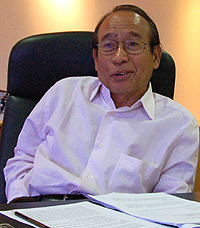 Nevertheless, Suhakam Chairman Abu Talib Othman (
right
) remains unbowed. He shared with
Malaysiakini
how he endured these challenges in Part 2 of an exclusive interview.
Nevertheless, Suhakam Chairman Abu Talib Othman (
right
) remains unbowed. He shared with
Malaysiakini
how he endured these challenges in Part 2 of an exclusive interview.
The former attorney-general explained that to accuse the body of inaction was misdirected.
"Suhakam was essentially established to act in an advisory capacity, and if the government does not implement our recommendations, we cannot act against the law," he said.
Moreover, the lack of support from civil societies and the government's reluctance to take its recommendations seriously often leaves the commission frustrated.
Having said that, Abu Talib does feel that Malaysia's human rights front is considerably better than other countries and that Suhakam had played its role well.
"I am happy to say that we have carried out activities which have led to more people understanding what is human rights today and help them exercise their rights more than ever before," he continued.
He explained that Suhakam had taken up complaints from indigenous people whose land were taken away without compensation, poor people whose police reports the police did not act upon and also cases of death in police custody.
"After we took a lot of action, the police started to hold inquests for every death in custody. In the past, these cases were just closed," he added.
Excerpts of the interview follow. The content has been edited for language and clarity.
Malaysiakini: Can you tell us about the challenges you face? Was it more from the government or other parties?
Abu Talib Othman : Challenges are many and varied. One is that the commissioners are serving part time. Then there is the attitude of civil society, because they have their own narrow agenda.
Can you elaborate more on the attitude of civil society?
You remember the Kg Medan incident? Somebody was killed and civil society demanded that there should be a public inquiry.
The law provides that if the matter has gone to court, we cannot conduct an inquiry. We explained to them when they met us but they refused to listen.
Then they criticised us because we did not want to join them for a street demonstration. Rather than sitting with us and looking at the issue objectively, they were dictated by emotions.
In the case of Kg Medan, they took us to court and said that we had failed in our duties. We won the case. But because we cannot appear in the court ourselves, we had to appoint a lawyer and had to pay legal fees around RM70-80 thousand.
So the civil society not very supportive?
They just want to criticise us.
But aren't you all on the same side?
They have their own narrow agenda while we look at things in a wider perspective.
We truly want to promote and protect human rights. We try to advise the government the best we can so that the rights of the individuals are protected.
That is why we raised the provision of Section 27 of the Police Act; right to peaceful assembly which is protected under the constitution. The police do not clearly state the ingredients to give permits. So how would the individuals know?
Therefore when you give A and don't give B then it gives rise to speculation. So we say, why don't you (police) make things clear?
We also raised the issue of ouster clause that the decision of the minister cannot be challenged on any ground for whatever reason. To me that is denial of rights of the individual to seek remedy in the court of law which is guaranteed by our constitution.
You cannot have such a law as it is clearly against the principle of human rights.
It has been there for a long time. But the time has come to review it, if we truly believe and respect the principle of human rights. You cannot deny a person to seek remedy in the court of law.
Newspapers (in Malaysia) are very careful today. Because their license is renewed annually and can be cancelled any time by the home minister without giving any reason and his decision cannot be challenged on any ground. What type of law is that?
We say that this is clearly contrary to the principles of human rights. But it had not been addressed.
Is there anything that you would have done differently in your tenure?
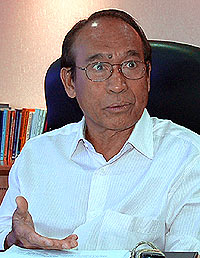 What I would like to do which I have done, is to urge the government to amend the law. And also to urge the government to give serious consideration to our recommendations.
It is clearly provided in the Suhakam Act that one of our functions is to advise the government on legislation.
And they do not refer to us, except one; the amendment to the Penal Code and the Criminal Procedure Code (CPC) and that they went to the (Parliament) select committee.
But that is how it should be done.
Yes. We urge that when it comes to laws that clearly affect the daily life of the people it should go to the select committee. So people have an opportunity to give their views. Not to present the bill at the last minute in Parliament where nobody has the chance to read.
We urge that the ISA be abolished. We did a review on why the ISA should be repealed. The PM indicated in his inaugural speech that ISA will be substantially amended. This was echoed by the home minister and they said that it will be presented in Parliament this time, as well as Section 27 of the Police Act which we have raised for a long time.
We urged them for a repeal, they don't agree, they said amendment. At least this is an improvement. But we have not seen the bill and we said we express the hope that the amendment is as such that it complies with the human rights principles and limits the possibility of abuse.
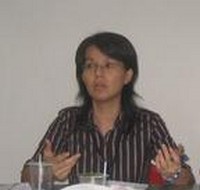 Clearly this act had been abused. The case in Penang where the reporter was
detained
,
Sin Chew
Daily
journalist Tan Hoon Cheng (
right
) in 2008, not for security reasons but for her own protection. Now what is this? And the decision cannot be challenged. What is this? This is not a police state.
Clearly this act had been abused. The case in Penang where the reporter was
detained
,
Sin Chew
Daily
journalist Tan Hoon Cheng (
right
) in 2008, not for security reasons but for her own protection. Now what is this? And the decision cannot be challenged. What is this? This is not a police state.
What is the meaning of human rights? What is the meaning of the government endorsing the 1948 declaration of human rights?
What rating would you give Malaysia on the human rights front?
I think the status of human rights is very good. You can compare with some other countries. The development (of the country) is going on; most people have food to eat, clean water, access to education, good health services, so there should not be any complaints.
It is a question of being allowed to exercise one's rights as protected by the constitution today. That is an issue today.
But we cannot deny that there are instances of human rights being violated.
The violations are in how the police implement the law and the way the court exercises its judicial functions.
And these are very vital issues.
That is why we say look at section 27, look at the Printing, Presses and Publications Act, Look at the ISA. These are issues that directly affect a person's daily life.
But it could be better?
It could be better if they (government) is more accommodating. You can listen to people, but it is your right to accept or reject (their ideas). So why deny their right to speak? The conditions of human rights here is good compared to other countries but it is not excellent.
The government is always using excuses like certain issues are sensitive, or for security reasons.
You have the laws to address that but the problem is in implementing the law. There cannot be selective enforcement of the law. This is the issue.
This is why the people want to be heard and it would be lovely if the government would listen. And if someone tell lies (about you), (then) you can sue the person in court. So there is already enough protection, there is no need to outlaw everything.
So if we address these issues, it will be an excellent country, the government is fair; there are enough opportunities for those who work very hard. We have enough laws to take care of those who act against the law.
Do you think that Suhakam is truly independent?
We are. When I first took over, I did not want my staff to be appointed by the public services department. This is because as we are not part of the government.
The law clearly states that we are independent. The government only allocates the funds and we manage it ourselves. Who is appointed is entirely up to Suhakam. And of course to the disappointment of the legal advisor, the administration agreed with us.
We have full independence. You can see this in some of our statements. Especially our statement with regards to what happened to the government of Perak. I was accused of many things, but I thought that it is the right of the individual to choose the government of their choice.
Suhakam was threatened with a drop in its ranking by the ICC last year. Do you see this as a failure to protect Suhakam's credibility?
No, because we are still ‘A'. But we are still heavily criticised. And I can tell you the depressing part of it, certain civil societies wrote to Geneva and submitted an adverse report against Suhakam but there is no merit in it. We are still rated A, but this rating will be reviewed in November, after the appointment of the new commissioners.


Report this comment
Are you sure you want to delete this comment?
This action cannot be undone.