




Don't get cocky, Najib told
A political analyst dismissed Prime Minister Najib Abdul Razak’s improved ratings in a recent Merdeka Centre poll as a “feel good” effect, and not a real barometer of BN’s election chances.
A political analyst dismissed Prime Minister Najib Abdul Razak’s improved ratings in a recent Merdeka Centre poll as a “feel good” effect, and not a real barometer of BN’s election chances.
 Yesterday, the pollster announced that their recent
survey
showed the PM’s approval rating had risen to 72 percent, from 69 percent in April this year.
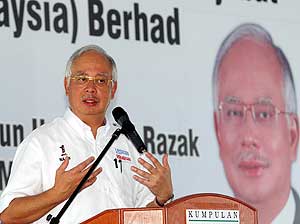
UCSI university lecturer Ong Kian Ming, however, advocated caution in assessing Najib’s ( left ) popularity spike.
"This is a snapshot taken at a particular place and at a particular time. (For example,) it was taken before the Sibu (by-election) results were announced,” he said.
While admitting that this is a confidence-building milestone for the Najib administration, he is sceptical on whether it could be maintained in the long run.
"He may not be able to maintain it because of the tough decisions he needs to make soon,” said Ong.
 Najib is currently facing implementing some hugely unpopular policies: major
subsidy cuts
which would see the cost of essential items skyrocket, the much opposed
GST
, as well as the New Economic Model
unpopular
with Malay activists for seemingly sidelining the New Economic Policy (NEP) and Malay interests.
In a tweet sent late this afternoon, Najib said: "Your support is key as I table the 10th Malaysia Plan in Parliament tomorrow."
"I'm encouraged by the Merdeka Centre report which states that 72% of the public approves of the government's efforts to drive the nation forward," he said in a subsequent tweet.
'Vague on policies '
Kuala Lumpur and Selangor Chinese Assembly Hall (KLSCAH) chief executive officer Tang Ah Chai concurred with Ong.
Tang contended that Najib’s frequent public relations events and his non-stop turun padang (visits on the ground) have left a good impression on the people, translating into the high approval rating.
“However this 'feel good' effect cannot be sustained when we go back to the policies. Issues like GST, subsidy cuts and other old issues cannot be solved immediately.
“Government efforts to listen to the people before making policies are not very significant. There is a gap between the ‘feel good’ factor and real policies,” he said.
Tang said that the public is practical when it comes to policies, and they want to know exactly what they are.
But Najib, he said, has been vague. He cited the PM’s shifting stance on the NEM and Malay NGO Perkasa’s demands, that the government distribute wealth according to ethnic percentage, as an example.
“So (the public is) seriously in doubt over what exactly is the government policy," explained Tang.
Najib’s personal popularity, Tang said, doesn’t translate to a BN edge, and neither does it help component parties MCA and MIC, that are still wracked with long-standing problems with their respective communities.
Opposition unimpressed
Meanwhile, opposition politicians are also mainly unfazed by Najib’s apparent rise in popularity.
 Pakatan coordinator Zaid Ibrahim (
right
) told
Malaysiakini
that the opposition coalition is not affected by Najib’s sudden rise in popularity.
“Whatever the case, we are ready to face our ‘popular’ political enemy. There are no worries,” he said.
The former federal minister also poked fun at the poll, which skirted comparison with public support for Pakatan.
“It is good that the PM is popular. We in Pakatan do not have the cash to pay Merdeka Centre to run a poll to see if we are popular or not,” Zaid quipped.
 PAS central committee member Dzulkefly Ahmad (
left
), in a Twitter posting, was more reserved but also shrugged off the finding.
Dzulkefly reminded Najib of what happened to his 'feel good' predecessor Abdullah Ahmad Badawi, who lost public support despite having very high approval ratings in polls.
His tweet said he “would like to remind him (Najib) that Pak Lah (Badawi) had 90 percent at one point”.


Report this comment
Are you sure you want to delete this comment?
This action cannot be undone.