




Kg Baru earmarked as fully commercial zone
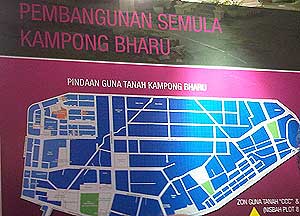
The amended Kuala Lumpur Draft Plan 2020 states that Kampung Baru will be developed as a commercial zone and key landmarks will be retained.
The iconic Malay enclave of Kampung Baru has been earmarked as a fully commercialised area under the amended Kuala Lumpur Draft Plan 2020.
According to the draft plan, which is currently exhibited at the Kuala Lumpur City Hall (DBKL) till Wednesday, the entire 250 acre tract of land in Kampung Baru is one of three City Commercial Centres (CCC).
 Two other CCC's are Kuala Lumpur City Centre (KLCC) region and KL Sentral region in Brickfields.
A CCC, as defined in the draft plan, does not need to contain any residential units and can be a 100 percent commercial district.
This raises questions of whether the many residential homes in Kampung Baru, including traditional Malay houses, would have to make way for commercial buildings.
No evictions
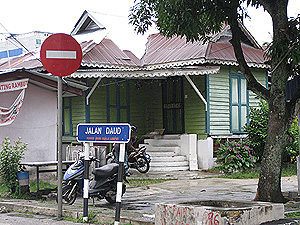 The draft plans states that the future developments will not dilute Kampung Baru as a Malay heritage settlement and stated that it will "strengthen Malay identity from various aspects".
The "various aspects" were not detailed other than the incorporation of Malay architecture.
A DBKL officer who was manning the booth explaining development plans for Kampung Baru, assured that landmarks such as the Masjid Jamek and Kelab Sultan Sulaiman will be kept intact.
"The mosque will even be expanded," he said on condition of anonymity.
Asked about the fate of the estimated 39,000 Kampung Baru residents, the officer assured that they would not be evicted.
 When asked how this could be achieved, he said that developments will be implemented in stages but did not elaborate further.
Requirements for open space
Meanwhile, the proposed site of the 100-storey Warisan Merdeka tower and Pudu jail area have been earmarked as mixed development zones.
In both areas, at least 30 percent of the development projects must be for residential units.
The draft plan will be submitted to the Federal Territories Ministry for approval by year-end and will be published on Feb 1 next year.
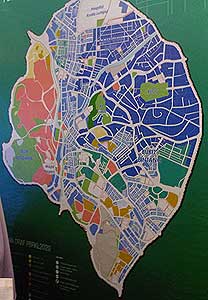
It also details land usage and development density plan for every area in Kuala Lumpur. It also specifies 10 percent open space requirements for new developments.


Report this comment
Are you sure you want to delete this comment?
This action cannot be undone.