




Illicit outflow likely higher than Najib's figure
The real amount of unrecorded capital outflows from the country is likely to be higher than the figure cited yesterday by the prime minister.
The real amount of unrecorded capital outflows from the country is likely to be higher than the figure cited yesterday by Prime Minister Najib Abdul Razak.
However, Ratings Agency of Malaysia chief economist Yeah Kim Leng said, the figure is unlikely to be as high as RM899 billion that the Global Financial Integrity (GFI) report cited as illegal capital outflows from 2000 to 2008.
"It is somewhere in between, but we can't say exactly if it's closer to one side or the other yet because it involves a lot of data," Yeah said when contacted.
Yesterday, the premier said the amounts unaccounted for was RM135.3 billion as estimated in the errors and omissions (E&O) of the balance of payments.
 The balance of payments shows capital inflows and outflows, while errors and omissions refer to statistical errors and estimated unrecorded amounts of capital flow.
According to Yeah ( left ), E&O only accounts for banking data, and much of capital flow information is lost as remittances and repatriation are also done through other means.
This includes those carrying cash overseas themselves and parking the cash in safe havens such as Switzerland, and increasingly Singapore, which practises a 'don't ask, don't tell' policy with foreign funds.
Money changers are small fry
Another means not recorded in the E&O is the transfer of funds through money changers, who the government claims now face stricter controls.
But, according to Yeah, transactions through money changers are only made by small businesses, and likely to account for only about 10 to 15 percent of the E&O.
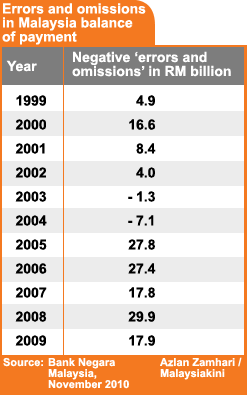 Of the E&O, he said about half is due to trade under-invoicing or over-invoicing which is less of a worry and is a common occurrence in international business.
Nevertheless, he said, the E&O figure in Malaysia has been on the rise since 2005, with yearly figures fluctuating between RM17 billion and RM30 billion, compared with 1999-2004 when the amounts averaged around RM5 billion a year.
"Part of this, however, can be explained through the growth in trade volume, as well as capital outflow, as local companies expanded abroad.
"The government has also become increasingly liberal in allowing funds to move abroad," Yeah added.
GFI figure a good indication
The huge discrepancy between the GFI numbers and Bank Negara's official figures, the economist said, is due to the use of different models.
GFI uses a combination of the Trade Mis-invoicing Model (looking at under and over-invoicing) and the World Bank Residual Model, which look at capital inflows and accounted use of funds.
For the latter model, excess in inflows over the recorded use point to a loss of accounted capital, indicative of illicit financial outflow.
 While the GFI report has been
ridiculed
by Deputy International Trade and Investments Minister Mukhriz Mahathir (
right
) as "bizzare", Yeah said it was helpful in highlighting loopholes in the current system.
"The model has its shortcomings, which the report points out, but it is useful to indicate the potential size of outflow that is not captured, with our main concern being illegal capital flight.
"Bank Negara has not yet come up with its findings, but I believe that whatever the outcome, it will mean (the central bank) needs to tighten controls on capital flow and this may go beyond its jurisdiction," he said.


Report this comment
Are you sure you want to delete this comment?
This action cannot be undone.