




Sodomy II trial turns into test case
A prosecution application in the sodomy trial against Anwar Ibrahim will turn this into a test case in applying specific provisions of the Evidence Act, in relation to the gathering of DNA evidence.
A prosecution application in the sodomy trial against Anwar Ibrahim will turn this into a test case in applying specific provisions of the Evidence Act, in relation to the gathering of DNA evidence.
The application , conceded as "unprecedented" by both parties in the Kuala Lumpur High Court this morning, is for the court to compel the accused to provide a DNA sample.
The prosecution cited Section 73 of the Evidence Act, which deals with comparisons of signature, writing and fingerprints, and Section 165 which pertains to the judge's power to obtain proof of relevant facts during the course of the trial.
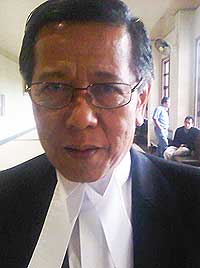 Solicitor-General II Mohd Yusof Zainal Abiden
(right)
argued that obtaining a DNA sample from Anwar is crucial and relevant, as this could establish whether or not there is a link with DNA retrieved from sperm found in complainant Mohd Saiful Bukhari Azlan's peri-anal region.
Solicitor-General II Mohd Yusof Zainal Abiden
(right)
argued that obtaining a DNA sample from Anwar is crucial and relevant, as this could establish whether or not there is a link with DNA retrieved from sperm found in complainant Mohd Saiful Bukhari Azlan's peri-anal region.
"There has been no application like this before but it does not mean it cannot be done...or else Section 165 will be mere words. We have the evidence but due to technical reasons it was not admitted (as evidence)," he said.
The defence, meanwhile, indicated that its objection is to the prosecution’s presumption that the DNA results are conclusive. It is due to deliver its submission tomorrow.
In his application, which was part of his final submission, Yusof cited Sarkar’s commentary on evidence which states that obtaining fingerprint marks from the accused does not jeopardise the pursuit for truth.
He argues that, as DNA evidence has been considered to be as valuable for the purpose of identification as fingerprints, Section 73 may be applied.
He further submitted that applying Section 165 would not be tantamount to forcing Anwar to testify against himself as he will only be “passively” showing “identifying marks” and not giving oral testimony.
"From this reading, the court cannot make (Anwar) surrender (his DNA) but can direct someone else to take (the DNA)," he argued.
'Arrest was lawful'
The submissions follow Justice Mohd Abidin Mohd Diah's ruling, in a trial-within-a-trial, that contact DNA from items taken from the lock-up cell where Anwar was held is inadmissable as it was obtained through illegal means.
This ruling was questioned by Yusof in his submission, in applying for a review of the decision.
Citing case law, he said the judge can review his decision if fresh evidence has been produced or if the judge believes that he has erred in the application of the law.
 In this case, the fresh evidence is the original warrant of arrest, which was missing during the trial-within-a-trial, that has Anwar’s signature of acknowledgement. The veracity of the signature was never disputed by the defence.
The warrant, Yusof argued, proves that the arrest was lawful, while case law provides that items taken while the accused was under detention are admissible as evidence.
The court heard that evidence obtained during detention is only inadmissible when it is in the form of a confession, or when it is taken after the confession through a search of the body of the accused or owned premises.
“The toothbrush, towel and mineral water bottle does not fall under any of the three categories,” he said.
He also cited cases which showed that it is legal to take ‘non-intimate’ samples from an accused who is under detention, if the sample has not yet been obtained from the person during the course of investigation.
“We didn't take anything from (Anwar). None. Here it is contact DNA…The results of the DNA test must be admitted. It is the right and lawful thing to do," he said.
‘Contempt’ application dismissed
During the proceedings, the judge turned down a defence application to cite several media outlets for contempt, rather than issue a verbal warning against disrupting the trial.
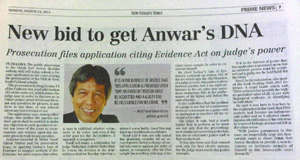 The prosecution’s submission affidavit had been leaked to web portal
Malaysia Today
, which published it in full for a few hours on Sunday, and to the
New Straits Times
which today published an article referring to the affidavit.
The prosecution’s submission affidavit had been leaked to web portal
Malaysia Today
, which published it in full for a few hours on Sunday, and to the
New Straits Times
which today published an article referring to the affidavit.
Karpal said the leak, which he blamed on Yusof was “scandalous and contemptuous”, also complaining about a demonstration by a group urging Anwar to surrender his DNA as well as media reports on the event.
While he assumed responsibility for the leak as head of the prosecution team, Yusof refuted Karpal’s claim that he answers to politicians.
“I fight my battles in court, and not outside,” he said”
Judge Mohd Zabidin turned down the contempt application after hearing the parties in chambers for about 10 minutes.


Report this comment
Are you sure you want to delete this comment?
This action cannot be undone.