




Polls Budget: Pakatan, BN compete to show they care
ANALYSIS Unveiled three days before Budget 2012 is tabled in Parliament, Pakatan Rakyat’s first-ever shadow budget appears to be a populist measure, aimed at showing the electorate that it is the coalition that cares more.
ANALYSIS Unveiled three days before Budget 2012 is tabled in Parliament, Pakatan Rakyat’s first-ever shadow budget appears to be a populist measure, aimed at showing the electorate that it is the coalition that cares more.
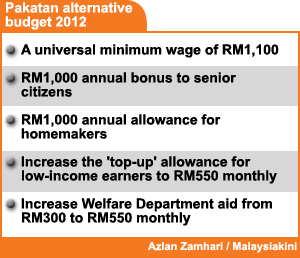
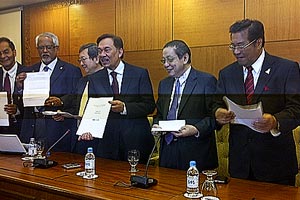 The shadow budget, revealed yesterday, places focus on the lower income group, providing a slew of means-tested
bonuses
for those earning less than RM1,500 a month.
The shadow budget, revealed yesterday, places focus on the lower income group, providing a slew of means-tested
bonuses
for those earning less than RM1,500 a month.
With inflation on the rise, and wages only inching up by the year, it is difficult to argue that the approach is not one that attempts to address Malaysia’s emerging economic conundrum that is the income divide.
But as polls loom near, it is also clear that it is a budget that could endear them to crucial voting blocs - senior citizens, working families and civil servants.
 Pakatan’s move to appeal to the masses is not a new approach for BN, which ironically has been repeatedly slammed for being not daring to take necessary, but unpopular measures in its previous budgets.
The government has alluded to similar populist measures in the lead up to Budget Day on Friday, with analysts speculating that it will use the extra cash gained from higher energy prices for this purpose.
Among the measures already in place are discount stores and restaurants, while new measures are expected to include things like food stamps and vouchers for public transport and utilities for households earning less than RM3,000 per month.
Like Pakatan, which budgeted RM5.9 billion to scale up civil service wages in line with a RM1,500 a month minimum wage, BN too is expected to pay out a bonus and cost of living allowance to the 1.3 million civil servants.
But where is the money coming from?
For Pakatan, it is quite simply a case of slashing the Prime Minister’s Department’s budget, auctioning approved permits (APs), higher petrol income tax from higher energy prices and more efficient corruption-cutting measures.
AP auctions are said to bring in RM1.2 billion while savings from the PM’s Department cuts of RM10 billion will cover bonuses for the senior citizens, homemakers and working mothers, and partly pay for the civil service pay rise.
 The petrol income tax revenue (an estimated extra RM7 billion) will pay for the remainder of the initiatives, which include a RM2 billion facilitation fund for smaller firms to implement the RM1,100 per month minimum wage.
It also reinstates the luxury tax on imported goods, removed by the government last year, which would bring in some RM200 million.
Interestingly, Pakatan also expects to gain some RM1 billion from more efficient Customs control and RM670 million from more efficient collection of excise duty. How it intends to hit this optimistic target remains a question mark and a point of contention.
On the surface, however, cutting the PM’s Department allocation signals that Pakatan would not stand for arbitrary spending by the chief of government, more recently on high consultancy fees - a signal likely to appeal to the electorate.
How is Pakatan different from BN?
Sources of funding appear to be the same, with Pakatan banking for much of its expenses on money from oil and BN expected to do the same on the back of higher energy prices.
However, Pakatan intends to set up a heritage fund for renewable energy research with the dividend payments from Petronas, the percentage for which will be jointly decided with the national oil company.
 BN’s populist bonuses and vouchers also reach out to more people, with the threshold expected to be set at a higher RM3,000 compared with Pakatan’s RM1,500.
But this would mean a heavier strain on the purse, as the government tries to rein in its deficit from the 5.6 percent at the end of 2010.
Both appear unprepared to take away race-based affirmative action, although Pakatan takes a middle ground approach on this sensitive issue by stating that such measures will be up for mandatory review on a biennial basis.
By this, it reassures Malay voters that they will not be left high and dry, while telling non-Malay voters it does not intend to perpetuate BN’s pro-bumiputera policies which are increasingly seen to be unfair.
So what about subsidies?
The government’s move to gradually cut consumer subsidies for the sake of curbing deficit has received flak from Pakatan from the onset, and as expected, it retains the subsidies at the current level of RM22 billion.
This move again reaches out to the masses, who are increasingly struggling to make ends meet on the back of subsidy cuts.
 Pakatan intends to pay for this through cutting corporate subsidies, for example, to independent power producers, although the timeline and rate of rollback is not stipulated.
This raises questions on whether such rollbacks will be enough to foot the large RM22 billion bill.
Another area of savings, according to Pakatan, are open tenders and efficient value management systems, but estimates of possible savings remain untested.
It claims that such savings are evident through its experience in governing Penang and Selangor.
But with the subsidy bill being about 20 times the size of the Selangor budget, it remains to be seen if such outcomes can directly translate at the federal level.
This, and its bold claim of garnering over RM1 billion through efficient collection of taxes, also opens the coalition to scrutiny and puts to question the feasibility and sustainability of its budget.
Related stories :
Malaysia was colonised, admits DPM Muhyiddin
Panel: Shadow budget direct aid is safe from abuse
Najib: Freedom for 125 'restricted residents'
Gov't foots RM1.2bil bill for Indah Water's losses


Report this comment
Are you sure you want to delete this comment?
This action cannot be undone.