




Negri royal okay with discussing decrees
Royal decrees can be discussed by academia and the media, so long as it does not pose real harm, says a member of the Negri Sembilan royal family.
Royal decrees can be discussed by academia and the media, so long as it does not pose real harm, says a member of the Negri Sembilan royal family.
In an email interview with Malaysiakini , Negri Sembilan prince Tunku Zain al 'Abidin Muhriz said this was in line with freedom of speech and assembly.
 "As a supporter of freedom of speech and assembly, I have always maintained that Malaysians should have the freedom to discuss anything not genuinely seditious, libellous or inciting violence.
"I also support the right of individuals to express their opinions (through) academicians and media portals," said the prince, who is founding president of think tank Institute of Democracy and Economic Affairs (Ideas).
Tunku Zain al 'Abidin, who is also a columnist with the Star , said this when asked about the criticism leveled against constitutional law professor Abdul Aziz Bari, following the latter's comments on the Selangor Sultan's decree .
Aziz, who is also a senior fellow of Ideas, was accused of challenging the royal institution when he raised certain issues pertaining to the sultan's decree on the search of the Damansara Utama Methodist Church by the Selangor Islamic Affairs Department.
News portal Malaysiakini also received brickbats for publishing Aziz's comments on the matter.
In his defence, Aziz said the Sedition Act 1948 allows criticism of rulers, so long as they do not advocate the abolition of the monarchy.
Selangor's Sultan Sharafuddin Shah in the decree issued on Monday said there was indication of attempts to proselytise at the Aug 3 event, but legal action would not be taken due to lack of evidence.
Royals' interest in policy expected
Separately, Tunku Zain al Abidin said that it was expected of all institutions, including the royalty, to "take a keen interest in government policies".
 He said this in response to a question referring to his
special address
at a conference yesterday, where he said the Malay rulers of yore championed liberal economic policies.
He said this in response to a question referring to his
special address
at a conference yesterday, where he said the Malay rulers of yore championed liberal economic policies.
Asked if he saw the royal institution playing a greater role in pushing for such policies today, he said: "Yes, but obviously the contemporary context is different to the eras I referred to in my speech.
"In the past, rulers had the bendahara to advise them on economic policy, but today's institutional and constitutional landscape means that the bulk of economic policy is determined by the federal (and to a much lesser extent, state) governments of the day.
"Malaysians would expect all institutions to take a keen interest in government policy and react accordingly," said the London School of Economics graduate.
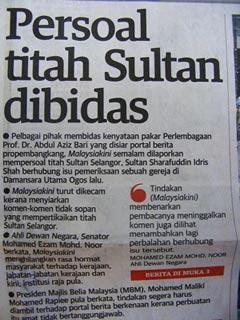
However, Aziz and Malaysiakini made the front page of Umno-owned Utusan Malaysia for the second consecutive day today, with a report quoting MPs calling for action to be taken against the two.
“Freedom of speech is allowed among academics but he (Abdul Aziz) made his criticism at the wrong time and place, he is not a constitutional expert, just an expert at twisting facts,” Kinabatangan MP Bung Mokhtar Radin was quoted as saying.
“Action should also be taken against news portal Malaysiakini for insulting the sultan as the head of religion,” the report added.
Related stories
Ezam wants Aziz Bari, M'kini probed over sedition
Utusan, didn't Umno question the royalty in 1993?
Sultan in position to defuse religious tension


Are you sure you want to delete this comment?
This action cannot be undone.