




M'sia improves to 54th place in graft perception index
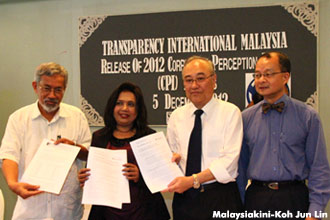
Malaysia’s position has improved in this year’s Corruption Perception Index (CPI), but major political scandals have held back the nation’s score, said Transparency International-Malaysia (TI-M) president Paul Low.
Malaysia’s position has improved in this year’s Corruption Perception Index (CPI), but major political scandals have held back the nation’s score, said Transparency International-Malaysia (TI-M) president Paul Low.
Based on a new methodology meant to improve the accuracy of year-to-year comparisons, Malaysia scored 49 out of 100 points and took 54th place out of 176 countries surveyed.
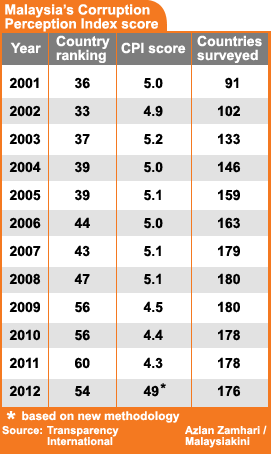 This is compared to Malaysia’s 60th position last year, which remained the same even when calculated with the latest methods.
“Although it has improved, our score is very mediocre... some of these things (high-profile corruption scandals) are holding our scores from going up.
“As far as I am concerned, 49 (points) is not good, but for all the effort, there is some improvement.
“In spite of all the scandals, we are better than where we were a few years ago. For example, we are able to discuss corruption issues much more openly. The atmosphere is different,” said Low.
He was speaking to reporters after announcing the annual CPI results and was asked to comment on the improved score, despite scandals such as National Feedlot Corporation and Sabah Umno’s ‘political donation’.
In a press statement released during the event, Low commented that, despite many initiatives under the Government Transformation Programme and the National Key Results Area initiatives, “the respondents have not experienced a significant decrease in corruption”.
 He pointed out that in TI’s Bribe Payer’s Survey published in August, 101 companies in Malaysia were asked if they had lost business over the past year because a competitor had paid a bribe.
“Fifty percent answered ‘Yes’, the highest score among the 30 countries surveyed.
“This is an extraordinarily high response and may indicate that corruption in the public sector is systemic and in some areas institutionalised,” he said.
The CPI is published annually by TI and is an aggregate score based on at least three independent surveys of businesspersons and country analysts. Eight surveys were used to evaluate Malaysia’s score.
Malaysia shares the 54th position with the Czech Republic, Latvia, and Turkey. Bahrain is placed 53rd while Cuba, Jordan and Namibia are 58th.
Sharing the top position are Denmark, Finland and New Zealand with a score of 90, followed by Sweden in fourth position and Singapore in fifth.
Reforms urged to reduce money politics
To improve Malaysia's score, Low called for political reforms to reduce money politics and eliminate opportunities for “state capture”, which is where businesses influence government decisions through graft.
One suggestion, he said, is to “formalise” the asset declaration of government officials by making it an offence to make false declarations.
In addition, he mooted that there should be a specific agency led by reputable persons, such as retired judges, with whom whistleblowers can share information with confidence.
He also called for whistleblower protection laws to be improved, the Official Secrets Act to be overhauled, and a Freedom of Information Act to be introduced.
In addition, Low suggested that MACC should tackle systemic corruption by focusing on specific sectors and involving its stakeholders.
“For example, a coalition involving the Construction Industry Development Board, contractors, professional bodies and other regulators in the construction industry could be established to drive the initiative to reduce corruption,” he said.


Are you sure you want to delete this comment?
This action cannot be undone.