




'Explain plunge in maths, science scores or quit'
Education Minister Muhyiddin Yassin has been urged to explain Malaysia’s drop in science and mathematics scores, failing which he should resign.
Education Minister Muhyiddin Yassin has been urged to explain Malaysia’s drop in science and mathematics scores, failing which he should resign.
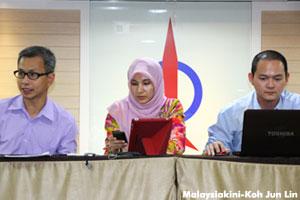 DAP publicity chief Tony Pua said that Malaysia’s drop in the scores of both subjects since 1999 is the highest among 42 countries surveyed in the Trends in International Mathematics and Science Study (TIMMS) 2011.
PKR vice-president Nurul Izzah Anwar said Muhyiddin should resign if he could not explain this or outline convincing steps to redress the issue.
Pua and Nurul Izzah, along with DAP election strategist Ong Kian Ming, were speaking at a press conference in Kuala Lumpur today as members of the Pakatan Rakyat Education Taskforce.
In a separate statement today, DAP secretary-general Lim Guan Eng urged Muhyiddin to retract his statement that Malaysia’s education system is better than that of the United Kingdom, United Staters of America and Germany.
Are we better than the UK, USA?
“Our Minister of Education and Deputy Prime Minister Muhyiddin Yassin said in March 2012 that our education system is better than that of the US, UK and Germany, using selective results from the World Economic Forum (WEF) Global Competitiveness Report statistics.
“Muhyiddin’s claims have now been totally repudiated by the recently released TIMSS 2011 findings,” he said.
Lim, whom is also Penang chief minister, urged also Muhyiddin to explain the matter and formulate a “crisis plan” to address it.
 Pua said that Malaysia’s maths score dropped from 519 points on a 1,000-point scale in 1999 to 440 points last year. The 79-point drop was the highest among all countries surveyed, followed by Thailand’s 40 points.
Malaysia is currently ranked 26th out of 42 countries for maths scores, down from 16th in 1999.
For science, Pua said Malaysia also suffered the largest drop of 66 points (from 492 points to 426 points) of all countries over the same period, followed by Macedonia’s 51 points.
This ranks Malaysia’s science score at 32nd out of 42 countries, compared with the ranking of 22nd in 1999.
The average score is 500 points and the top three maths scorers are South Korea, Singapore and Taiwan, which scored 613, 611, and 609 respectively.
The three countries are also the top science scorers, with Singapore leading the pack with 590 points, followed by Taiwan with 564 points and South Korea 560 points.
The USA and UK ranked 9th and 10th respectively in science scores, 10th and 9th respectively for maths scores, while Germany did not take part in the survey.
Malaysia worsened in 14 categories
Pua also noted that Malaysia’s scores had worsened in all 14 categories tested in the survey – a dubious distinction it shares only with Jordan.
Some of these areas include application and reasoning skills, algebra, geometry, biology and physics.
“Although we know that our education standards are dropping - everyone talks about it - but having to see the results for itself is scary,” he said.
As an example, Pua said, only 43 percent of Malaysian students could answer the question ‘What does xy + 1 mean?’ correctly (Answer: ‘Multiply x by y, then add one’), while only 67 percent of them knew that CO2 is the formula for carbon dioxide.
 Meanwhile, Nurul Izzah pointed out that Malaysia ranked 37th in gender gap in maths performance and 24th for science, with female students outperforming their male counterparts.
“And mind you, in 2009 this (worsening scores) was brought up in Parliament. I remember repeated attempts to get the minister and deputy minister to answer why have we dropped so severely in the TIMSS 2007 ranking.
“But hardly any serious consideration was given, no serious reply and now, three years on from 2009 to 2012, the problem has worsened,” Nurul Izzah she added.
Ong said the Pakatan Rakyat Education Taskforce would incorporate the issues raised today in its response to the National Education Blueprint, which is still open for public feedback.
“We hope to get feedback from various stakeholders on this response and we will come up with a comprehensive document by the end of the year,” Ong said.
The latest TIMSS survey was conducted in collaboration with the Education Ministry last year and its results were published yesterday.
It involved 5,733 Form 2 students who were given the option of being tested either in English or in Bahasa Malaysia.


Are you sure you want to delete this comment?
This action cannot be undone.