




In battle for Labis, MCA legacy on Chua Jr's shoulders
ANALYSIS JOHOR While all eyes are on DAP's heavyweights who have descended on the MCA bastions in southern Johor, one parliamentary constituency in the north - which represents over two decades of MCA's legacy - appears to have been overlooked.
The Labis parliamentary seat was held by two MCA presidents for 22 years, namely Dr Ling Liong Sik and Dr Chua Soi Lek, in succession since 1986 before the baton was passed on to the latter's son - Tee Yong.
ANALYSIS JOHOR While all eyes are on DAP's heavyweights who have descended on the MCA bastions in southern Johor, one parliamentary constituency in the north - which represents over two decades of MCA's legacy - appears to have been overlooked.
 The
Labis
parliamentary seat was held by two MCA presidents for 22 years, namely Dr Ling Liong Sik and Dr Chua Soi Lek, in succession since 1986 before the baton was passed on to the latter's son - Tee Yong.
However, Labis had fallen off the radar as it was the odd one out where DAP only announced its challenger there on April 19 - the eve of nomination day - in the form of former senator S Ramakrishnan.
According to party sources, the DAP central leadership had wanted to place its own choice there but gave in after the state leadership convinced them that Ramakrishnan would be most suited to capture the MCA stronghold.
Chua has taken to labelling Ramakrishnan as Selangor’s "reject" who has fled to Johor, but the reality on the ground suggests otherwise.
Ramakrishnan who had helped PAS campaign during the Tenang by-election in 2011 - a state constituency in Labis - had maintained his presence there even though Pakatan Rakyat lost the contest. The other state constituency is Bekok whose incumbent is from MCA.
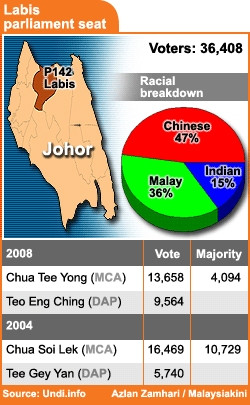
Even though Labis is a Chinese-majority seat, the town has an Indian population of 15 percent, the highest of all parliamentary constituencies in Johor. The Chinese population is 46 percent and Malays make up 36 percent.
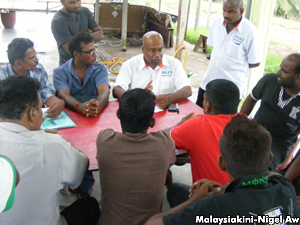 The Tamil-speaking Ramakrishnan was able to quickly build his network among the estate workers, as observed during his visit to Voules Estate last Sunday. The locals welcomed him at their community hall which had been built by BN as a promise during the Tenang by-election.
"During the by-election, the people here would not even let me in. Now look, opposition flags are flying in the estate. This is unprecedented " Ramakrishnan told Malaysiakini as he pointed to the fluttering DAP and PAS flags.
Ramakrishnan urged the crowd of about 40, most of them youths, to convince their elders to vote for change as they shouted "Matruom!" (Change).
Pakatan's strategy appears to hinge on Ramakrishnan's appeal in the Indian Malaysian community, coupled with an already dissenting Chinese community, to boost the anti-government vote and wrest the seat.
Eroding support?
Unlike other constituencies where the anti-government sentiment among the Chinese is at record levels, MCA's long history in Labis means that the community here, especially the elderly who are staunch MCA supporters, are less likely to be swayed.
 This was seen as Chua hit the streets during his walkabout in Bekok yesterday, backed by almost 50 older men and women from the Chinese community who were in BN t-shirts.
Despite being smug about his political opponent, Chua was able to switch to people-friendly mode when he met with the locals, and his team diligently took down their complaints.
The locals describe Chua's service here as "very good" but many who insist on supporting the opposition say the prospect of changing the federal government is difficult to ignore.
Sources within Chua's campaign team acknowledged that the winds of change are strong and MCA must maintain its Chinese support above 30 percent or the chance of retaining Labis would be bleak.
In the 2008 general election, the BN got slightly more than 40 percent of votes in the polling district of Bandar Labis Tengah which has the largest Chinese population. This fell to about 30 percent during the Tenang by-election, bucking the trend by other communities.
With the anti-establishment trends expected to be even stronger now, this may not bode well for MCA in trying to maintain the Chinese support above 30 percent.
However, Chua pointed out that the party had never won in the heart of Labis town and MCA's stronghold is in Chaah, a satellite town some 15km southward.
In one of the Chinese-majority polling district there, Bandar Chaah Tengah, MCA was able to garner almost 60 percent of votes in 2008.
MCA's hope then, is to hold the fort against DAP's attempts to further erode its Chinese support over the next 12 days of campaigning. The sentiments in Chaah will be an indicator of Chua's political future there.
 Mindful of this, DAP roped in Teoh Lee Lan
(left)
during a ceramah on Sunday, who gave an emotional account of her ordeal after her brother Beng Hock - a DAP political aide - mysteriously fell to his death from the Malaysian Anti-Corruption Commission building in Selangor. The crowd of 300 mainly consisted of senior citizens.
Sources within DAP's campaign believe they have 70 percent support from the Chinese community and the party is aiming to push it higher, although 80 percent is unlikely as the elders of the community are unlikely to abandon MCA.
The sources also acknowledged that wooing the Malay vote has been difficult as about 60 percent are from the one of three Felda schemes there - Felda Tenang, Felda Chemplak and Felda Chemplak Barat - which are BN fortresses and difficult even to enter.
For this, DAP is being assisted by PAS which hopes to push Pakatan's Malay support, particularly in Felda to the high 20 percents from the approximately 15 percent it received during the Tenang by-election.
PAS lost the state seat in 2008 by 2,492 votes and suffered its biggest lost by 3,707 votes in the 2011 by-election, But it believes it can recover lost ground as the might of a well-oiled BN national machinery descending on a small area will not happen during a general election.
 "The Tenang by-election is not representative as there was a massive flood that day, the army trucks helped ferry Felda voters but the town voters did not come out, that was why we lost by a larger majority but we believe we can do better this time," said Tenang PAS election director Mohamed Nasir Ahamed.
According to the Tenang by-election results, the turnout in the polling district of Felda Chemplak Barat was a whopping 81 percent but it was only 55 percent in urban centres such as Bandar Labis Tengah.
The Tenang factor
Even though PAS lost the Tenang by-election, it has been an important catalyst that will influence the results of the parliamentary seat of Labis in the 13th general election. Ramakrishnan's candidacy is an example of being a product of that by-election.
DAP campaigners also acknowledged that the by-election had helped foster strong cohesion among the local DAP and PAS machinery.
Malaysiakini understands that PAS has planned a total of 30 ceramahs and DAP has planned at least 15 throughout the campaign period, the schedule of which had been exchanged between the two parties to allow PAS' Tenang state seat candidate Md Zin Johar and DAP's Ramakrishnan and Bekok state seat candidate Lim Eng Guan to jointly appear at one another's events.
The BN's candidates for the Tenang and Bekok state seats are Mohd Azahar Ibrahim of Umno and Tan Chong of MCA.
This coordination is also being seen for simple tasks such as putting up flags - driving along the road in Labis, one would notice that many of DAP and PAS flags share the same bamboo pole.
Even in a worst case scenario where Pakatan is only able to capture 15 percent of the Malay vote - which is unlikely and will possibly be more - it can still scrape through with a razor- thin victory in Labis with 75 percent of the Chinese and 60 percent of the Indian vote.
Furthermore, the fact that Labis is the smallest parliamentary constituency in Johor with a voter population of about 38,000, coupled with a longer campaign period in this general election, may be detrimental to BN.
The resource-strapped and mainstream media-deprived opposition tends to benefit from a longer campaign period, especially in a small constituency as it can cover more ground.
The decisive factor, though, will be along urban-rural lines as outstation voters are expected to return home in record numbers from Singapore and Kuala Lumpur for this "mother of all general elections".
 Labis which Chua won by 4,094 votes in 2008 only saw a 72 percent turnout, suggesting that many did not return to vote.
"The most critical moment of campaign will be the last five days when everyone comes back to vote," Chua told Malaysiakini, adding that he estimates that they comprise 30 percent of Labis' population.
However, these outstation voters, most of whom are youths and are more information savvy, may prove harder to convince.
All factors considered, Labis is potentially one of the most dangerous seats in northern Johor and Chua will need to fight tooth and nail to keep it in BN's fold and to defend MCA's legacy.
NIGEL AW is a member of the Malaysiakini team.
Related stories
MCA crooner gets Soi Lek's thumbs up
Ex-army chief to take JB with 'Bosnia war plan'
Khaled: You help Normala, I'll help you ...
A Pakatan Johor better for business, says Anwar
Yawn... Umno still playing same old racial record
'Hadi preferable to Muhyiddin as PM'
Free PRU13 app - GE updates at your fingertips


Report this comment
Are you sure you want to delete this comment?
This action cannot be undone.