




Gerrymandering not to be blamed, says ex-EC chief
Political parties should not blame electoral boundaries for their loss but instead develop the right strategy to exploit the existing first-past-the-post system, said former Election Commission chief Abdul Rashid Abdul Rahman.
Political parties should not blame electoral boundaries for their loss but instead develop the right strategy to exploit the existing first-past-the-post system, said former Election Commission chief Abdul Rashid Abdul Rahman.
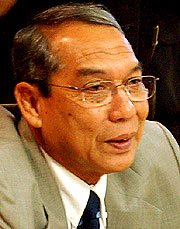 Abdul Rashid (
left
) said it is the BN's ability to crack the formula that has given them a winning streak, and competitors should develop their own strategies to suit the system.
Abdul Rashid (
left
) said it is the BN's ability to crack the formula that has given them a winning streak, and competitors should develop their own strategies to suit the system.
"The BN had formulated the correct formula right from the first election in 1959 as it adjusted itself to the need to suit its election strategy to the geographical and racial pattern of the country's voting population.
"Constitutency boundaries cannot be blamed for failure to attract voters within different set of environments to win the majority of seats to form a government," he said.
In an email interview with Malaysiakini , he said that Pakatan Rakyat, on the other hand, has found their winning formula in Selangor, having won "against all odds" to form a strong state government.
This, and Pakatan victories in Kelantan and Penang, he said, made claims of gerrymandering preposterous.
"I do not see how gerry(mandering) should get into the picture... Where is the gerry(mandering) is Selangor, Penang or Kelantan?" he asked.
Abdul Rashid was asked if the fact that the BN had won 60 percent of seats in Parliament with only 46 percent popular vote in the May general election is evidence of gerrymandering.
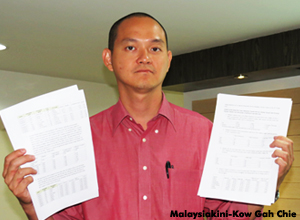 He was also asked to comment on Serdang MP Ong Kian Ming's (
left
) research which reveals that a party or coalition need only to get 20 percent of popular vote to win 112 of the smallest constituencies, thus obtaining a simple majority in the 222-seat Parliament.
He was also asked to comment on Serdang MP Ong Kian Ming's (
left
) research which reveals that a party or coalition need only to get 20 percent of popular vote to win 112 of the smallest constituencies, thus obtaining a simple majority in the 222-seat Parliament.
To this, he said that if this is the case, then Ong should strive to change DAP's platform to win those 112 small and overwhelmingly rural constituencies.
"Delimitation exercises involve the multiplex of important guidelines and principles which had to be compiled or taken into consideration.
"In politics, you can just naughtily twist a small fact to win arguments and the ignorant followers will roar in agreement without looking at realities far and beyond," he argued.
Wan Ahmad 'empty head and big mouth'
On the same note, Abdul Rashid, who was part of the team which conducted the last delimitation exercise in 2002, blasted current EC deputy chief Wan Ahmad Wan Omar for trying to put the blame on his team for the wide disparities in the electoral boundaries.
 Wan Ahmad (
right
), at a forum in June, conceded that the sizes of some constituencies are
very hard to justify
, for example Baling, a rural constituency in Kedah which has more voters than the state capital, Alor Setar.
Wan Ahmad (
right
), at a forum in June, conceded that the sizes of some constituencies are
very hard to justify
, for example Baling, a rural constituency in Kedah which has more voters than the state capital, Alor Setar.
"It is difficult to justify, but we will definitely revise it as this was done in the 2002 redelineation exercise and now we have a different panel," Wan Ahmad had said.
To this, Abdul Rashid shot back: "One should not get involved in a serious forum with an empty head but just a big mouth.
"I take my hat off to Wan Ahmad for his attempt at pulling a lousy plough when confronted with a question I reckon he was not fully equipped to answer."
He added that as the EC secretary then, Wan Ahmad was also part of the 2002 delimitation exercise.
"He may start searching for gerry(mandering) right from today if he had enough knowledge, experience and ability to handle the subject of delimitation.
"Let us wait and see if he could really ‘walk the talk' under the present laws, circumstances and environments," he said.
Abdul Rashid however did not elaborate on the "circumstances and environments" which resulted in gross malapportionment in electoral boundaries.


Are you sure you want to delete this comment?
This action cannot be undone.