




'Jinjang incinerator just one of many options'
Under pressure from growing protests, the government has clarified that the proposed incinerator in Taman Beringin, Jinjang, is one of many "waste to energy" options on the drawing block.
Under pressure from growing protests, the government has clarified that the proposed incinerator in Taman Beringin, Jinjang, is one of many "waste to energy" options on the drawing block.
National Solid Waste Management Department (JPSPN by its Malay acronym) director- general Nadzri Yahaya said Urban Wellbeing, Housing and Local Government Minister Abdul Rahman Dahlan had made a mistake last month in saying that the government is opening an international tender exercise for an "incineration" plant.
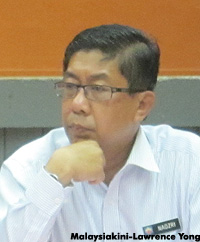 "It's not his fault. Sometimes it's colloquial (use of words). We say 'incinerator' so that everybody understands,” Nadzri (right) told MPs, NGO leaders and residents at the Jinjang community hall in Kuala Lumpur last night.
“But we can confirm here that it is a ‘waste to energy’ plant. I take the responsibility for (giving the minister) the wrong information."
The dialogue had been arranged at short notice by Kepong MP Tan Seng Giaw, with the JPSPN agreeing to meet 20 local representatives to explain the government's stand.
But more than 60 people gathered and despite police attempts to keep about two dozen protesters and the media out, a few got into the hall.
Nadzri explained that the open tender for a ‘waste to energy’ facility covers three options:
- Thermal Treatment Plant in the form of an incinerator plant, a gasification plant or a pyrolysis plant;
- Anaerobic digester for organic waste; and
- Refuse Derived Fuel or Materials Recovery Facility
Questioned further, Nadzri conceded that he could not guarantee that an incinerator will not be built next year in Jinjang.
The questions then came fast and furious for Nadzri to clarify the government's stand, and the DAP MPs for Kepong, Segambut and Serdang had to play referee between irked members of the audience and Nadzri.
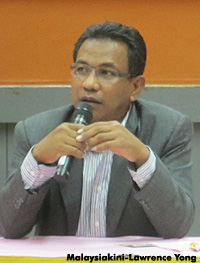 Another speaker, Universiti Technologi Malaysia Mohd Rozainee Taib (right) - who has studied waste management for over a decade - intervened to say that rubbish is piling up in Taman Beringin, which has been used as a solid waste transfer station for some 30 years.
The move to instal a ‘waste to energy’ plant at the site would reduce pollution and operational costs, he said.
The government now spends RM84 on ferrying each tonne of trash to a landfill, he noted, with Taman Beringin alone receiving 2,000-3,000 tonnes daily.
Mohd Rozainee said alternatives to garbage disposal - such as the ‘recycle, reuse, reduce’ approach - have not taken off in Malaysia.
Tokyo and Singapore are just two cities which have used incineration plants to good effect, he said.
A resident pointed out, however, that both examples are not illustrative of “democratic or progressive societies”.
‘More confusion now’
After the session, the protesters said their confusion has only increased.
"We know they are going to build the incinerator, but now the department says it's not confirmed whether it will be an incinerator or other (form of) technology,” said Martin Shek, the chairperson of Kepong-Jinjang Anti-Incinerator Committee.
"Now, two different people have different versions ... if there is a second dialogue, it is best that the minister comes ... we have many questions to ask him."
Last month, the group organised a campaign to raise awareness, in the process collecting more than 6,000 signatures to back a petition against the project.
The group plans to hold a protest on Nov 23 and march to Parliament to present an eight-point demand.
 Isaiah Jacob (in green t-shirt) of the Kuala Lumpur Rejects Incinerator Action Committee (KTI) queried the logic of Nazdri's claim that the government will not proceed with the incinerator if a detailed environmental impact assessment (DEIA) study does not support it.
"They should have done the study before announcing the decision. That is my stand," Jacob said, adding that KTI too plans to organise a major rally next week.
The DAP’s Serdang MP Ong Kian Ming called on the minister to clarify “that this is not an incinerator”.
"They started off by saying it is an incinerator and this has created a lot of mistrust,” he noted.
In a statement today, he outlined the assurances provided by Nadzri during the dialogue:
- Bids for the different options, by local as well as international players, will be made public so that the members of the public can evaluate for themselves on whether the best option was chosen;
- The bids will be evaluated based on the ‘best available techniques not entailing excessive costs’ and that the technology must be a proven technology that is environmentally friendly and cost effective; and
- A DEIA will be conducted for a period of nine months after the ‘waste to energy’ option is chosen.


Report this comment
Are you sure you want to delete this comment?
This action cannot be undone.