




Malaysia on track in meeting MDGs
Malaysia has made remarkable achievements to attain the United Nations' Millennium Development Goals (MDGs) but will have to give urgent attention to the alarming increase in HIV/Aids cases.
Malaysia has made remarkable achievements to attain the United Nations' Millennium Development Goals (MDGs) but will have to give urgent attention to the alarming increase in HIV/Aids cases.
Of the eight goals under the MDGs, only the sixth - to combat HIV/Aids cases - has yet to be satisfactorily achieved in Malaysia.
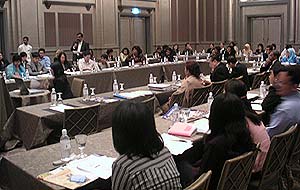
"HIV/Aids cases have not yet been halted and reversed," said Shamsiah Dahaban, the social services director in the Economic Planning Unit (EPU), told some 60 participants at a workshop in Kuala Lumpur today.
She presented data to show that close to 60,000 HIV/Aids cases and about 6,000 deaths were reported last year, a tremendous increase from about 15,000 cases (3,000 deaths) in 1995.
 Shamsiah also said Malaysia will have to continue tackling challenges like hard-core poverty; to define new indicators to identify and target marginalised groups; and further reduce spatial and ethnic inequalities.
The MDGs are part of an agenda for reducing poverty and improving lives. It emerged from the Millennium Summit Declaration held in 2000, in which world leaders participated. All countries have until 2015 to reach the goals.
The eight targets are to eradicate extreme poverty and hunger; achieve universal primary education; promote gender equality and empower women; reduce child mortality; improve maternal health; combat HIV/Aids; ensure environmental sustainability; and develop a global partnership for development.
The one-day workshop was jointly organised by the UN Development Programme (UNDP) and the Human Rights Commission of Malaysia (Suhakam), to obtain civil society feedback on efforts to reach the MDGs.
Fresh ideas
 UNDP resident representative Richard Leete said the Malaysian government will have to generate fresh ideas in resolving HIV/Aids. The majority of the cases involve Malay males who practise needle-sharing.
"Don't view it as a criminal activity and lock up all drugs users. We are trying to get a new national strategy which will look at Aids as not just a health problem, but as a multi-sectoral problem," he told reporters.
He said every ministry will have to be involved in the campaign against Aids. If the issues are neglected, the incidence of HIV/Aids would affect the country's progress.
He said the UNDP is working with the EPU, the Malaysian Aids Council and Department of Islamic Development Malaysia in combating the deadly pandemic.
Leete said the country is moving beyond basic MDG targets and in the right direction in eradicating poverty. However, he also pointed out that five states - Sabah, Sarawak, Kedah, Kelantan and Terengganu - are lagging in this respect.
He also called for basic human rights principles to be upheld in the process of achieving the MDG targets - this means institutionalising efforts to sustain equality and to avoid discrimination on the basis of gender, age, ethnicity, location and income.
Leete added that a report documenting Malaysia's successes and challenges in achieving the MDGs is expected to be finalised and handed over to the government in December.


Are you sure you want to delete this comment?
This action cannot be undone.