




Tsunami disaster: Govt negligent?
The Malaysian government has been taken to task for its inaction in dealing with the deadly tsunami threat last Sunday. Residents, proprietors and tourists on Penang island are questioning why there had been no warning given to those who were in harms way.
The Malaysian government has been taken to task for its inaction in dealing with the deadly tsunami threat last Sunday. Residents, proprietors and tourists on Penang island are questioning why there had been no warning given to those who were in harms way.
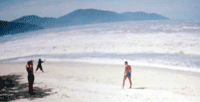 The tsunami which hit Penang beaches at around 1.30 pm on Dec 26 has - according to official reports - thus far claimed 66 lives in Malaysia, a majority of whom were on this west coast island. The worldwide death toll as it stands is close to 124,000.
One irate Malaysian, Azlan Yusof - a dive instructor who was at the Batu Feringgi beach when the disaster occurred - is surprised and shocked at the government's incompetency in handling the situation.
"There was nothing - no news, no warnings - from the authorities (after the disaster first hit the Malaysian island of Langkawi). What happened to the coast guards? What about the Langkawi police? Why didn't they warn others after what happened there?" he demanded to know.
The quake causing the tsunami occurred at 8.58am off the Sumatra coast in Indonesia.
"How do we know the government did not know anything about it? The tsunami hit Langkawi a few minutes earlier. Why wasn't something done to alert us here (in Penang)?. I received a call from my friend in Langkawi immediately after it happened there".
The sentiment was shared by numerous individuals on Penang island, whom malaysiakini interviewed just days after the event, that has till today, shocked the world.
 The tsunami - which has hit Malaysia, Indonesia, Thailand, India, Sri Lanka, Maldives, Burma, Bangladesh, Somalia, Tanzania, Seychelles and Kenya - was caused by an underwater earthquake. Its giant waves had immediately obliterated parts of Indonesia's armed-conflict province Aceh.
The real heroes?
Upon receiving the alert from his friend - a proprietor on Langkawi's Pantai Cenang - Azlan immediately warned tourists and beachgoers in Penang's Batu Feringgi to get off the beach.
"My friend asked me if I could see a long straight white line on the sea's horizon. I said yes, we've noticed it coming from afar for the past half hour. He then told me to immediately get out of there!" he recounted.
The 'white-line' is likened to the white foam that forms when sea water hits the beach shores.
At about 1.28pm Azlan said he rushed on to the beach - with a few other jet-ski operators and 'beach boys' (locals who man jet-ski and other water sport operations) - to get as many people as they could off the beach and to save their boats and equipments.
Two minutes later, he said, the first wave hit the beach front. It did not alarm many people. However, shortly after, a bigger - more threatening - wave approached which unleashed panic on those around.
"The first wave was about 4-5 feet high. A 'simple' wave. People began to walk back on the beach after that. However, we saw a few more waves building and heading towards the shore again. As it drew near, we just took everything else we could and left the area," the part-time tour agent added.
The shore had apparently become dry for a short while before the second wave - about 10 feet high - hit the shore releasing a sound similar to a "loud bang from a car".
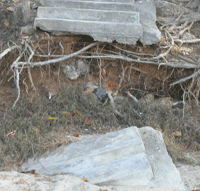 "The impact was great, causing destruction. The currents dragged everything (in its path) back to sea," he added.
He lamented that despite being able to save some lives, many had lost important goods and property.
Four other water-sport operators commented that they too had gotten calls from friends in Langkawi warning them of the danger. They said they got on their jet-skis and boats and shouted out for those on the beach to evacuate.
A few of the remaining tourists whom malaysiakini spoke to said they were thankful to have had warnings from the 'beach boys' who had saved many lives.
The operators were said to have had ridden out on their jet-skis further into sea to inspect the oncoming "strange waves" which was a result of the biggest quake in 40 years, measuring 9.0 on the Richter scale.
Azlan also related how he saw a foreign tourist save the life of a toddler whose parents had not seen the danger coming.
It has been reported that lifeguards from the 'Feringgi Baywatch Tower', situated in front of Shangri-la's Golden Sands Beach Resort, were "pivotal" in ensuring there were no casualties on its beach-front.
However, a jet-ski operator, who only wished to be named as Rosli, claimed the lifeguards were not around at the time close to when the giant waves hit.
Attempts to obtain comments from the lifeguards failed as the tower was pad-locked from the outside.
No one was seen watching the sea from the Baywatch tower - a Civil Defence Department project - which incidentally had a plaque marking its officiation by Prime Miniser Abdullah Ahmad Badawi.
Too little, too late
A half hour later, Azlan said he heard sirens from authorities' vehicles. By that time, the beach had been deserted.
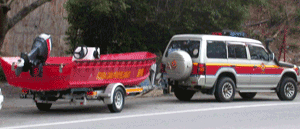 "Two to three hours later the police, fire brigade and others started arriving but it was too late. Helicopters should have been ready earlier," said Azlan, who only recently returned from Holland where he worked for the past four years.
He added that all it took was for the authorities to send its defence or emergency air units to caution people on the beach, while coast guard boats and tankers could have also radioed-in sight of the incoming abnormal waves.
"Only on the second and third day were there people from various government departments on the beaches. Why not earlier? There just to clean up the mess?" he lambasted.
The government has since been said to have placed rescue personnel at the affected areas and personnel to monitor the possibility of a recurrence.
There has been two coast guard boats anchored close to the Feringgi beach stretch while an army helicopter was seen occasionally scouting the area today.
However, walking along the two kilometre beach-line - for two hours - days after the tragic day, malaysiakini only managed to spot six members of the fire-brigade's rescue unit, Unit Penyelamat Bomba, despite fears of other deadly waves hitting from the quake's after-shocks.
The unit said they were stationed there, on 24 hour shifts - to retrieve remaining bodies which may wash onto shore.
The beach was clear of any gruesome sights apart from a few relatively big dead fishes washed ashore, which the Penang City Council have yet to clear.
Malaysiakini sighted a fire-brigade rescue unit camp off the island's coastal road, just outside the Feringgi Beach Hotel situated opposite Tanjung Bungah's Miami Beach, were a majority of the victims were picnicking on the public beach.
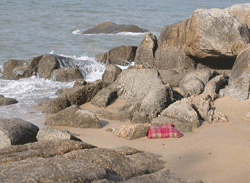
"Most of the victims were not Penang-ites but Malaysian tourists from other states," he said adding that the particular beach area was steep, narrow and rocky.
 A budget-hotel proprietor, Zuhar Mohd Ali, said the news had spread to other proprietors and vendors on Miami Beach who in-turn had attempted to warn those on the public beach area to leave. However not many headed the advice in time.
"Perhaps they didn't listen because the warnings came from lay-persons. If there had been authoritative figures and enforcement units present to advise the holiday-makers then, I'm sure the tragedy would have been avoided," he said.
Lax
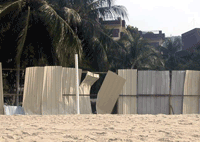 Inspecting the Rasa Sayang Beach hotel front area further down - which had been recently closed for renovations - where the tsunami hit hard displacing and denting zinc fences,
malaysiakini
discovered a few tourists walking along it while some were still sunbathing on its beach.
Inspecting the Rasa Sayang Beach hotel front area further down - which had been recently closed for renovations - where the tsunami hit hard displacing and denting zinc fences,
malaysiakini
discovered a few tourists walking along it while some were still sunbathing on its beach.
There were no warning signs placed, neither were there presence of relevant enforcement and rescue units.
Another jet-ski operator - whose store is adjacent to the hotel - also related how his boats and skis had been flung metres away when the tsunami hit. He pointed out structural damage to the low embankment close-by.
Zuhar, who has been in the family's guesthouse business for the past 30 years but had yet to ever see such huge waves in the area, said he had telephoned the Malaysian Meteorological Department in Penang an hour after the tsunami hit.
"They just said the waves were receding and it'll be clear after three to four hours," he said adding that his guests also spoke to the department for reassurances.
A couple from the United Kingdom, staying at the Lone Pine Hotel, told malaysiakini that even after the tsunami hit the hotel's beach front that there had been no sense of caution by the hotel's management.
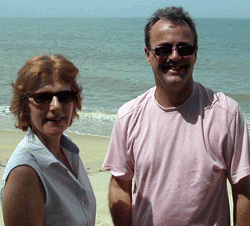 "There were no warnings or security alerts before or after. Later, the hotel manager, along with hotel guests, stood on the beach on the look-out for another wave, which was thought to happen at about 8pm, during high tide," said the Mills.
However the family decided to stay on in Penang as danger had seemed to have passed and it would have also been inconvenient to reschedule travel arrangements.
Some tourists were seen on the beaches, although relatively smaller in numbers for a usually packed year-end 'peak-season', with some even brave enough to swim in the sea.
Para-gliders were back in the sky while jet-ski enthusiasts hit the waters again.
However, small business operators noted that a considerable amount of tourists had cancelled bookings and many had left Penang resulting in their empty stores.
( Photos by Roshan Jason )


Report this comment
Are you sure you want to delete this comment?
This action cannot be undone.