




Remove ringgit peg before 2008 recession: Economist
 Removing the ringgit peg before an anticipated 2008 recession would benefit the country in the long run, Malaysian Institute of Economic Research (Mier) executive director Emeritus Professor Mohamed Ariff told a forum in Kuala Lumpur today.
 Removing the ringgit peg before an anticipated 2008 recession would benefit the country in the long run, Malaysian Institute of Economic Research (Mier) executive director Emeritus Professor Mohamed Ariff told a forum in Kuala Lumpur today.
Despite having declared from the onset that he did not intend to take a position on the controversial ringgit peg issue, Mohamed eventually said that the ringgit should be freed from the current RM3.80 to US$1 fixed exchange rate sooner than later.
"If the ringgit peg is removed now, it will appreciate gradually with no jolt to the economy," Mohamed told the 'Hot Seat Forum' organised by the Liberal Forum Malaysia and Mier with support from the Friedrich Naumann Foundation.
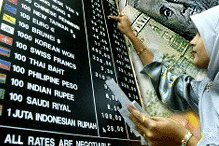 In his analysis, he presented views from the government, economists, entrepreneurs and the general public. He qualified his presentation by saying he was going to address '... what is likely to happen and not what should happen' in the near-term outlook for the Malaysian economy.
The depreciating greenback has brought to life a national debate on whether the ringgit's peg should be removed. The ringgit peg was introduced in 1998 by former premier Dr Mahathir Mohamad at a time when the country's economy was troubled.
The same year saw the country's economic and political situation dictated by a power struggle between Mahathir -who has recently called for the ringgit's de-pegging - and his sacked former deputy premier Anwar Ibrahim.
Some gain, some lose
The forum was also informed of the arguments as to why some agree the peg should remain.
"The arguments are that it's working. Bank Negara says the ringgit is at a 'fair value' and that the policy focus is on the exchange rate's stability. China is also sticking to its own peg," said Mohamed.
The Chinese yuan, he said, is even more undervalued that the Malaysian ringgit. The ringgit is said to be undervalued by some 10 to 12 percent. China is the largest economic power in the East Asian region.
 The Malaysian government has said that as long as the ringgit is still competitive vis-a-vis regional currencies and if the ringgit does not go beyond the 20 percent undervalued range, the peg will remain.
Asked who gains from the currency's status quo, Mohamed acknowledged that sectors such as plantation, oil and gas - namely local oil exporter Petronas - and tourism benefited from the peg.
"There will certainly be losers and gainers. The obvious losers, who are effected the most, are the consumers," he added.
Among the reasons supporting the call to remove the peg were that the peg has outlived its usefulness and that it would be wiser to undo it now while it still has some beneficial effects.
Why now?
"The situation is still strong now but the window of opportunity to benefit from the de-pegging would last for only the next year or so," Mohamed told reporters later, reiterating that it would be better to de-peg from the ringgit's current position of strength.
While some participants showed support for calls to de-peg, there were those who said it would be taking too much of a risk to do so now or in the near future as the volatility of currency exchange rates would make any recession difficult to weather.
Mohamed warned against taking too long to de-peg as the local economy may not be able to recover from the 'shock' of de-pegging if the difference in value to the dollar is too wide such as RM 2.50 to the dollar.
 He explained that if it was de-pegged now, the ringgit would stand between RM3.35 to RM3.42 against US$1.
"It may then gradually lower to RM2.50, the rate it was before the financial crisis seven years ago".
Mohamed debunked theories to re-peg the ringgit to another value saying it was a risk to do so since such re-pegging may not be done accurately and tinkering with currency pegs would diminish the country's credibility.
"If the peg is removed now, the ringgit will appreciate by more than 10 percent. Exports will be temporarily affected but will recover. Trade surplus will narrow, imports will cost less and there won't be an inflation worry," he stressed.
About 150 participants, including diplomats, parliamentarians, politicians, corporate figures, social activists and journalists, were present at the one-day forum.


Report this comment
Are you sure you want to delete this comment?
This action cannot be undone.