




No business deals in Burma: UN envoys firm
Iris Technologies today denied that the company was doing business with the military junta in Burma contradicting claims made by an international trade organisation early this year.
Iris Technologies today denied that the company was doing business with the military junta in Burma contradicting claims made by an international trade organisation early this year.
 Iris managing director Tan Say Jim however said that the company did have a pilot e-passport project in Burma three years ago. He added that the project failed to materialise into anything concrete.
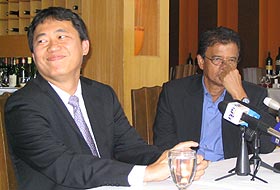
"We have no more business in Burma. The last was three years ago and that was just a pilot project," said Tan at a press conference held to announce Iris' RM100 million e-passport deal with Thailand.
Under the deal, Iris will supply 70,000 electronic inlays to be embedded in Thai passports over the next four years.
Tan dismissed suggestions that the failure of the company's Burma project - to supply the country with 'smart chips' used to store information in passports and identity cards - was linked to Iris' chairperson and UN special envoy to Burma Razali Ismail.
"It has nothing to do with him," said Tan.
 Iris, and Razali in particular, have been
criticised for their involvement
with the military-ruled nation given its human rights track record and Razali's diplomatic role in seeking a resolution between the junta and the opposition.
Iris, and Razali in particular, have been
criticised for their involvement
with the military-ruled nation given its human rights track record and Razali's diplomatic role in seeking a resolution between the junta and the opposition.
According to a report released in January by the International Confederation of Free Trade Unions (ICFTU), Iris is one of the 25 Malaysian companies that conducts business with the Burmese military generals.
Nevertheless, Tan did not rule out the possibility of stitching future deals with the Burmese military.
"I will go anywhere where there's business," said Tan.
UN 'disappointed but hopeful'
Meanwhile, Razali - who announced at the media event that he was not going to speak on issues unrelated to Iris - was asked in private of his views on the Burma situation and the current calls to strip it of Asean's 2006 chairmanship.
"Credit must be given to Asean (for its pressure on Burma). It takes a lot of effort from anybody's behalf to make inroads there. The UN is disappointed with the situation but it is, as I am, quite resilient," said Razali.
He was further asked to comment on a media report which quoted him as saying Burmese democracy icon and opposition leader Aung San Suu Kyi would soon be released.
"I never said that. I wish it was true and I'll do anything to make it true. There is no indication of her release. I know the Myanmar government, and they will strongly stick to any decisions they make," clarified Razali, using the military junta's new name for Burma.
 Suu Kyi has been detained - for the third time in her political career - since May 30, 2003 after her supporters clashed with government-backed groups which had violently stopped a journey she was making to northern Burma.
Suu Kyi's National League for Democracy won a landslide victory in 1990 but was denied by the military junta from taking power.
Strong calls have been made by Asean parliamentarians - primarily from Malaysia and Singapore - to revoke Burma's Asean chair if they continue to detain the Nobel Peace Prize laureate.


Report this comment
Are you sure you want to delete this comment?
This action cannot be undone.