


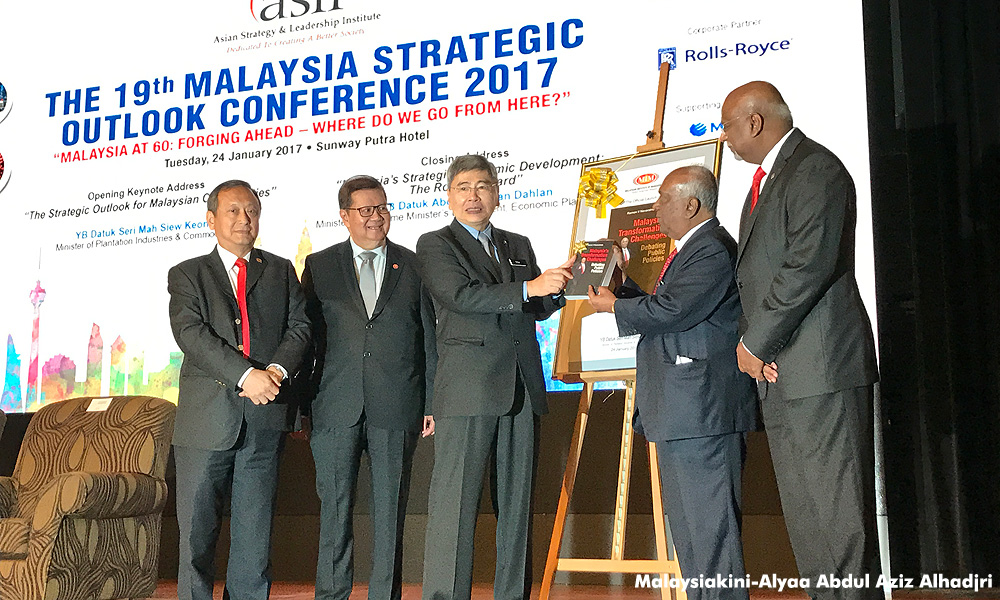

Mah: Commodity industry disappointed with Trump's TPPA exit
Plantation Industries and Commodities minister Mah Siew Keong expressed disappointment with US President Donald Trump's decision to pull out of the Trans-Pacific Partnership Agreement (TPPA).
Mah told a press conference in Kuala Lumpur today that Malaysia had been looking forward to exploring new commodity markets from among the 12 TPP countries.
"From the commodity industry's viewpoint, this is actually very very disappointing.
"We know that the TPPA involves 12 countries and covers more than 40 percent of the world economy," said Mah, who earlier delivered a keynote address at the 19th Malaysia Strategic Outlook Conference 2017, organised by think-tank Asian Strategy & Leadership Institute (Asli).
"From the TPP countries of course there are old and new markets but we were looking for new markets where we can export our commodities," he said.
Among others, Mah cited Peru and Chile as potential markets which had earlier been identified for exports of palm oil, cocoa and rubber.
 "The export of palm oil to 12 TPP countries (in 2014) was more than RM13 billion. Just the TPP countries.
"And we were looking to increase this, also to the US. Especially in the US some of the palm oil-based products are being taxed up to 18 percent on year to year tariff," he said, adding that the TPPA would abolish taxes and import tariffs for almost 95 per cent of Malaysian products to US.
With the signing of the TPPA, Mah said, Malaysia had also targeted to increase its total export of palm oil-based products to RM20 billion by 2021.
In noting that many years had been spent negotiating the TPPA, Mah also expressed hope that the remaining countries could salvage some of the terms to pursue other bilateral trade agreements.
"Just one signature and it (TPPA) is off," he said.
Aside from TPP countries, Mah said he had last week met with ambassadors from 16 European Union countries to correct certain "misinformation" about palm oil products in Europe.
On top of exploring new markets, Mah said he would also be holding a meeting with all local stakeholders next month to discuss the issue of certification for palm oil.
These engagements, he said, were part of efforts to overcome challenges affecting the commodities industry and maintain the government's growth rate targets of between five to eight percent increase in export of palm oil.
Trump, who was sworn in as the 45th US president last Friday, had targeted both the TPPA and the North American Free Trade Agreement (Nafta) during his White House campaign.
Mah also earlier launched Asli chairperson Ramon Navaratnam's latest book, "Malaysia's Transformation Challenges - Debating Public Policies".


Report this comment
Are you sure you want to delete this comment?
This action cannot be undone.