




Q&A: Brokering peace in Aceh, Sri Lanka
Malaysiakini: How did you get involved in the Aceh peace process?
Ramasamy: There were a number of Acehnese students at the university who worked with me, and I talked to them, listened to them. I was very sympathetic with their cause. I organised seminars for them during the martial law in Aceh in 2002-2003. We discussed about Aceh, Indonesia, Papua and I would give them information on how they (Liberation Tigers of Tamil Eelam) were trying to resolve their problem. It was a fantastic exchange of opinions in a very sterile atmosphere in the university.
 You have argued that the real reason for your abrupt termination was your involvement in the Aceh peace process.
They did not give me any reason. I can only speculate. I have been fighting for labour, criticising the government and university policies and lately the CSMU (Crimea State Medical University). But they (Universiti Kebangsaan Malaysia) have not given me any reason (for the termination).
When I talked to somebody here, he said the only reason I was terminated was because I was involved with the Helsinki peace talks. When I got back from the first round of the Helsinki talks, the secretary-general of the Higher Education Ministry called me. I went there and he said Indonesia complained to Wisma Putra that I was a GAM (Free Aceh Movement) advisor in Helsinki.
Malaysiakini: How did you get involved in the Aceh peace process?
Ramasamy: There were a number of Acehnese students at the university who worked with me, and I talked to them, listened to them. I was very sympathetic with their cause. I organised seminars for them during the martial law in Aceh in 2002-2003. We discussed about Aceh, Indonesia, Papua and I would give them information on how they (Liberation Tigers of Tamil Eelam) were trying to resolve their problem. It was a fantastic exchange of opinions in a very sterile atmosphere in the university.
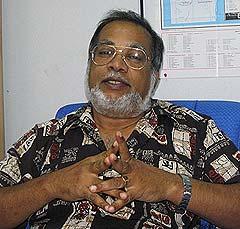 You have argued that the real reason for your abrupt termination was your involvement in the Aceh peace process.
They did not give me any reason. I can only speculate. I have been fighting for labour, criticising the government and university policies and lately the CSMU (Crimea State Medical University). But they (Universiti Kebangsaan Malaysia) have not given me any reason (for the termination).
When I talked to somebody here, he said the only reason I was terminated was because I was involved with the Helsinki peace talks. When I got back from the first round of the Helsinki talks, the secretary-general of the Higher Education Ministry called me. I went there and he said Indonesia complained to Wisma Putra that I was a GAM (Free Aceh Movement) advisor in Helsinki.
I told him I went there for an on-going research on the effects of tsunami in both Aceh and Sri Lanka. I went there not purely for the Helsinki talks. I had some other engagements in Helsinki. I was trying to contact some friends who were working on another issue. I showed him (Higher Education Ministry secretary-general) a letter and he replied that he accepted my reasons that I was there as part of my profession. He advised me that next time, I should not go there because this might be misconstrued, that it might affect the relationship between Malaysia and Indonesia. After that I did not go.
So the matter was cleared. The letter was also sent to the vice-chancellor. I had gone to Helsinki on my own accord. I took 10 days leave. What was wrong with that? A lot of people take leave and go overseas to do academic work.
The point is after my retirement when they gave me a month-to-month contract, I already sensed that they were going to terminate me at some point. The question was on what grounds. They were going to get me. I supposed they used the Helsinki talks (as the reason).
Why do you think the government is so concerned with your involvement in Helsinki?
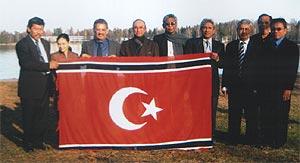 Apparently Indonesia protested to Wisma Putra (Foreign Ministry) about that. Otherwise I don't see why Malaysia should be concerned about it. I'm not the official advisor of GAM. Of course, GAM came to see me and a lot of other people also came for advice. That did not mean I was their official advisor.
I contributed in some meaningful ways (to the peace process). They have a peace agreement now. Malaysia should be happy. At least, we can send home 40,000 Acehnese who are here. In fact, some people came to me and said, "Prof, in some countries you could have been given an award."
The university should be proud that I was doing something good. Their mind has the inability to accept that an academic can play a bigger role (other than teaching).
What are the similarities in the struggles of LTTE and GAM?
They are both nationalists. GAM struggles for independence, but of course, now they have renounced independence. The LTTE has never renounced independence. But given the global circumstances, both parties are willing to explore positions that are able to address their concerns.
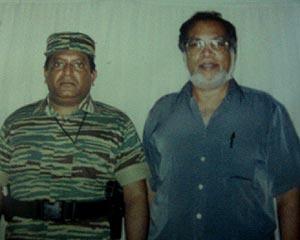 I think the LTTE is a much more powerful army and they can take on the Sri Lankan army. In the case of GAM, they are not so strong. To me, it's simple - sometimes you struggle with arms, sometimes you struggle politically.
I am very happy that they (GAM) have reached a peace agreement with Indonesia and hopefully normalcy returns. Aceh has been devastated.
The point is I'm well-recognised in many places. I have a series of seminars in Norway, in universities in Oslo, in Germany. I'm not saying I am very knowledgeable, but I do have an in-depth understanding of the issues involved.
How do you feel about LTTE's suicide bombers?
In the beginning stages of their conflict, they (LTTE) did not have any weapon. So they had to break the enemy and confuse them. One of the tactics was suicide bombers. They (suicide bombers) had been ingrained that being a martyr was the highest honour. That was the intensity of the struggle that I don't think GAM has reached.
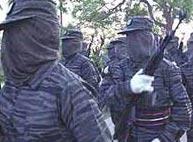 If GAM is seen as an Islamic movement, its struggle could have been extinguished a long time ago. Theirs is very much a secular struggle - a struggle for rights, for resources, for dignity and the well-being of the Acehnese which have been denied by the Indonesian government. With the LTTE struggle, you have people who have been fighting for more than 20 years.
Now going back to civilian life is a challenge for them because they have been trained to fight and kill, and die. When you go to the northeast of Sri Lanka, the first thing they do is to take you to the martyr's graveyard and show how these people had sacrificed their lives for the Tamil cause. Women carry arms and they are ferocious fighters in LTTE.
What really struck me is that nobody talks about these things. They only talk about LTTE - the fighting mercenaries, the ruthless fighters, the so-called terrorists and so on but what is interesting is the social transformation of the Tamil society, from a caste society to a society where we have actually to some extent eliminated the gap between men and women.
That is the most striking aspect of the Tamil society. How the war has actually eradicated the caste system and brought to forth the equal status of women. Because of the discrimination of Sinhalese, they can't go to the universities. The system was so bad that the Tamils were simply non-existent. There was growing numbers of the unemployed and the situation was ripe for an arm struggle.
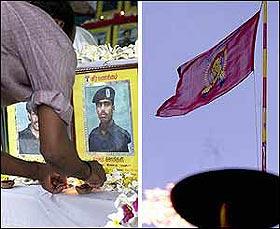 The Tigers are not that devilish. They are actually very decent people. They won a decent settlement for the people. When you talk to them you become very sympathetic and gravitate towards their cause and see how you can actually be involved in the peace process. I think we should be able to transcend all the narrow values. I think the Acehnese have a lot of respect for me because I think I am the only one who supported them during the darurat (emergency) by organising seminars and all. There is no barrier and in fact they told me "none of our Muslim brothers are supporting us here."
Recently the anthropology department wanted to organise a seminar on the peace agreement and they invited me. Two days later, they cancelled my invitation. So I told the Acehnese students and one of them was shocked. He told them this was an insult to Prof Rama and this was an insult to the Acehnese. So they cancelled the seminar.
The majority of Acehnese students here came after martial law was imposed in 2002.
Yes. Some of them are doing degrees, mostly post-graduate (degrees). As far as the Indonesia military is concerned, every able Acehnese is a GAM member.
How does the peace process in Aceh compare with the one in Sri Lanka?
They (Acehnese) rejected the special autonomy offer but they will go for the self-governance of Wilayah Aceh. Independence is something integral and essential to them. They have talked about independence for 30 years. It doesn't matter. You can go for a deal with some dignity intact, some international support, and at the same time they are able to control their natural resources, allow for Indonesia to withdraw and also for European Union participation.
 To me there is a lot of positive aspects but also a lot of negative aspects, especially the local election in 2006. Can GAM take control of the situation? Implementing the peace deal is a herculean stuff.
Sri Lanka is much more tensed. They have a cease-fire, and now a low-intensity conflict, the recent murder of (former foreign minister Lakshman) Kadirgamar, they don't know who was responsible. The Tigers could have done it, others could have done it. They are putting the blame on LTTE. The situation is much more polarised. And India is always playing a dirty game there.
To me, the issue is very simple. I don't think Sri Lanka has a problem with LTTE. The problem with LTTE has always been with India because India doesn't want a separate Tamil state. If the Tamils in northeast Sri Lanka get independence, it might influence a similar movement in (India's) Tamil Nadu.
I think they are trying to find out how they can move forward. Of course, we have the Norwegian mediator in a very difficult situation where a lot of killings are going on. The situation is much tense in Sri Lanka. I wouldn't be surprised if there is war tomorrow.
Superficially, there is some kind of settlement in Aceh but no settlement in Sri Lanka despite the fact that both areas are badly hit by the tsunami.
It is a very difficult situation and hopefully the low-intensity killings will stop. If not, they could actually lead to a major confrontation. I don't see how to resolve the conflict there unless the international community decides that there should be a settlement. But India is not very happy with Norway's involvement.
Any differences between the Sri Lankan and Indonesian governments in dealing with their respective conflicts?
The Sri Lankan government have been sort of checked by LTTE. They outnumbered the LTTE in terms of weapons, but they lost many battles. They know that they cannot go and take over Tamil Eelam. They already accepted that.
In the case of Indonesia, I think the Indonesian army is much more brutal compared to the Sri Lankan army. The Indonesia army is very strong but quite fragile in many ways. The problem with Indonesia is that it is very much centralised. Unless they move in the direction of federalism, the separatist movement is not going to die down.
The Sri Lankan army is actually afraid of the Sri Lankan government. The Sri Lankan army is all paid by the Sri Lankan government. In the case of Indonesia, the government pays only 25 percent of salary to the armed forces. So Aceh for them is 'rezeki' (benefits). There are businesses and more after the reformasi in Indonesia, when the army took a beating in East Timor.
How do you see the peace deal in Aceh affecting Malaysia and its Acehnese refugees?
I think Malaysia would benefit from it. There will be a lessening in the burden of the government, especially in terms of refugees. There are about 30,000 to 40,000 refugees. They want to go back. They are not like the Indonesians who come to work here.
Malaysia might have some role in the Aceh monitoring mission. However, after the Semenyih detention camp incident (where a number of Acehnese detainees were killed), the Acehnese do not trust the Malaysian government. The tragedy of Asean, which was clearly seen in East Timor, is their wait-and-see approach. They will never be pro-active. In the case of Burma, there is some. But in the case of Indonesia, Malaysia doesn't want to interfere.
Apart from closing one eye on the Acehnese refugees, there is no Asean spirit in resolving the Aceh conflict.
At one point you were the president of Prim (Parti Reformasi Insan Malaysia)?
No, that's another Prof P Ramasamy. [Laughs] He stays in Sabah. He is a bio-chemist from Universiti Malaya and he became the president of Prim and he is now working as a professor in Universiti Sabah. I was never involved in Prim although I know the members of Prim [Laughs].
So what are your future plans?
I have not really thought about it. Germany is quite interested in me. They wanted me to come for a few months as a guest professor in the University of Kassel. I might go there for a month. Two months is a bit long. I also need to discuss with another local institute which wants to see me next week.
Otherwise, I'm thinking of a more active role in politics. Maybe more towards the oppositional politics. I will continue to do research. I also want to raise issues. I think we need to make more noise in this country. Of course, I would be highlighting labour issues and the underclass in the Indian community.


Are you sure you want to delete this comment?
This action cannot be undone.