




ACA probes only 10 percent of graft cases
 The Anti-Corruption Agency (ACA) investigated no more than 10 percent of the reports containing allegations of corruption that it received since 2000, Deputy Prime Minister's Department Minister M Kayveas revealed today.
 The Anti-Corruption Agency (ACA) investigated no more than 10 percent of the reports containing allegations of corruption that it received since 2000, Deputy Prime Minister's Department Minister M Kayveas revealed today.
At a press conference held in the Parliament's lobby, he said up to August this year, a total of 57,194 reports had been lodged to the ACA and out of that, 5,568 investigations were carried out.
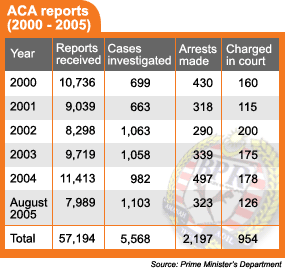 "A total of 2,197 arrests were made in relation to that, while 954 were charged in court on corruption charges," Kayveas told reporters.
He explained that the low percentage of the cases probed by ACA were due to the reports lacking in evidence, false complaints and the unwillingness of witnesses' to come forward.
The deputy minister added that the ACA planned to boost its numbers by 600 next year to overcome its severe humanpower shortage.
Meanwhile, he also blamed local municipal councils for contributing to the drop in Malaysia's placing in the Transparency International's Corruption Perception Index by two notches, from 37 to 39 last year.
Kayveas, who is also the People's Progressive Party president, has been embroiled in a controversy recently after he likened the local councils to 'secret societies'.
He had argued that local councils were functioning as 'rubber stamps' in approving projects, which were done behind closed doors without consultation from representatives of citizens groups.
Under pressure to apologise, he later clarified that he had intended to highlight the fact that local councils "were societies being run in secrecy" and that he had not meant them as "secret societies".
Select committee on integrity
Earlier, during the Dewan Rakyat's question-and-answer session, Kayveas in responding to a query by Nasaruddin Hashim (BN-Parit) reiterated the government was committed to eliminating graft.
He said the government had implemented a three-pronged strategy in fighting corruption, and this included taking legal action against errant government officials.
In addition, the strategy also involved the streamlining of government bureaucracy to reduce the opportunity for corruption and abuse of power.
Kayveas also noted that a committee was set up to oversee the code of ethics of government members of parliament as well as the introduction of the National Integrity Plan.
He said the government's commitment in enhancing integrity and to create a corruption-free society is underscored by the cabinet's approval for the formation of a parliamentary select committee on integrity.
The select committee will be headed by Minister in the Prime Minister's Department Bernard Giluk Dompok and comprises 11 other parliamentarians, including two from the opposition.


Are you sure you want to delete this comment?
This action cannot be undone.