




Oil-for-food scam: PM cleared, relatives implicated
 Prime Minister Abdullah Ahmad Badawi has been cleared from involvement in an illicit oil-for-food deal with deposed Iraqi leader Saddam Hussein, but a United Nations inquiry has implicated two of his close relatives.
 Prime Minister Abdullah Ahmad Badawi has been cleared from involvement in an illicit oil-for-food deal with deposed Iraqi leader Saddam Hussein, but a United Nations inquiry has implicated two of his close relatives.
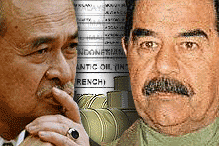 The independent inquiry committee's report, released yesterday, claimed that the duo via a Malaysian trading company called Mastek, paid a whopping US$10 million (RM38 million) to Saddam's regime for the single largest oil allocation under the UN-administered oil-for-food programme.
The duo were identified as Faek Ahmad Shareef and Noorasiah Mahmood. Faek, an Iraqi immigrant, was married to Abdullah's sister-in-law - the sister of the premier's late wife, Endon Mahmood - but the couple had divorced later. Meanwhile, Noorasiah is another Endon's sister.
According to the 623-page report, Faek began to receive oil allocations in phase 5 of the programme and the oil allocated to him in phase 5 and 6 was 'lifted' by another Malaysian company, Tradeyear.
However, Faek was said to be unhappy with the commission he was receiving from Tradeyear and therefore decided to revive the dormant Mastek with Noorasiah and another partner named Jaya Sudhir.
The report stated that Mastek acted as the main intermediary for oil trader Vitol Group to maintain its access to Iraqi crude oil as Vitol had limited access to contracts under the programme. Vitol had allegedly financed and 'lifted' a total of 40 million barrels of oil under Mastek contracts.
'National duty'
After receiving 2.5 million barrels in Phase 7 (December 1999) and five million barrels in Phase 8 (June 2000), Mastek's oil allocation increased dramatically in Phase 9 as it received over 39.5 million barrels of oil - the single largest allocation during the programme.
It is said that Mastek obtained the high volume when the company agreed to pay the surcharges imposed by Iraq after its minister of oil, Amer Rashid, had purportedly told Faek at a meeting in December 2000 to perform 'his national duty for Iraq' in order to keep its crude oil flowing. Such surcharges are illegal and considered as bribes.
Later, the Iraqi State Oil Marketing Organisation (Somo) levied a total of approximately US$10,380,361 in surcharges on Mastek's contract and between January 2001 and April 2002, approximately $9,803,960 was paid into Somo's account with the Jordan National Bank.
According to the report, Mastek paid the single largest bribe among the 2,200 companies from 66 countries which were found to have paid bribes.
"Mr Shareef's (Faek) oil allocations were tied to political considerations as Iraqi officials perceived him as someone who could assist in countering the effects of sanctions by improving Iraq's ties with Malaysia," the report said.
"This perception was due in part to Mr Shareef's family ties to Abdullah Ahmad Badawi, the Malaysian deputy prime minister in1999 and its current prime minister, and Mr Shareef's ability to arrange for trade delegations to visit Iraq," it added.
The report was referring to a letter, presented to the committee, which was sent by Abdullah in November 2001 to then former Iraqi vice-president Taha Yassin Ramadan recommending a delegation headed by Faek and Noorasiah be sent to Iraq.
However, Faek testified that Abdullah had issued the letter as a way to support the Malaysian private sector and had done so for other Malaysian companies as well.
The report, officially called 'Manipulation of the Oil-for-Food Programme by the Iraqi Regime', is the final report prepared by the three-person Independent Inquiry Committee into the United Nations Oil-For-Food Programme, chaired by former head of the United States Federal Reserves Paul Volcker.
'No evidence'
Abdullah, who was among those implicated earlier , was cleared by the committee.
He became embroiled in the matter when a preliminary report last October named an 'Abdullah Badawi' as one of hundreds of individuals, world leaders, governments and firms that had been bribed by Saddam in an effort to undermine UN sanctions imposed against Iraq.
The report, prepared by the United States' Iraq Survey Group, claimed that this 'Abdullah Badawi' was given vouchers in 2000 to sell two million barrels of Iraqi oil. It was estimated that the profit could be as high as 65 cents per barrel.
It added that 'Abdullah Badawi' - through a company called Tradeyear - had sold 1,949,900 barrels, making a tidy profit of as much as US$1.3 million.
Also named in the report was state-owned oil company Petronas, a former Malaysian ambassador, two other Malaysian companies and an Iraqi named Fariq Ahmad Sharif (believed to be Faek), who was described as an immigrant to Malaysia.
However, the latest UN report said it found 'no evidence' that the premier had profited from the programme.
The committee also found that Saddam had received a total of US$1.8 billion from the scam and more than half of the 4,500 companies - from 60 countries - involved in the oil-for-food programme paid kickbacks or surcharges to the Iraqi government.


Report this comment
Are you sure you want to delete this comment?
This action cannot be undone.