




Strangers in their own land
special report Few Sabahans would have anticipated five decades ago that they would have to grapple with the enormous problems created by the presence of a large number of illegal immigrants in the state.
special report Few Sabahans would have anticipated five decades ago that they would have to grapple with the enormous problems created by the presence of a large number of illegal immigrants in the state.
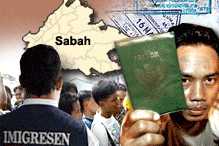 That day has come - and the multi-faceted political, social and economic problems can best be summed up as both self-created and forced on Malaysians living in Sabah.
It is not known how many of the 2.9 million inhabitants are illegal immigrants, although Chief Minister Musa Aman estimated their number at about 100,000.
Some non-government organisations (NGOs) have dismissed this as a 'big joke', claiming that at least one million identity cards have been issued to illegal immigrants over the last three decades.
The precise number may never be known because the government is too embarrassed to find out, or is incapable of counting every head in a state which has a porous borders with the southern Philippines and Indonesia.
 Lawyer Christina Liew, who heads the Sabah Chinese Women Association, said those concerned appear to be free to come and go.
"They also multiply - and when they come back, they bring back relatives with them," she alleged.
"The preponderance of foreigners is particularly noticeable in places like Kinabatangan and Kunak, where locals are outnumbered one to two and sometimes one to three."
External factors
The arrival of the first batch of illegal immigrants in the 1960s was said to be linked to a move by the administration of then Philippine president Ferdinand Marcos, to support his country's claim to Sabah.
At about the same time, Indonesia objected to the formation of Malaysia. But with jobs and money scarce among Indonesians, many are said to have crossed the border illegally into Sabah.
Another push factor which saw arrivals of Filipinos from southern Philippines was a rebellion in Muslim-predominated Mindanao, which the army used force to crush. This was exacerbated with the formation of the Moro National Liberation Front and its rival, the Moro Islamic Liberation Front, in the 1970s.
The Malaysian Immigration Department issued IMM 13 temporary passes to 57,000 Filipinos who escaped the conflict by fleeing to Sabah.
Hardly any have returned to their countries of origin since and it is safe to assume that many of their relatives would have joined them.
Malaysians of Filipino origin can be seen today, plying petty trade in the markets of major towns. They are also prepared to take up other jobs shunned by locals for half the wages.
 As NGO leader and author Joshua Kong said: "Suddenly, the locals found that others were taking over their jobs."
Yayasan Islam Sabah secretary-general Yahya Ahmad Shah said foreigners are coming to Sabah because of supply and demand in the market-place.
State DAP chairperson Dr Hiew King Cheu said about 300,000 illegal immigrants are employed in the plantation industry.
"There is a hefty levy on bringing in foreign workers. This is why so many illegal immigrants are employed in estates. To solve the problem, the government should do away with middle men and hefty fees," he said.
However, estates are barely touched during immigration operations because of the possible economic implications - locals said the oil palm industry, like the logging industry before it, is a major source of income for the state.
 "If you repatriate the illegal immigrants, the economy could very well collapse," said Hiew.
It would also be practically impossible - not to mention costly and time-consuming - for the authorities to check on all estates as these are spread all over the state.
The issues are not confined to land matters. One of the biggest headaches for the state government is the incidence of 'fish bombing' in the seas. Filipino fishermen are being blamed for this quick approach to income-generation.
Pull factor
Even as factors in their countries of origin were influencing the choices of those seeking escape or a better life, events within Sabah were shaping up to draw in sympathisers.
Domestic politics in the1960s saw then chief minister Mustapha Harun, a Suluk from the southern Philippines, building his power base.
He had no qualms about drawing in other Suluk from the Philippines and the Bugis from Indonesia to alter the demography of Sabah to establish a strong Muslim minority among the mainly Chinese population.
Mustapha, the leader of United National Sabah Organisation - which later became Umno Sabah - ruled the state like a dictator from 1967-1975. This coincided with an acceleration in the influx of illegal immigrants.
Today, Sabah Umno's membership has jumped to about half a million and it controls about 35 of the 62 seats in the state legislative assembly.
Part 2: Problem that will not go away
TONY THIEN is malaysiakini's Sarawak-based stringer.


Report this comment
Are you sure you want to delete this comment?
This action cannot be undone.