




Problem that will not go away
special report As far back as 1989, a special federal task force was set up to weed out illegal immigrants in Sabah. Today, their presence remains as large as ever, to the concern of those watching the ease of their assimilation into the state.
special report As far back as 1989, a special federal task force was set up to weed out illegal immigrants in Sabah. Today, their presence remains as large as ever, to the concern of those watching the ease of their assimilation into the state.
Local activists have openly accused the government of issuing at least a million identity cards (ICs) to foreigners for political and economic reasons. With these documents comes access to all the rights and privileges accorded to the bumiputera community, they claimed.
Lawyer and opposition politician Christina Liew said there are three categories of illegal immigrants.
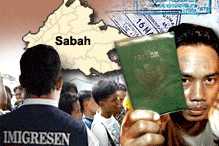 One group comprises
refugees
who fled the southern Philippines at the height of a separatist rebellion in the1970s. They have been issued IMM13 passes that renewable every year, but which allegedly have not been subsequently renewed.
One group comprises
refugees
who fled the southern Philippines at the height of a separatist rebellion in the1970s. They have been issued IMM13 passes that renewable every year, but which allegedly have not been subsequently renewed.
There are also undocumented foreign workers and stateless children, who were separated from or were left behind by their repatriated parents.
"The real victims are stateless children who have had to fend for themselves over the years - they are street children, refugee children and the children of illegal immigrants," said a human rights activist who declined to be named.
Those born in the 1970s are probably married and have their own children by now, thereby increasing the number of undocumented persons living in the state.
The porous borders with Indonesia and the Philippines have aggravated the situation, as people move in and out of Sabah freely and often bring in relatives as well.
Rising resentment
The issuance of citizenship status and ICs to foreigners has created much unhappiness and resentment among locals.
One manifestation of their anger has been in Kampung Maang in Penampang, about 15km from Kota Kinabalu, where villagers have protested the government's plan to relocate squatters comprising foreigners or former refugees to the area.
A state-wide signature campaign is underway, initiated by a group calling itself 'Patriotic Citizens Forum on Identity Card' (Pacific).
It is seeking 200,000 signatures to pressure the government to set up a Royal commission of inquiry to probe how so many foreigners have obtained official recognition over the last three decades.
 Pacific secretary Joshua Kong said: "We feel that the government should explore the root cause and verify the presence of the so-called 'Project ICs' coded as P1 and P1 with the National Registration Department."
This grouping of several local NGOs, concerned citizens and professionals want the authorities to check the validity of all ICs issued in Sabah as well as holders of ICs from Sabah in other states.
It has been suggested that ICs issued to foreigners that are ultra vires the Federal Constitution should be cancelled and that holders of dubious ICs should be excluded from applying for permanent residence.
One school of thought is that even citizenship given to children born to parents with doubtful status should be revoked, and that a grace period should be set for dubious ICs to be turned in.
Action required
In a paper presented at a recent forum on 'Reducing Violence Among Children' - organised by the Human Rights Commission of Malaysia (Suhakam) - Liew recommended five ways to deal with Sabah's problems.
Research should be conducted on the status of illegal immigrants and stateless children, she said.
The United Nations High Commissioner for Refugees (UNHCR) had provided financial support for 57,000 Filipino refugees in Sabah, but had withdrawn this in 1987 after the rebellion in southern Philippines ended.
 "There has been no resolution to the presence of these refugees in Sabah,' said Liew, who suggested three options - to repatriate them, institute proper documentation, and record or register these refugees.
Liew said young illegal immigrants should be provided with basic education and skills training in Peninsular Malaysia as it may deter newcomers to know they would be sent out of Sabah.
The government should also waive or minimise the levy on foreign workers and do away with middle men in the recruitment of foreign workers, especially for the oil palm industry.
According to her, Sabah needs foreign workers but the levy only encourages workers and potential employers to look for a way around the payment.
Given the large number of stateless children, Liew said there is a need to launch a joint reunification exercise to trace parents or relatives in the home countries.
"UNHCR and Unicef (UN Children's Fund) could provide the necessary assistance," she said.
There should also be a new record or registration of children born to illegal immigrant couples in the state, she said.
In addition, the federal government should provide adequate funding to Sabah, commensurate with the size of the population, for education, security and health care.
Opposing views
Suhakam commissioner Prof Dr Hamdan Adnan, when launching the Pacific campaign last week, had raised the prospect of a 'reverse takeover' by foreigners who have entered the state illegally since the 1960s.
Not everyone agreed with his view. Yayasan Islam Sabah (YIS), headed by former chief minister Harris Salleh, described Hamdan's statement as "rather far-fetched".
YIS secretary-general Yahya Ahmad Shah said Malaysia has laws to protect sovereignty and that "there is no cause for worry".
While he said everyone should complement the government's efforts to stop the influx of foreigners into Sabah, he did not spell out details beyond saying that foreigners are needed in the job market.
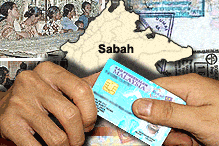 Recent police operations within and around Kota Kinabalu saw some 800 undocumented persons - mainly children - being detained and sent to already crowded holding centres.
"What do we do? Send them home?" asked a senior police officer, who said parents are usually advised to apply for official documents so they will be allowed to stay.
Many are of the view that the problem of illegal immigrants will not go away until the governments of Malaysia, Indonesia and the Philippines get down to serious discussion to find a solution.
Without such political will being demonstrated, Sabahans only expect the situation to worsen.


Report this comment
Are you sure you want to delete this comment?
This action cannot be undone.