




Plan spells out pro-poor strategies
 The 9th Malaysia Plan has targeted the eradication of hardcore poverty and halving overall poverty to 2.8 percent by 2010, thereby adding to the "considerable progress" achieved under the previous Plan.
 The 9th Malaysia Plan has targeted the eradication of hardcore poverty and halving overall poverty to 2.8 percent by 2010, thereby adding to the "considerable progress" achieved under the previous Plan.
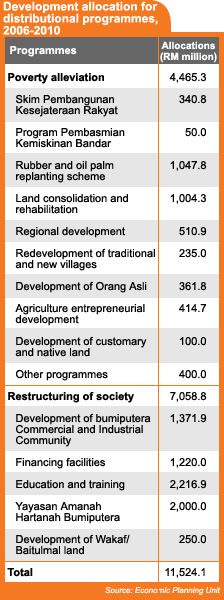
This will be carried out through an allocation of RM11.5 billion for distributional programmes that will reduce income inequalities, narrow the rural-urban income disparity and restructure society. (See chart)
Implementation of programmes and projects will be closely supervised by a strengthened monitoring mechanism in the Economic Planning Unit and Implementation Coordination Unit of the Prime Minister's Department.
 An improved system of targeting beneficiaries and minimising leakages will be instituted to achieve the objective of growth with distribution.
Towards this end, a national poverty database will be created that includes the register of urban and rural poor and which uses a common definition of income. Poverty mapping will be conducted in selected urban and rural areas to assist in designing programmes that meet needs of different target groups
Specifically, the Plan targets reducing the income disparity ratio between bumiputeras and Chinese to 1:1:50 in 2010 (1:1:64 in 2004) and between bumiputeras and Indians to 1:1:15 (1:1:27 in 2004).
Main strategies
Income-generation projects and employment opportunities are among measures to reduce hardcore poverty in urban and rural areas, particularly in Sabah, Terengganu and Perak which have a high number of hardcore poor households.
The emphasis will be on human capital development and access to credit and micro-credit facilities.
Only the elderly, poor single parents, the disabled and destitute who are unable to participate in gainful economic activities will continue to receive outright assistance.
In terms of overall poverty, the thrust is on education and training in specific skills/knowledge, as well as inculcation of a good work ethic and self-confidence.
Rural communities will obtain improved access to new technologies, modern farming methods and off-farm economic activities, as well as to training and credit schemes. Land development schemes and rural growth centres will benefit those in Sabah and Sarawak.
A comprehensive plan will also be implemented to address poverty among Orang Asli, by increasing income and improving quality of life.
Last year, the Poverty Line Income (PLI) was substantially revised to cover two components - food and non-food - and defined separately for each household based on size, demographic composition and location (state and stratum).
Gross PLI to determine overall poverty ranged from RM634 (Johor) to RM888 (Sabah), and from RM367 (Perlis) to RM503 (Sabah) for the hardcore poverty category.
Send your comments on the 9MP to us at voxpopuli@malaysiakini.com . Your email may be published in Malaysiakini. Please keep your comments brief, and do let us know if you wish to remain anonymous.


Report this comment
Are you sure you want to delete this comment?
This action cannot be undone.