




Graduates employment problematic
Human capital development will be a key thrust in the Ninth Plan period. It is forecasted that 1.1 million net additional jobs will be created over the five years with just under 400,000 of these jobs require some form of tertiary qualifications (certificate, diploma, degree, masters or a PhD).
Human capital development will be a key thrust in the Ninth Plan period. It is forecasted that 1.1 million net additional jobs will be created over the five years with just under 400,000 of these jobs require some form of tertiary qualifications (certificate, diploma, degree, masters or a PhD).
However, the figures reveal that there will be over 250,000 local graduates from both private and public institutions of higher learning per year.
This would mean that depending on the number of people who exist in the workforce each year (taking into account deaths, retirements, emigration etc) up to two-thirds or 66 percent of new graduates will not find graduate-level employment.
 Addressing this, the Plan says various initiatives will be undertaken including the implementation of several training and re-training programmes to reduce skills mismatch and enhance the employability of labour, particularly graduates.
It said that in line with the policy to shift to technology-intensive and higher value added activities, there will 'judicious employment' of foreign workers until 2010. The number of foreign workers will be reduced gradually to provide greater employment opportunities to local workers and to reduce administration costs as well as he outflow of foreign exchange.
Local labour, particularly graduates, will have to change their mindset as not to be choosy in selecting occupations.
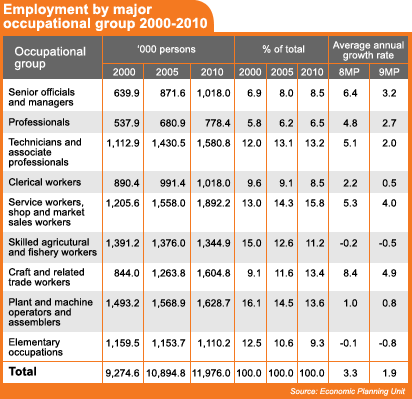
Under the Eighth Malaysia Plan, the labour force increased to 11.3 million in 2005 as shown in Table 11.2. The quality of the labour force improved with the share having educational attainment at tertiary level increasing from 13.9 percent in 2000 to 20 percent in 2005.
Holistic development
The unemployment rate for that year was 3.5 percent. Labour shortages, especially for the low-skilled, resulted in the increased employment of foreign workers with work permits for them being increased 1.7 million as of now. The number of expatriates stands at 35,480.
The demand for knowledge workers, which comprise senior officials and managers, professionals, technicians and associate professionals categories is expected to grow at an average rate of 2.5 percent under the Ninth Malaysia Plan. The demand for professionals workers is expected to be about 97,500.
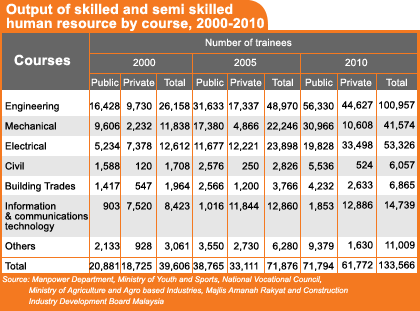 The Plan says human capital development will be one of its main thrusts. Greater focus will be given to holistic human capital development encompassing knowledge and skills, progressive attitude as well as strong moral and ethical values.
Lifelong learning programmes will be expanded. The inculcation of entrepreneurial values will be intensified to promote self-employment.
Measures will be undertaken to upgrade capabilities to drive innovation. Smart partnerships and collaboration among stakeholders in education, training and lifelong learning will be intensified.
Greater private sector participation in the provision of quality education and training will be encouraged.
Delivery systems for the above will be improved to enhance the quality of human capital and to produce 'towering individuals to meet the challenges of driving a knowleddge-based economy'.
Send your comments on the 9MP to us at voxpopuli@malaysiakini.com . Your email may be published in Malaysiakini. Please keep your comments brief, and do let us know if you wish to remain anonymous.


Report this comment
Are you sure you want to delete this comment?
This action cannot be undone.