




IPCMC: Royal police commissioners meet MPs
Five commissioners of the now-dissolved Royal Police Commission briefed about 100 parliamentarians at a closed-door meeting on the much debated Independent Police Complaints and Misconduct Commission (IPCMC) proposal.
Five commissioners of the now-dissolved Royal Police Commission briefed about 100 parliamentarians at a closed-door meeting on the much debated Independent Police Complaints and Misconduct Commission (IPCMC) proposal.
IPCMC - a powerful independent police watchdog proposed by the government-backed commission - has been opposed by several Umno backbenchers and the police.
 Met after the meeting at the Parliament building, commissioner Michael Yeoh said: "We explained to them (MPs) the need and rationale to set up the IPCMC. Why in some countries like Australia and the United Kingdom, they have an ombudsman as well as an independent police commission."
"Having the IPCMC does not mean you cannot have an ombudsman. IPCMC focuses more specifically on the police," he added.
The government recently revealed that it was studying a proposal to establish an ombudsman to cover all enforcement agencies.
Also present at the meeting was commissioner and former inspector-general of police Haniff Omar. However, he left without speaking to reporters.
The other commissioners present were Ivy Josiah, Dr Denison Jayasooria and A Kadir Jasin.
Not successful
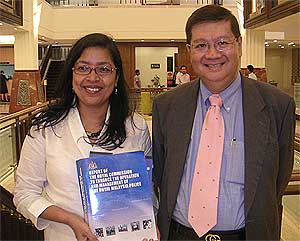 Yeoh when asked, said he did not feel that the meeting was successful because the commissioners had failed to convince the Umno backbenchers who were opposed to the IPCMC.
"People have strong views whether for and against," he said.
While he declined to comment on wether the government would back down from the IPCMC proposal, he nevertheless expressed disappointment over the matter.
"We (commissioners) were sort of disappointed because we thought that the IPCMC would enable the public to have a mechanism to seek redress.
"The IPCMC was be formed under an act of Parliament and MPs would have a role in overseeing what happens in the IPCMC," he said.
New arguments
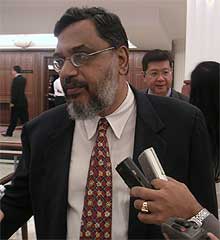 Meanwhile, Denison said the commissioners had to clarify to the MPs the rationale of setting-up the IPCMC.
"I think one or two of them may not fully understand (the proposal). One of the major areas that we are looking into is why countries with strong internal mechanisms (to check on the police) found them inadequate and needed external mechanisms," he told reporters.
The commissioners were invited to the meeting by the Parliamentary human rights caucus.
Met later, caucus deputy head and Parliamentary opposition leader Lim Kit Siang noted that new arguments had emerged during the meeting which deserved more public discussion.
These included arguments that to oppose the IPCMC was tantamount to defending police rights and why was the police solely targeted.
"It is very wrong to say that to oppose the IPCMC was to defend the police's rights because it should be the other way around where the IPCMC is to enhance the police," he said.
Lim said he would seek a meeting with Prime Minister Abdullah Ahmad Badawi to discuss the IPCMC issue.


Are you sure you want to delete this comment?
This action cannot be undone.