




The Ming Court Affair, Pt 3
special report The notion that a night's sequestration from the swirling anti-Taib Mahmud currents would bring reprieve - and, more importantly - perspective, was rudely dispelled on Monday morning when personal secretary George Entigar informed Daniel Tajem over breakfast that Abdul Rahman Hamzah had wanted his signature the previous night on a letter of resignation as deputy chief minister. Worse followed. News arrived from Kuching that the morning's Sarawak Tribune (now defunct) had trumpeted Tajem's resignation as DCM.
special report The notion that a night's sequestration from the swirling anti-Taib Mahmud currents would bring reprieve - and, more importantly - perspective, was rudely dispelled on Monday morning when personal secretary George Entigar informed Daniel Tajem over breakfast that Abdul Rahman Hamzah had wanted his signature the previous night on a letter of resignation as deputy chief minister. Worse followed. News arrived from Kuching that the morning's Sarawak Tribune (now defunct) had trumpeted Tajem's resignation as DCM.
 Tajem now felt like a canoeist paddling on both sides to keep from capsizing in the rapids. He evaded a TV3 reporter hot on his trail, went to Parliament in the afternoon, could not concentrate on the proceedings, ducked out, told Entigar to check him out of the Shangri-La Hotel, and got chauffeur Adam to drive him to Ming Court where he booked a room as more members of the cabal to oust Taib began streaming in. The lounge and coffeehouse were a welter of conspiracy.
He continued to be ambivalent about the whole question of ousting Taib. His views on a host of issues in Sarawak politics and his feelings about Taib and other top politicians in the state had not yet crystallised, understandable given that the overall political culture enabled platitudinous public utterance to hide ulterior venal intention.
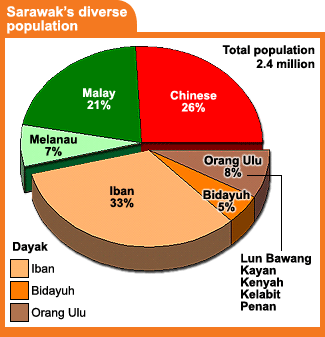 In March 1987, Tajem had completed five years as DCM, in charge of agriculture and community development, a portfolio with high impact on the Dayak community, particularly his fellow Iban who were not only the majority ethnic group among the Dayaks, but were also the largest of all races in the state (the Chinese, conceding two percentage points, were second at 26%).
The Dayaks were mainly farmers, planting rice, rubber, oil palm and pepper, on land held under Native Customary Rights (NCR). They lived in longhouses close by rivers - the Iban mainly in the upper reaches of the mighty Rejang - that wend their way from the mountain fastness of neighbouring Kalimantan to the continental shelf in the South China Sea. Fish and prawn the Dayaks obtained from the rivers and meat came mainly from boar roaming the jungle-clad hills.
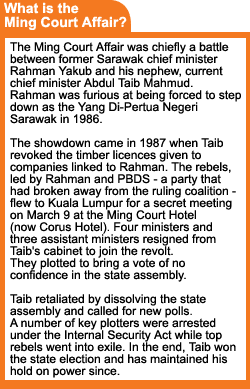 In rudiment this existence can spawn Rousseau-like visions of the noble savage among idle theorists. In reality, Dayak life in the longhouses in the deepest interior, if not nasty, was often brutish and short. Tajem, born in hardscrabble conditions in a longhouse near Kuching in 1937, was among the first Dayaks to escape the poverty trap through education and emerged in post-merger (with the Federation of Malaysia in 1963) Sarawak as one of the first lawyers from the community.
As agriculture minister his priority was not to put more food on the Dayak farmer's table, essentially the thrust of Dr Wong Soon Kai, his SUPP predecessor in the ministry, who viewed well-fed Dayaks as satisfied with being cheap labour for Foochow-owned construction sites and industries in the state. Tajem's purpose was to put more income into the Dayak tiller's pocket so that he could afford to send his children to better residential schools in the major towns, a surer way out of the poverty trap of the longhouse.
Meeting with Mahathir
When he discovered that only 30% of the government's fertiliser subsidy reached the end-user, he tried to alter that reality, coupling it with encouragement for the farmer to use better methods for higher yields and income. He pressed for higher allocations for agriculture from the annual budget but in vain. The SUPP-controlled finance portfolio in the ruling coalition and CM Taib's focus on forestry meant that his requests were not priority. Even simple matters like requisitions for the use of a helicopter for visits to the interior where farmers resided were not easily granted. It appeared the powers-that-be wanted his stewardship of Dayak aspirations to meet the forms and not the substance of representation.
But for the navigation of shoals requiring delicacy and a dollop of courage, he was point man of first choice. As when it became necessary to tell former CM Rahman, at one time while he was governor (1981-86), that his publicly expressed unhappiness with the 5% royalty to the state from the federal government from revenue garnered by the Liquefied Natural Gas project in Bintulu was roiling federal-state relations. Tajem led the delegation, with Taib in tow, to appeal to Rahman to pipe down. When that mission did not quite succeed in achieving its goal, Tajem was again the leader of a delegation to see Prime Minister Dr Mahathir Mohamad to assuage federal disquiet over Rahman's public indelicacies.
To be sure, towards the end of his tenure as chief minister (1970-81), Rahman had asked lawyer Tajem to examine the issue of state rights with respect to royalties on offshore deposits of oil and gas and how the international protocols concerning the issue of such finds in the continental shelf, to which Sarawak accessed before joining Malaysia in 1963, may provide a way round the federal stipulation that royalties would be higher than 5% only for deposits found within three nautical miles off the coast.
The huge gas deposits off Bintulu lay beyond that range. The revenue from the find at one stage was reported to have provided a third of the annual federal budget. Rahman, a Sarawak-first man, felt that if the 5% limit on LNG royalty was inflexible, the federal government should pour more money into development of the Bintulu hinterland. Mahathir, never solicitous of state rights, was impervious to the what's-taken-out-should-be-funneled-back argument.
Observing at close quarters, the tug of these conflicting imperatives provided Tajem invaluable insight into the complexities of government. But he realised that complexities should not be allowed to perplex and sever the nerve of action. Politicians have to act even when all the facts are not known. It came as no surprise to him that at the end of the day he checked into Ming Court, he was told he would have to brief Mahathir in a one-on-one meeting on the petition to the Sarawak governor to express no confidence in Taib. Point man yet again.
Next: Part four of the Ming Court Affair


Report this comment
Are you sure you want to delete this comment?
This action cannot be undone.