




60-40 formula for civil service proposed
The Asli Report Should the government implement a 40 percent target for recruitment of non-Malay public servants, civil service would see a more equitable and representative workforce in about three decades.
The Asli Report Should the government implement a 40 percent target for recruitment of non-Malay public servants, civil service would see a more equitable and representative workforce in about three decades.
Based on a 35-year projection, such a formula would ensure both the continued increase of Malays in civil service alongside an incremental amount of non-Malays.
 The recommendation made by the Asian Strategic and Leadership Institute (Asli)'s in its proposal for the Ninth Malaysia Plan in February, said the formula would see about 4,600 to 6,500 Malay recruits and about 3,000 to 4,300 recruits annually.
"The most noteworthy feature of the 60-40 intake proposal, apart from its simplicity and ease of implementation and monitoring, is its gradual nature. It will not introduce any radical change to existing recruitment patterns," said the report.
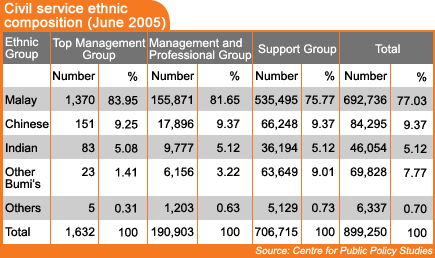
In its projection, the formula would see civil service comprising of 65 percent Malay and 35 percent non-Malay by 2040. Based on June 2005 figures, Malays make up 77.03 percent of civil service.
Un-level playing field
The report believes the major reason for the lack of non-Malay applications into the civil service was a widespread perceived Malay bias in recruitment and promotion.
As examples, the report said nearly all secretary-generals of ministries, director-generals of professional departments and senior officer posts from school deans and upwards, were all held by bumiputeras.
It also dismisses allegations that non-Malays find wages in public sector jobs unattractive.
"In fact, the relative security, prestige and other non-monetary perks that accompany the upper-level civil service make these positions much sought after...
"Many analyst and independent observers believe - almost certainly correctly - that inequalities in personnel practices are no less important than the pay factor in explaining low non-bumiputera applications," the report adds.
Forging national unity
The report warns that an unrepresentative civil service tends to generate ill-feelings from poorly represented groups.
"Groups without adequate representation in the civil service would also tend to see the government as 'not our government' but 'their government' and would question its legitimacy," said the report.
In practice, the report argued that an unrepresentative civil would tend to display ethnic bias in the way they discharge their duties.
"The threat of racial bias to national unity is demonstrated for all Malaysians by the police's lack of even-handedness in the Kampung Medan incident in 2001,
 "There can be little doubt that the problem would not have occured had the police been more representative instead of predominantly Malay," said the report.
(On 21 March 2001, Malaysia saw its worst bout of racial clash since 1969 in Kampung Medan, Selangor which left 29 Indians and three Malays dead due to fighting).
Citing another example, the report said evidence shows that Malay and Islamic influences are increasing in national schools because the teachers and headmasters were predominantly Malay, thus causing uneasiness among non-Malays.
It said civil service should rightfully be promoting national unity, rather than being left to dividing the various ethnic groups.
The report was prepared by Asli's Centre for Public Policy Studies which is headed by prominent academic Dr Lim Teck Ghee.
Previous parts of The Asli Report
Racialising research: The Asli report debacle


Report this comment
Are you sure you want to delete this comment?
This action cannot be undone.