




Bumi, non-bumi firms equally hit by crisis
Both bumiputera and non-bumiputera companies were equally affected by the 1997 Asian financial crisis, said a university research which also found the 30 percent bumiputera equity ownership target was reached in that year.
Both bumiputera and non-bumiputera companies were equally affected by the 1997 Asian financial crisis, said a university research which also found the 30 percent bumiputera equity ownership target was reached in that year.
Malaysiakini reported yesterday that the research, done by Universiti Malaya academician Dr M Fazilah Abdul Samad, found that the bumiputera equity ownership hit the target set by the New Economic Policy in 1997, when it reached 33.7 percent.
The research, published in 2002, was based on a 10-year analysis of bumiputera equity ownership between 1988 and 1997 of public listed companies on the Kuala Lumpur Stock Exchange (KLSE), now known as Bursa Malaysia.
However, Fazilah's analysis of the bumiputera equity ownership did not cover the post-Asian financial crisis in 1997. This has led to unanswered questions on whether the crisis has affected the equity ownership structure.
Nevertheless, Fazilah found that both bumiputera and non-bumiputera companies were dealt an equal blow by the crisis.
But without a follow-up study, it is not clear whether the debilitating financial crisis has changed the country's equity ownership structure.
When contacted by malaysiakini , Fazilah declined to elaborate on her research, citing that as a lecturer she had to abide to the university's 'Akujanji' (pledge of loyalty), which banned academics from speaking to the media without prior approval from the campus administration.
Her ground-breaking research was commissioned and published by UM's independent research unit, the Centre for Economic Development and Ethnic Relations.
No significant difference
Fazilah, who is head of the finance and banking department at UM's business and accountancy faculty, examined 29 non-bumiputera and 29 bumiputera-controlled companies before and after the crisis.
She used the monthly stock return as a measure of performance of these companies.
The 58 companies were chosen as they met the research requirement of having a complete historical monthly return data between February 1995 and December 1999.
The Asian financial crisis was sparked by the floating of the Thai baht in July 1997 after sustaining heavy attacks from currency speculators. This created a ripple effect in many other Asian countries including Malaysia.
In the months following the crisis, the market value of KLSE was slashed by half.
"The BBC performed almost as badly as the market since the BBC lost 54.73 percent of its total market capitalisation while KLSE lost 55.2 percent of its market value," said Fazilah.
According to the research, the average return for bumiputera-controlled companies (BCC) dropped from a positive 0.448 before the crisis to a negative -1.153 after the crisis, while non-BCC fell from 1.226 to -0.730.
Both findings showed all the companies examined were badly hit by the crisis, she said.
The comparison between BCC and non-BCC before and after the crisis showed there was no statistically significant difference in their performance.
"Nevertheless, a mean score analysis indicate that the BCC had a mean score of 1.600 while the non-BCC had a mean score of 1.956.
"This suggests that average non-BCC experienced larger differences in performance due to the crisis than the BCC even though the difference is not statistically significant," said Fazilah.
Par value calculations
Fazilah's research was compiled into a 107-page report entitled 'Bumiputeras in the corporate sector: Three decades of performance 1970-2000'.
The study found that in 1997, the bumiputera equity ownership was at 33.7 percent. This figure is made up of bumiputera corporate equity ownership (30.6 percent) - which is equity held by bumiputera companies - and individual bumiputera share ownership (3.1 percent).
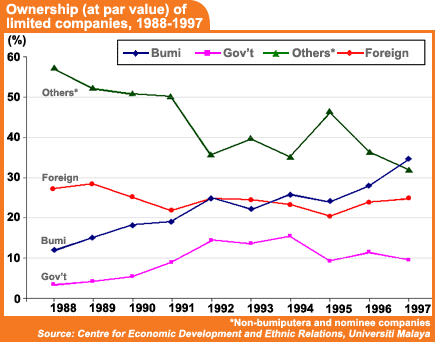
The research calculations was done based on the par value of the KLSE companies, not their market value, which generally considered as a more accurate measure of wealth.
Interestingly, the government which has always maintained that the country has yet to achieve the 30 percent bumiputera equity ownership target, also used par value calculations in its tabulation. However, the government's methodology involves some 600,000 registered companies.
Critics have alleged that the government undervalues the bumiputera share of corporate equity - which stands at 18.9 percent - to justify the continuation of the NEP and its related policies which give favourable treatment to bumiputeras.
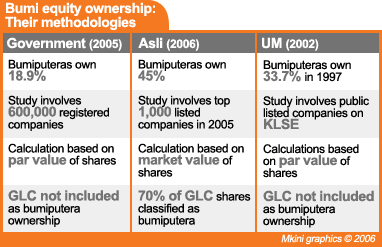 In recent months, a study by a local think-tank which estimated the bumiputera equity ownership at about 45 percent - almost double the government figures - had drawn widespread
consternation
from the authorities.
In recent months, a study by a local think-tank which estimated the bumiputera equity ownership at about 45 percent - almost double the government figures - had drawn widespread
consternation
from the authorities.
The government was quick to dismiss the findings, which was done by the Asian Strategy and Leadership Institute (Asli)'s Centre for Public Policy Studies. The public was also told not to question the credibility of the figures provided by the authorities.
At the height of the controversy, the government said it was prepared to reveal its methodology in its computing of the statistics. However, there has been no new development on the matter.


Report this comment
Are you sure you want to delete this comment?
This action cannot be undone.