




Some details of NEP equity methodology unveiled
The government has unveiled part of the information in its methodology to calculate the corporate equity ownership in the wake of a heated public debate on whether the 30 percent bumiputera share has been reached.
The government has unveiled part of the information in its methodology to calculate the corporate equity ownership in the wake of a heated public debate on whether the 30 percent bumiputera share has been reached.
The explanation was made in a five-page statement by Deputy Minister in the Prime Minister's Department Abdul Rahman Suliman during his ministerial winding-up on the Budget 2007 in the Dewan Rakyat this evening.
 Abdul Rahman - who told reporters at the Parliament lobby later that his explanation was in line with the government's move to reveal the methodology - said his statement today however represented only "part of the methodology".
The statement did not provide any breakdown of figures. He said a detailed methodology will soon be "discussed and finalised" by the government.
Responding to a barrage of questions from members of parliament on the matter during the Dewan Rakyat debate, Abdul Rahman said a special committee had been formed in the drafting of the Ninth Malaysia Plan to determine for the 'best methodology' in calculating the corporate equity ownership.
The special committee involves the Economic Planning Unit (EPU), Companies Commission of Malaysia (CCM), Securities Commission (SC), Bursa Malaysia and the government's investment corporation, Permodalan Nasional Berhad (PNB).
Par value vs market value
In computing the corporate equity ownership, the deputy minister said there are several main sources of information used, including:
- Records of a company's final statement for companies registered with the Companies Commission.
"The figures on share capital ownership of companies registered with the CCM is the main and most important information in computing the share capital ownership according to ethnicity," explained Abdul Rahman.
On criticisms that the government is using par value in its calculation, the deputy minister said it is a consistent yardstick that can gives a "complete picture" on the share capital for the overall corporate sector.
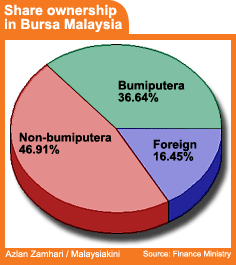 The Parliament has earlier been told that the bumiputera corporate ownership
was 36.6 percent
but this was based on 1,000-odd companies listed in Bursa Malaysia.
The Parliament has earlier been told that the bumiputera corporate ownership
was 36.6 percent
but this was based on 1,000-odd companies listed in Bursa Malaysia.
Abdul Rahman said while market value can also be utilised in the calculations, it will however be limited to listed companies.
"For companies that are not listed, market value cannot be used because the market value changes from time to time and it is influenced by factors that are not necessary reflect the actual share value and companies' performance," he added.
Therefore, he said the government's calculation by using par value is appropriate. The government has argued that its figures are based on 600,000 companies, where only 1,000 were listed on Bursa Malaysia.
"However, the government always refined its methodology in calculating the equity from time to time and is open to advice from any quarter to improve its calculation," he noted.
Most nominee firms under non-bumis
Meanwhile, on nominee companies, he said the Companies Commission has conducted surveys and it "showed that a large portion of the local nominee companies shares are owned by non-bumiputeras".
The deputy minister also pointed out that a large portion of government ownership is in public listed companies.
"Agencies and companies not categorised under any ethnic group but are considered of government importance are company shares owned by Employees Provident Fund, Khazanah Holdings as well as share capital under Finance Ministry Incorporated and others.
"However, equity held by public companies and individuals in GLCs (government-linked companies) are included in the equity calculations according to ethnic groups (by effective interest). This group includes part of the shares in Petronas, Telekom, TNB (Tenaga Nasional), MAS (Malaysia Airlines) and others," he added.
He said that the information regarding corporate equity ownership only takes into account equity wealth owned by Malaysian companies within the country, not overseas.
A specific study was conducted on strategic asset ownership in urban areas to provide a more complete picture on wealth ownership in the country.
"The results from that research showed that bumiputera commercial asset ownership in urban area is less than12 percent compared to the Chinese (72 percent) and Indians (almost 5 percent)," said Abdul Rahman.
UM research dismissed
During his winding-up, Abdul Rahman also dismissed a Universiti Malaya (UM) research paper which found the 30 percent bumiputera equity ownership had been reached about a decade ago.
He argued the methodology used in the research led by UM academician Dr M Fazilah Abdul Samad, only covered public listed companies on the Kuala Lumpur Stock Exchange, now called Bursa Malaysia.
"It used data that were available on the Bursa Malaysia and it did not differentiate between the bumiputera ownership and government-owned shares. Its definition of bumiputera equity include agencies which the government has interests.
"Therefore, the definition and interpretation used in Dr Fazilah's research was not accurate to reflect an actual picture on the bumiputera equity ownership," he said.
Fazilah's research was based on a 10-year analysis of bumiputera equity ownership between 1988 and 1997 of public listed companies on the KLSE. Its calculations was based on the par value of the shares.
However, her calculations which showed the bumiputera equity ownership hitting 33.7 percent in 1997 did not include government-linked companies as claimed by Abdul Rahman. Fazilah had put the government-held ownership at 9.5 percent in 1997 under another category.
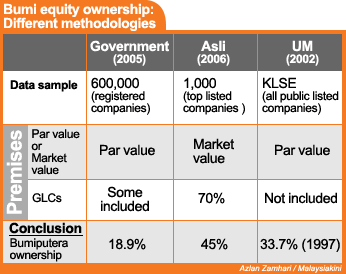
This is the second time the government had shot down findings from studies which contradicted the official figures of the bumiputera equity ownership at 18.9 percent.
The government has earlier rejected a study by think-tank Asia Strategy and Leadership Institute which estimated the bumiputera equity ownership at about 45 percent, based on market value of some 1,000 listed companies.


Report this comment
Are you sure you want to delete this comment?
This action cannot be undone.