




Q&A: Improve 'marketing' of Islam
exclusive In the second of a two-part interview, Perlis mufti Dr Mohd Asri Zainul Abidin, 35, considers the difficulties of maintaining the Islamisation process in Malaysia's multi-religious society.
He also speaks about intellectual influences on his thinking, the role of a mufti and the 'understanding' on which he accepted his two-year secondment from Nov 1.
exclusive In the second of a two-part interview, Perlis mufti Dr Mohd Asri Zainul Abidin, 35, considers the difficulties of maintaining the Islamisation process in Malaysia's multi-religious society.
He also speaks about intellectual influences on his thinking, the role of a mufti and the 'understanding' on which he accepted his two-year secondment from Nov 1.
Malaysiakini: There is a reawakening of Muslim consciousness. How do we balance this tajdid with the demands of a pluralist society? Such issues such as even extending Deepavali greetings have led to tensions recently in Malaysia.
Mohd Asri : The first reason behind these tensions is that information that has reached non-Muslims about Islam is received with a lot of fear. Non-Muslims do not have the most accurate information about Islam. Contributing to this is the fact that the Islamic movements are among the slowest in publishing their views and making these known. When they do write at all, it is in circumstances that make people upset.
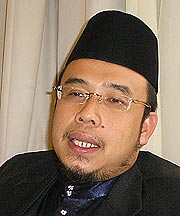 If only they can do it in a more professional manner, perhaps we can reduce a lot of misconceptions and misunderstandings. It's a matter of marketing Islam so that it is accepted.
Secondly, we cannot deny that every ideology will have opponents. Even when you have explained to the best of your ability, there will be those who disagree. There can never be a view that has everyone's agreement. That is a natural phenomenon from which Islam is not exempted.
We know that Muslims have at times been confrontational in their approach with non-Muslims. They have not propagated the religion (properly).
The third reason, tensions arise is because some quarters made it a tense situation.
Non-Muslims can live and have lived in Muslim areas for a long time. They've co-existed (throughout history) in relative peace. In many countries, they are richer than non-Muslims. Elements of antagonism against non-Muslims is not inherent in the majority of Muslims. Perhaps among a fringe minority, but not in most Muslims.
All humans can co-exist if there is no blatant injustice and no blatant oppression. If this can happen, where one can pray, go to church, go to temple, what more do you want? You can conduct business, you can eat, you can get rich. You can go abroad, you can see the rest of the world. Harmony and peace does not come about only because I celebrate your religious occasions and you celebrate mine.
 Let's not focus on these things (joint celebrations). Even if you celebrate my religious occasion and I celebrate yours, but in fundamental matters someone feels he has been treated unjustly, what is the use? Let's not use (differences over) the
kongsi raya
issue as an excuse to jeopardise the peace and harmony of this country - this is not the determinant of communal ties.
Let's not focus on these things (joint celebrations). Even if you celebrate my religious occasion and I celebrate yours, but in fundamental matters someone feels he has been treated unjustly, what is the use? Let's not use (differences over) the
kongsi raya
issue as an excuse to jeopardise the peace and harmony of this country - this is not the determinant of communal ties.
The determinants and elements of peace and harmony are the presence of justice, fairness, and that every community enjoys its rights to the extent that is appropriate. Just because I do not come to your Deepavali occasion does not mean I have oppressed you and just because you do not come to my religious occasion does not mean you have oppressed me.
Once that is agreed upon, then we can discuss whether or not religion permits Muslims to (extend, for example, Deepavali greetings). The factors external to the issue do not affect the issue itself. Only then can I give a view that would be considered reasonable.
I believe that wishing Gong Xi Fa Cai or Selamat Tahun Baru Cina or Merry Christmas or Selamat Hari Deepavali is all right. You are wishing for a safe, happy celebration of the occasion as long as this is done without invoking the names of deities or the spiritual values attributed to the deities.
Muslims cannot invoke such values of another religion. Our religious festivities are tied to our aqidah (beliefs). For instance, in celebrating Eid 'God wants you to fulfill your days (of fast) and glorify God for His guidance unto you and so that you may give thanks,' says the Quran.
These matters must be discussed in a proper environment. We have to give our opinions independent of the authorities' wants. We (muftis) have to be independent. I have to give my opinion independent of the government's position.
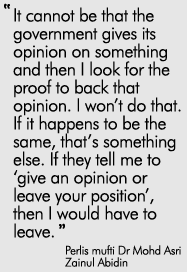
It cannot be that the government gives its opinion on something and then I look for the proof to back that opinion. I won't do that. If it happens to be the same, that's something else. If they tell me to 'give an opinion or leave your position', then I would have to leave.
Tell us about your background - where did grow up, where did you study, what/who were your influences?
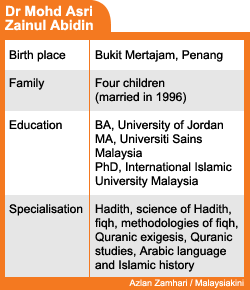
I was born and raised in Penang. I studied for my bachelor's degree in Jordan. I completed my Master's degree at Universiti Sains Malaysia and my PhD at Universiti Islam Antarabangsa Malaysia.
 Alhumdulillah
, I've been an avid reader ever since I was young. I read many different books and different thinkers and, as is usually the case when a person reads different books, the mind of that person also responds accordingly. At certain stages of a person's life, a person may move in accordance to the books of a particular current thinker.
Alhumdulillah
, I've been an avid reader ever since I was young. I read many different books and different thinkers and, as is usually the case when a person reads different books, the mind of that person also responds accordingly. At certain stages of a person's life, a person may move in accordance to the books of a particular current thinker.
I think the person who has attracted me most to his thoughts and for the longest time is Ibn Taymiyyah (1263-1328) because of the firmness of argumentation, methodology and excellence of his deliberations on fiqh , and because he lived his life together with the ummah (Muslim community).
He was not one to formulate theories that were divorced from the worldly circumstances of the ummah . He did not just theorise, but he was also part of the struggle. Nobody can deny that he was a mujaddid , a revivalist, who was the catalyst for revivalism.
History has proven that Ibn Taymiyyah gave rise to disciples who excelled, such as Ibn Qayyim Al-Jawzi (1292-1356), Ibn Kathir (1273-1301). Most of the revivalists in (modern) times are not averse to citing the name of Ibn Taymiyyah because of his ideas. Ibn Taymiyyah has been called 'Sheikh al-Islam'.
People have expressed wariness about you being a Wahhabi (a purist, literalist strain of Islamic thought predominant in Saudi Arabia derived from late 19th century scholar Muhammad Abdul Wahhab). The Wahabbi are accused of being intolerant of cultural and spiritual variations of Islam. How do you feel about being called a Wahhabi?
This is among the bad habits of conservatives. When they cannot answer questions on some matter, they just label the person asking the question, since this is the easier thing to do. This is the habit of conservatives who seek to control the religion, just as the Catholic Church sought to do long ago. They wanted to control the religion and they did it by simply labelling (dissenters) as apostates. Alternatively, whoever criticised them were assumed to be enemies of Christianity.
Similarly, whoever comes to these (Islamic) conservatives, they label as Wahhabi. There are many who have been accused of being Wahhabi but do not themselves know what Wahhabi means. Even the accusers themselves do not know what it means.
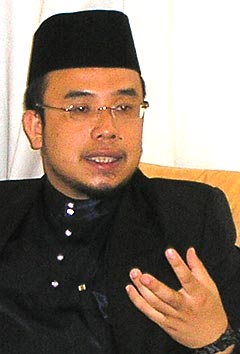 I, for one thing, studied in Jordan. I did not study in Saudi Arabia. The books of Muhammad Abdul Wahhab have not influenced my thoughts much. I think they number the least of the books that I have read compared to the luminaries of whom I am fond.
The proponents of the Bareilvi Muslim persuasion in the Indian sub-continent - who practise grave worship and saint worship - in order to counter the (strict monotheist) Deobund scholars who are of the Hanafi (school of fiqh ), merely label the Deobundi as being Wahhabi.
Some of the Deobund scholars have even written about how they only found out what Wahhabi means after we were accused of being Wahhabi. Even if some of the Deobund scholars are influenced by Sufi thought.
Long ago, the entrenched traditionalists in Malaysia accused fellow villagers who went against them of belonging to the Kaum Muda (Young Turks) and of being anti-religion, when they were only seeking to revive (Islam). Such is the case, for example, of Sheikh Syed Al-Hadi in the early years, Abu Bakr al-Bakir, Burhanuddin Helmi and so on. They were accused of all kinds of things.
For convenience, whenever people ask (pertinent questions), conservatives lump them all together and say, 'Be careful, he is Wahhabi'.
Do you think this will affect your ability to reach the Malay-Muslim masses whose only impressions of the Wahhabi are negative?
I'm not sure, but alhumdulillah , up to this moment, the youth and university students have shown a strong positive response and I frequently receive invitations from them to speak. In some states I am defended (in face of accusations of being a Wahhabi).
(I have been appointed as Perlis mufti although) I am not from Perlis. Perlis has no connection to (the traditions of) Abdul Wahhab. There is a revivalist movement there but in the early stages of that movement they did not even have the books of Abdul Wahhab.
 We want to highlight this tendency of trying to avoid responding to arguments just because someone comes with a different religious viewpoint. The conservatives just resort to labelling, as if such labels suffice. This is the answer, they say. 'Wahhabism' is a label used by certain quarters in order to avoid addressing questions.
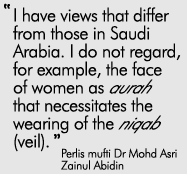
I've actually written an article entitled Katakan tidak kepada Wahhabi (Say no to Wahhabism). I have views that differ from those in Saudi Arabia. If Saudi Arabia has been labelled as (the seat of) Wahhabism. I do not regard, for example, the face of women as aurah that necessitates the wearing of the niqab (veil).
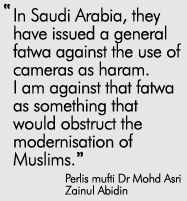
In Saudi Arabia, they have issued a general fatwa against the use of cameras as haram . I am against that fatwa as something that would obstruct the modernisation of Muslims.
You were appointed on Nov 1. What is so special about muftis, anyway? Apart from one or two, muftis seem to be in the background. What can a mufti do?
It's difficult to speak on this as there may be some quarters who would feel slighted... What can a mufti do? He can just attend meetings to discuss or formulate a fatwa , and he can give his views on a matter. Even then, that does not mean it will be gazetted.
In Malaysia, if a particular mufti gives a view on something, sometimes it does not trigger any significant response. Or, there is merely silence. Some might even ask whether he really is a mufti at all. Perhaps it shows that such people are not an influence on the ummah . There are others, however, who give views and these are followed by many people.
I feel the institution of mufti has to be improved. There are some muftis who are more effective than others.
 I do not know exactly what the criteria are for the appointment of muftis, but it cannot be denied that the appointment involves elements of political needs and the needs of certain quarters.
The important thing is, of course, that the criterion of knowledge must be fulfilled, and there are some who are qualified in terms of knowledge but are not chosen. Because of political, local or (state) palace considerations, they do not fulfill the criteria.
It is the factor of the mufti's personality, not his position.
The only real weapon that can be wielded effectively by a mufti, if he is at all effective, is when he has the trust of the ummah . That is more than all the fatwa others can muster. There are many scholars in the world of Islam who are not official muftis but their fatwa are taken more seriously than the official muftis.
It is because of the strength of his character that the ummah would recognise one or other mufti.
Ibn Taymiyyah in his life was never an official mufti. Hassan Al-Banna (1906-1949) also figures in the works of many intellectuals, though he was not a mufti. Unofficial muftis are heeded in the Islamic world when they are known to possess a lot of knowledge.
Yusuf Al-Qaradhawi is listened to because of his knowledge, not because he is the mufti of Qatar. Many people don't even know whether he is mufti or not. Another mufti who I think has been listened to significantly in modern history is Sheikh Abdul Aziz Abdullah bin Baz (1909-1999), the late mufti of Saudi Arabia, because of his knowledge. We respect the new mufti who replaced Bin Baz, but he does not have the same effect as Bin Baz.
There is speculation that you placed certain conditions in accepting your post. Is this true? What were those conditions?
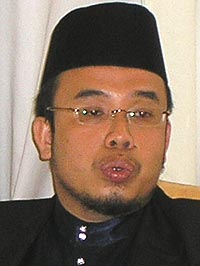 I had no conditions, at least not written ones. There is just an understanding between me and the authorities.
Generally speaking, the understanding is what my role as a mufti should be - to give fatwa and to give views on and to discuss fatwa . I cannot be functioning as a shadow behind some pre-eminent figure, following his every step forward or retracing my steps so that he can take certain steps backwards.
My personality (as mufti) cannot drown in the personality of someone else. If the mufti's identity drowns in the identity of the authorities, then what is the use of a mufti? No need, then, to seek people with knowledge. Look for any bloke who can say 'yes' to everything.
Part 1
Mufti: Religious leaders can be challenged
Q&A: Loosen conservative grip on Islam


Report this comment
Are you sure you want to delete this comment?
This action cannot be undone.