




Why par value measurement is flawed
Following the publication of a study on 'Corporate Equity Distribution: Past Trends and Future Policy' by the Centre for Public Policy Studies (CPPS) there has been public debate on the extent of ownership of equity capital by ethnicity in the Malaysian economy and the methodology employed by the government.
Central to the debate has been the divergence in the estimates contained in the Ninth Malaysia Plan and the CPPS study. The debate has revolved around two key issues, namely: what should be incorporated in the calculation of equity and the basis of valuation.
Public discussion has been further fueled by the release of new estimates, along with some information on the methodologies used by the Economic Planning Unit (EPU) of the Prime Minister's Department.
In addition to the CPPS estimates and those issued by the government, a study conducted by Dr Fazilah Abdul Samad of the Universiti Malaya has also become available.
Following the publication of a study on 'Corporate Equity Distribution: Past Trends and Future Policy' by the Centre for Public Policy Studies (CPPS) there has been public debate on the extent of ownership of equity capital by ethnicity in the Malaysian economy and the methodology employed by the government.
Central to the debate has been the divergence in the estimates contained in the Ninth Malaysia Plan and the CPPS study. The debate has revolved around two key issues, namely: what should be incorporated in the calculation of equity and the basis of valuation.
Public discussion has been further fueled by the release of new estimates, along with some information on the methodologies used by the Economic Planning Unit (EPU) of the Prime Minister's Department.
In addition to the CPPS estimates and those issued by the government, a study conducted by Dr Fazilah Abdul Samad of the Universiti Malaya has also become available.
Origins of equity targets
In the aftermath of the May 13, 1969 tragedy, the National Operations Council directed the EPU and other agencies to develop a set of policies and plans to achieve the goals for promoting national unity and harmony. There was near unanimity on the need to reduce ethnic disparities.
As far as the goal of achieving inter-ethnic economic parity was concerned, according to the Second Malaysia Plan (1971-75), its aim was that "within two decades, at least 30% of the total commercial and industrial activities of all categories and scales of operation should have participation by Malays and other indigenous people in terms of ownership and management."
When the New Economic Policy (NEP) was introduced, the government's explicit aim was to ensure that wealth was more equitably distributed between ethnic communities. The government, however, subsequently focused its attention on merely tabulating ethnic ownership of corporate stock.
There was a reason for this. It became patently clear to the government that formulation of new policies and setting of new targets would demand a comprehensive assessment of the prevailing patterns of ownership of capital, land and other tangible assets by race and ethnic origins. Officials charged with the responsibility for preparing and formulating new policies immediately faced daunting information gaps.
For the immediate tasks, all available information was assembled and analysed. For instance, the records of the Registrar of Companies were analysed to obtain benchmark estimates of equity capital by ownership groups divided by foreign and domestic, and the latter sub-divided by ethnicity. All equity was valued at par in the absence of full accounting information.
This was the basis for the estimates contained in the Second Malaysia Plan. To fill the glaring data gaps, the Department of Statistics mounted a crash programme to collect comprehensive data with breakdown by races in the household and establishment surveys. It started for the first time an 'Ownership Survey' of limited companies requesting data on paid-up equity share capital.
The Ownership Survey provided a basis for somewhat more elaborate and refined estimates of the net worth of branches of foreign incorporated companies. The net worth of these companies was accepted to be equal to the paid-up capital (par values) of the limited companies in Malaysia. The treatment of the branches of foreign incorporated companies indicated that the net worth of the company should have been the basis of measurement.
The Department of Statistics should have similarly valued the net worth of public-listed companies that were incorporated in Malaysia, but the workload of such valuation may have prevented the department from doing so. As for the private limited companies, their par value could have been continually revalued to secure an approximate true value. This does not appear to have been done.
Thus, the methodology adopted in the 1970s, despite its inherent weaknesses and flaws, has largely remained in place. It must also be noted that the methodology has not been fully described in the succession of Plans and Mid-Term Reviews thereof.
Ownership of share capital
It should be recalled that a central part of the NEP concerned the issue of ownership of share capital of corporate entities.
The immediate objectives were two fold:
- establish benchmark estimates of ownership of the share capital of limited companies by Malaysians and non-Malaysians with a further breakdown of the Malaysian-owned capital by Malays, Chinese, and Indians, and
It is important to recall that the primary purpose of these calculations was to obtain estimates of distribution of corporate wealth and the setting of targets for restructuring.
The key elements of the calculations need to be understood. The entities covered all limited companies (both public-listed and private) registered and reporting to the Registrar of Companies in accordance with the provisions of the Companies Act.
The statutory provisions of company law required all companies to file annual reports to the registrar. These reports included, inter alia, names of all shareholders, the number of shares held by each, the par valuation of those shares, a list of directors, total number of shares issued, and some limited financial information. No information was available regarding ethnicity or citizenship of shareholders, the companies' capitalisation, or the net-worth of the company in question.
Although the data available in the files maintained by the Registrar of Companies supplemented by data collected through the Ownership Survey could have allowed the Department of Statistics to determine market value and wealth distribution better, the approach taken was to categorise all companies into public and private, locally incorporated and foreign incorporated.
For each company, the shareholder lists (from the Registrar of Companies) were analysed and the shares held were categorised as belonging to 'Malays', 'Chinese', 'Indians', 'Other individuals and locally controlled companies' and 'Foreign' on the basis of name of the holder.
All valuations were done at par or nominal values and no effort was made towards alternative valuations which are normally used in commercial accounting (e.g. net-worth, market capitalisation, shareholder funds etc.)
 The system of valuation at par was clearly flawed as it deviated from normal accounting conventions. These benchmark valuations understated the true worth of the corporate sector of the Malaysian economy when the NEP was launched. No distinction was made between corporate entities of different sizes, or their respective benchmark net worth.
The aggregate value of equity at par values was a poor approximation as well as an underestimate of the benchmarks valuations. By continuing to use par valuation, the updated values reported in subsequent periods merely added the number of new shares issued and took no account of the growth in value of existing shares.
What is pertinent to note is that this flawed system of valuation, adopted for ad hoc reasons in the early 1970s, continued to be used from the Mid-Term Review of the Second Malaysia Plan to the Ninth Malaysia Plan.
The continued use of par valuation has led to a gross understatement of the true value of wealth or capital represented by the corporate sector. This method takes no account of capital appreciation. Indeed, growth in the stock of assets owned by the corporate sector has increased rapidly, and represents wealth accumulation.
Exclusion of GLCs
A second crucial dimension concerning the five-year Malaysia Plans related estimates of equity calculations done by EPU is that of coverage.
There is uncertainty concerning the coverage of entities included in the calculations and the extent to which changes have occurred over time. An issue of some importance is the exclusion of certain entities, for example, Petronas - the largest and richest corporate entity in Malaysia - and Felda from the earliest estimates.
Public enterprises (not incorporated under the Companies Act) were wholly excluded, e.g. the SEDCs (state economic development corporations). Other government-owned companies were only included in the initial calculations if incorporated under the Companies Act.
 However, with privatisation and the launch of GLCs (government-linked companies), these entities should have been included as they now belonged to the corporate sector. There is thus no reason for these to be excluded from the overall calculations. These changes have affected comparability and consistency of the resulting estimates as published in the various five-year Malaysia Plans and the Mid-Term Reviews.
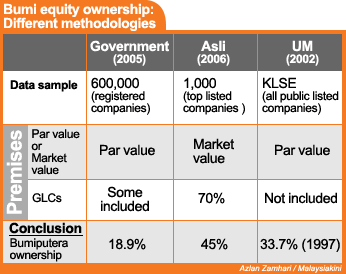
The CPPS (Centre for Public Policy Studies) study took account of these limitations in methods and coverage and attempted to develop new estimates. The CPPS study, in order to correct for the under valuation arising from the use of par values, chose to use market capitalisation as the basis for valuation.
The CPPS study was limited to the equity capital of companies listed on the Bursa Malaysia not by choice but by data constraints, as it did not have ready access to data on the 600,000-odd private limited companies for which information is available to EPU from the Ownership Survey and other surveys conducted by the Department of Statistics.
Thus, the CPPS study took account of all listed companies, including the listed GLCs, so as to ensure the totality of publicly listed companies. It should be noted that GLCs account for approximately a third of the total market value of the equity of listed companies. The exclusion of shares held by the government within GLCs, as is the case in the EPU calculations, can by any yardstick be considered inappropriate in the assessment of assets attributable to listed companies.
 The exclusion has further distorted the gross undervaluation (because of the use of par valuation) reflected in the EPU estimates. The CPPS, it must be stressed, was limited by data constraints, as CPPS had no access to the specific equity values held by private companies, individuals and the government within listed GLCs.
The CPPS study was nevertheless explicit in stating the rationale for attributing 70 percent of the total GLC equity to bumiputera interests. Further refinement of the CPPS estimate is desirable and should be attempted.
The CPPS study has been castigated by some quarters and attacked on what appear to be political grounds. Some commentators and critics have focused primarily on the finding that 45% of equity in publicly listed companies can be attributed to bumiputera interests.
While there has been an acknowledgment that there are differences in methodologies employed by CPPS and EPU, official statements have not explained or fully defended the EPU's estimation methods. It is also pertinent to point out that in the various statements made by public officials no attempt has been made to refute the CPPS methodology of using market valuations.
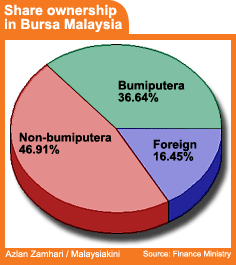 During his reply to a oral question from MP for Gua Musang, Tengku Razaleigh Hamzah, Deputy Minister of Finance Dr Awang Adek, revealed that bumiputera own 36.6% of equity ownership at Bursa Malaysia valued at RM78.4 billion as at Dec 31 last year. This compared to 46.9%, or RM100.4 billion, for non-bumiputera, and 16.45%, or RM35.2 billion for foreigners.
Although a full disclosure of the method and coverage was not provided, the estimates appear to be based on market capitalisation of listed companies. The methodology, at least in terms of the basis of valuation, appears to be similar to the one employed by CPPS.
It should be noted that the 2002 Universiti Malaya study by Dr Fazilah was somewhat similar to the CPPS study in that it made use of the data pertaining to all listed companies traded on the Bursa Malaysia and used market capitalisation as a basis for valuation.
The deputy minister's reply offered for the first time a government response that dealt with one aspect of the critique by CPPS and other commentators. It dealt with the basic methodological issue concerning the basis of valuation. This statement was also in the general spirit of the prime minister's remarks that the government had nothing to hide and would be transparent and make public the basis of the calculations.
The new estimates were comparable in part to the CPPS figures compared to the estimates contained in the Ninth Malaysia Plan. The statement offered a basis for starting an informed and rational basis of discussion with the ultimate objective of developing a consensus on the appropriate measurement of equity and its distribution.
It is pertinent to point out that the three studies (UM, CPPS and the Finance Ministry estimates) broadly used a similar approach valuation based on capitalisation and covered approximately the same set of companies made up of listed entities. It is salient to also point out that all three exercises yielded an estimate of bumiputera shareholdings that broadly converged - 33.7% to 44% - or well above the estimate of 18.9% cited in the 9th Plan.
Government's retraction
However, the press statement by Minister in the Prime Minister's Department Effendi Norwawi on Nov 13 retracted the deputy minister's and noted:
"The methodology used in deriving the estimated figure of 36.64% for 2005 is inaccurate because it apportioned 45% of equity ownership held by nominee companies to the bumiputera. Instead, based on a survey conducted by the EPU on equity of nominee companies, bumiputera ownership in such companies is only at 8.3%. Not only that, the estimated figure of 36.64% so derived, assumed that the equity held by government agencies are also owned by bumiputera."
The statement went on to defend the EPU methodology based on par valuations on the grounds that the "methodology used by the technical committee is based on the best practice available and has been consistently used. The methodology used is recognised by international financial bodies, such as the World Bank, the International Monetary Fund and the Asian Development Bank."
The minister's statement went on to assert that: "The government, therefore, wishes to reaffirm that the equity ownership of bumiputera in the corporate sector, as at Dec 31, 2004, was 18.9% as clearly set out in the Ninth Malaysia Plan."
 The Nov 13 statement raises a host of issues. It is not only a retraction of what was stated by the deputy minister of finance on Nov 7; it reaffirms the use of par valuations and it provides an unsatisfactory estimate of the allocation of nominee company holdings based on a partial and incomplete survey.
The statement refers to the work of a technical committee that developed the methodologies but offers little insight into the actual approach used in the preparation of these estimates. The statement also makes claims that the methodology used by the committee is based on the best practice available and has been consistently used by the government.
There is the further assertion that the methodology used is recognised by international financial bodies, such as the World Bank, the International Monetary Fund, and the Asian Development Bank.
Brief comments on each of these issues are appropriate:
Par valuation
The government's case for using par valuation is weak. The NEP originally emphasises the issue of equitable corporate wealth distribution. Therefore, it is imperative that the yardstick employed is an accurate measure.
It is important that equity measures take account of positive or negative changes in value. Thus nominal holding gains/losses that may accrue during the accounting period to the owners of financial and non-financial assets and liabilities because of a change in their prices must be factored in.
Holding gains are sometimes described as "capital gains", but "holding gain" is a preferred concept because it emphasises that holding gains accrue purely because of holding assets over time without transforming them in any way. The use of par valuation takes no account of these factors and runs counter to basic accounting principles.
The EPU has argued that figures on "market capitalisation" are not available in respect of non-listed limited companies and therefore par values need to be relied upon. This contention is only partially true. All limited companies irrespective of their listing status are required by law to prepare and submit their annual accounts, which includes their balance sheets.
All balance sheets record the estimates of the companies' net worth, net equity of shareholders and/or shareholder funds. These permit the calculation of capitalisation approximating "market" value.
Adoption of a method approximating market capitalisation is not only justified by economic and accounting norms but is also feasible as the data can be collected with relative ease.
Recognition of methodology
The government's claim that its methodology is recognised by international financial bodies, such as the World Bank, the International Monetary Fund and the Asian Development Bank, is somewhat surprising. This statement is also surprising given that these international bodies have not been engaged generally in calculations of corporate wealth, except in the context of general macro-economic studies.
To the best of our knowledge, these institutions have relied upon the guidelines contained in the universally accepted 1993 System of National Accounts (SNA). The SNA does not use par valuations. Thus, in the interest of complete transparency, the EPU should cite in full the references that the international financial institutions have endorsed the use of par values.
It is also unclear from the government's press statement as to why experts from the accounting and statistical professions were not included in the membership of the technical committee.
Allocation of nominee company holdings
The explanation concerning nominee companies can be legitimately questioned on methodological and statistical grounds. The estimate of 8.3% bumiputera equity in nominee companies appears to be based on data from an EPU survey of 359 nominee companies, of which only 179 provided responses.
The key issues are: are the 359 companies the total of all nominee companies; who owns these shares; and how much of this equity is that of public-listed companies. Clearly what are needed are the details about ownership data of shares held through nominee companies, and not merely the nominal share capital owned by the nominee companies.
 When less than half of the respondents provided responses, and the amounts of the total equity share capital reported on were not known, the estimate cannot be evaluated for reliability. Indeed,
sampling technique does not work in this case, since the non-respondents could have unique features.
It is far from clear how the data reported by the responding 179 companies was extrapolated to the entire 359 nominee companies. EPU is under a clear obligation to disclose in full the survey methodology that it employed.
There is a further larger question about the need for the category of "nominee companies" at this stage of our economic development, more so when the government now claims that it is practicing a more open and transparent form of government.
Allocation of GLC equity
There is an unresolved issue of how the GLCs (government-linked companies) should be treated. Their total exclusion from official calculations cannot be justified. They exist and constitute almost a third of the total value of quoted equity capital. What can be debated however is how the shares owned by the GLCs should be distributed.
The CPPS study argued a case for 70% to be allocated to bumiputera. Alternative ratios could equally be justified, e.g. current population ratios.
There is also the argument that shares owned by the GLCs belong to all Malaysians. If so, there should still be a separate category for GLCs to provide a more accurate picture of distribution of wealth distribution.
In this context, we respectfully point to the following paragraph in the Mid-Term Review of the Second Malaysia Plan which clearly laid out the rationale for the treatment of government-owned shares.
"The task ahead is indeed formidable but by no means impossible to accomplish. While there will be greater Malay private savings to finance expanded share capital ownership as the economy grows and as Malay participation in economic activity expands, a significant part of the financial resources required in the earlier years will have to come from the federal and state governments and institutions which harness Malay savings.
"These resources will have to be used to acquire a significant part of the increases in the growth of the total financial stock of the economy and to hold them in trust for the Malays and other indigenous people until they are in a position to acquire them from their own savings..."
The same document went on to state:
"The degree of restructuring which is required in the ownership of assets will not result in loss and deprivation on the part of other Malaysians, as the process of restructuring is to be undertaken in the context of a rapidly expanding economy. There should, therefore, be no grounds for fear or anxiety on the part of other Malaysians that government intervention in the private sector on behalf of the Malay community will lead to deprivation of the rights or prospects of non-Malays."
These statements show that from early on, government intervention in the private sector and government acquisition of share capital was seen as holding assets in trust for the Malays. It is clear that had these policies been strictly applied, the government's shareholdings within GLCs should not be excluded from the overall calculations, as the Ninth Malaysia Plan does, but would probably have been wholly attributed to the bumiputera category.
Set up panel of experts
The method of calculation employed by the government and EPU in the context of the various five-year Plans has until recently been shrouded in secrecy.
The various five-year Plans, the Mid-Term Reviews of these plans and official pronouncements have glossed over the issue of a proper evaluation of wealth distribution. The entire focus has been on the percentages with little said about the basis of calculations.
It is with the publication of the CPPS study that the public has become aware of the basis of these official calculations, which have been central to economic policy formulation in Malaysia for some three and a half decades.
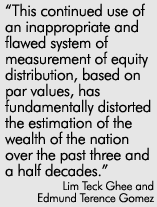
This continued use of an inappropriate and flawed system of measurement of equity distribution, based on par values, has fundamentally distorted the estimation of the wealth of the nation over the past three and a half decades.
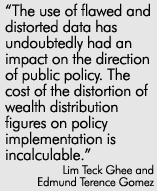
The use of flawed and distorted data has undoubtedly had an impact on the direction of public policy. The cost of the distortion of wealth distribution figures on policy implementation is incalculable.
There is a growing and widespread perception that the government must abandon the present system of valuation and immediately move to the use of standard internationally accepted basic commercial accounting concepts that provide a true value of companies, based on concepts of net-worth, capitalisation or universally accepted notions of equity value. There is no rational and objective argument to the continued use of par valuation.
It is in this context that the recent statements by the prime minister and deputy prime minister concerning the need for transparency concerning the statistics relating to the ownership of corporate equity should be warmly welcomed.
The prime minister, in remarks to the media (on Oct 16), indicated that Malaysians have the right to question the government or to seek answers on issues when referring to calls for the public disclosure for the EPU methodology and data.
The prime minister is quoted to have said: "If people question, then we must have answers. We do not have a problem. If we are transparent, what is the problem?"
His remarks reinforced the statement by the deputy premier a day earlier, that the government's methodology to calculate bumiputera equity ownership was no secret and could be disclosed.
In the spirit of these statements, it would be most appropriate for both the prime minister and the deputy prime minister to direct EPU to make public in full the methodologies, classifications and assumptions it used in estimating the equity ownership figures that were listed in the Ninth Malaysia Plan. Concurrently, EPU should be asked to publish the underlying detailed data sets it used.
The prime minister should as a matter of urgency establish an independent Panel of Experts to review the current methodologies and practices used by the EPU and other government agencies, and evaluate the data sources used in computing the ownership of corporate equity.
The panel should, based on its review, make comprehensive recommendations concerning methodological modifications that are needed, taking into account professional statistical and accounting best practices and standards.
The panel's terms of reference should be wide enough to permit it to consult with knowledgeable professionals and appropriate bodies in developing new standards of measurement. The panel, to enable it to enjoy credibility, should include professional accountants, economists, corporate analysts, academicians and statistical experts and be representative of both the public and private sectors. Its work should be transparent and made available to the public.
The panel should be charged with completing its work speedily and new agreed estimates should be available for use in the preparation of the Mid-Term Review of the Ninth Malaysia Plan.
We believe that it is in the national interest that these steps are taken immediately with the objective of defusing unhealthy speculation and restraining the polarising trends associated with this issue.
What the nation needs is a clear and agreed set of yardsticks that contribute to building national unity rather than becoming tools for fueling divisiveness.
DR LIM TECK GHEE is former director of Asli's Centre for Public Policy Studies and Dr EDMUND TERENCE GOMEZ is research coordinator at the United Nations Research Institute for Social Development.


Report this comment
Are you sure you want to delete this comment?
This action cannot be undone.