




Nazir calls for 'thorough review' of NEP
A top local banker, Nazir Abdul Razak - who is also the brother of Deputy Prime Minister Najib Abdul Razak - has called for a thorough review on the controversial New Economic Policy (NEP).
A top local banker, Nazir Abdul Razak - who is also the brother of Deputy Prime Minister Najib Abdul Razak - has called for a thorough review on the controversial New Economic Policy (NEP).
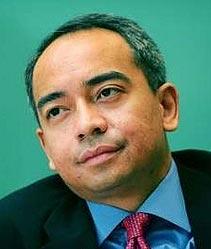 Nazir - who is the chief executive officer of investment giant, the CIMB Group - said he believed that the multiracial society of Malaysia will need the NEP "for a long time to supplement conventional economic instruments to achieve growth with equity".
"But I also believe that a thorough review of the NEP and its implementation has become critical," he wrote in the most recent issue of financial weekly The Edge under a special focus on 'How to make Malaysia competitive'.
Nazir's stand contradicted his elder brother's, who has defended and advocated for the NEP - a racial-based affirmative policy that gave preferential treatments to the bumiputeras enacted in the 1970s.
"In our little corner, in the capital markets, for instance, if we have moved to free pricing for IPOs (initial public offerings), how dangerous is that we insist that bumiputeras have preferential allocation?" said Nazir.
"Potential issuers today are being courted by exchanges throughout the world; in its present form, the NEP discourages companies from listing on Bursa Malaysia; how helpful is that to the country or indeed the bumiputera community?" he asked.
Success taken for granted
The banker said he felt "sad" that the success of the NEP in eradicating poverty and removing identification of race and economic status, as well as maintaining racial harmony, has been taken for granted.
He opined that the public has ignored other economic progress measurement such as employment and net wealth measured on all asset classes.
"We are obsessed instead with corporate equity ownership when we know, not least from watching the fallout following the financial crisis, that large equity ownership is often synonymous with unsustainable debt," said Nazir.
The NEP was a heated topic late last year when two studies from a local think-tank and an university revealed that the 30 percent target for bumiputera corporate equity ownership had been achieved.
The government however rejected this and maintained the figure stood at 18.9 percent.
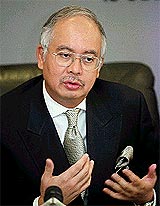 During the height of the debates, Najib had warned groups not to dispute the official NEP figure and
dismissed
the assertion that the policy had only benefitted those at the top.
During the height of the debates, Najib had warned groups not to dispute the official NEP figure and
dismissed
the assertion that the policy had only benefitted those at the top.
The deputy premier said the affirmative action policy will be maintained as the government had succeed in reducing poverty rate drastically via the NEP while he argued the non-bumiputeras also "received the spillover and contracts from the government and also certain approvals".
Judicial reform
Meanwhile, in the same commentary, Nazir also asked for a review on the judicial process to "make it faster and more predictable".
"Just from a banker's standpoint, when I compare our legal process for loan recovery to, say, Singapore, the consequential economic loss to the nation is huge. It's not just legal fees or cost of delays.
"When it is so difficult to recover money from defaulters, good borrowers ultimately bear the cost as banks have less to lend to them and furthermore, banks will factor in much higher 'loss given default' in pricing of loans," he pointed out.
Nazir was among the top 20 corporate figures and society leaders who were invited to contribute what they feel was necessary to be done to take Malaysia forward in the special series published by the financial weekly.
Other contributors included Transparency International Malaysia president Ramon Navaratnam, Umno's Kota Baru MP Zaid Ibrahim, Maybank president and chief executive officer Amirsham A Aziz and the Associated Chinese Chamber of Commerce and Industry Malaysia president William Cheng.
The CIMB group was in the limelight recently after it backed a merger among three plantation conglomerates in a combined value of RM31.4 billion and will provide seed financing for the deal.
The investment giant wants to boost Malaysia's status as a top palm oil producer.


Report this comment
Are you sure you want to delete this comment?
This action cannot be undone.