




'Secret reservoir' blamed for floods
Residents of Kota Tinggi were not unduly worried when the heavy rain continued to pour on Dec 18 last year. After all, the rain was pelting the whole of Johor.
However, they had no idea of what was in store.
Residents of Kota Tinggi were not unduly worried when the heavy rain continued to pour on Dec 18 last year. After all, the rain was pelting the whole of Johor.
However, they had no idea of what was in store.
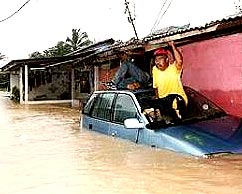
The next day, the banks of Sungai Johor, which flows through the town, burst. Kota Tinggi became the worst-hit town in the floods that struck the southern state, not once but twice - in last December and January this year.
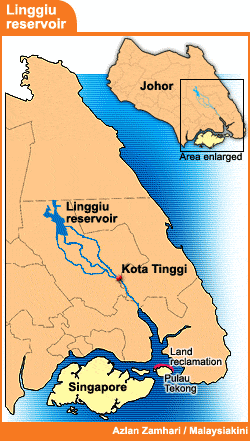 Menteri Besar Abdul Ghani Othman said Kota Tinggi was hit not just by heavy rainfall but also large quantities of water released from a "catchment area" in the surrounding reserve forest.
He added that the topography of the district turned Kota Tinggi into a 'flood trap' and the whole town was subsequently submerged.
According to a local activist, the culprit is obvious - the Linggiu Reservoir, located some 40km north of the town.
The area which is completely under Singapore's control is massive - one-third the size of the island republic.
He claimed that this 'secret reservoir' belonging to the Singapore government" played a vital role in the floods which hit Kota Tinggi.
"In the first place, the location of the reservoir itself is wrong. It poses a danger for the towns and villages along the foot of the area," said Zaaba Abdul Samad when met recently.
Armed with the topography map of the area, he showed that the reservoir was located on higher ground than the surrounding areas.
"What I want to know is why the Johor government agreed to build this reservoir here?" he asked.
Details sketchy
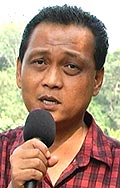 Zaaba (
right
) has been trying to dig up details of the agreement between Johor and Singapore but there is next to nothing in the public archives. The only thing he discovered was a Gazette Plan for the reservoir.
Zaaba (
right
) has been trying to dig up details of the agreement between Johor and Singapore but there is next to nothing in the public archives. The only thing he discovered was a Gazette Plan for the reservoir.
"We have public documents for the other two reservoirs that supply water to Singapore. Everything is intact. But for the Linggiu Reservoir, nothing is available. This is strange," said Zaaba, a local businessman who has deep interest in Johor's heritage.
It is not just public documents on the reservoir that are scarce but even its existence is not known to many.
The first signboard indicating the location of the reservoir comes after some 40km along the Kota Tinggi-Kluang main road. This is near a small town called Bandar Tenggara.
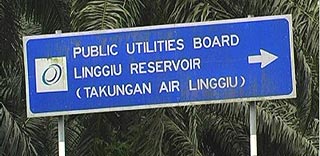 From there, a straight road leads to the Linggiu Felda scheme and here lies a second, smaller signboard. Both the signboards are in English.
The reservoir lies 11km from the entrance to the Felda scheme. The road leading to the reservoir is bumpy as a result of lorries plying the route to a sand quarry along the way.
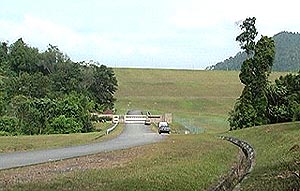 The road suddenly leads into a well-maintained area with manicured lawn, flower plants and little shrubs on both sides. Much like Singapore.
At the end of the road, is a huge fenced area and a signboard warning against trespassing. Security personnel are stationed at the main gate.
Locals, who were spotted fishing in the area, told malaysiakini that security was tight at the reservoir.
"The security personnel are not locals. If they are, we would know them. They are from there (Singapore). So are the people working in there," they said.
Malaysiakini was unable to access the reservoir as the main entrance was locked and during the visit no security personnel were in sight.
Safety concerns
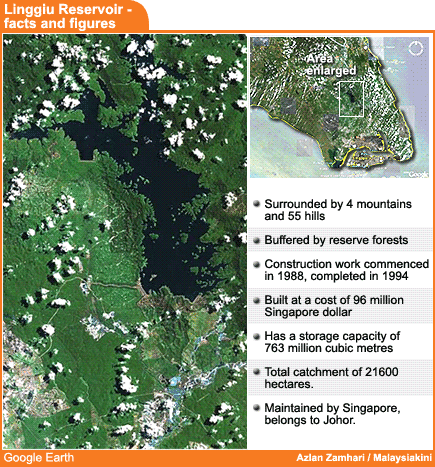
The reservoir - which is located about 88km north of Singapore - is surrounded by four mountains, 55 hills and buffered by reserve forests in all sides. There are dozens of small rivers and water sources running into the huge lake.
 "This is an ideal water catchment area. There will never be lack of water here. The collected water is transferred downstream through Sungai Johor to a water treatment plant in Senai. From there, it is channelled to Singapore," explained Zaaba.
"However, the immediate concern is the safety of the thousands of people living around the base of this reservoir.
"If an accident happens at the Linggiu Reservoir, the escaping water will surely cause massive flooding," he noted.
 There are numerous other issues pertaining to the Linggiu Reservoir. Many local activists said details regarding the building of the reservoir and its subsequent maintenance were sketchy at best.
"There are no public record of any details on how long the reservoir will function and what other payments are being made by the republic to the Johor state government," said an activist, who wished to remain anonymous, when met.
He said the only payment made by the Singaporean government was a RM320 million one-off payment as compensation to the locals for the environmental damages and loss of land use caused by the construction of the reservoir.
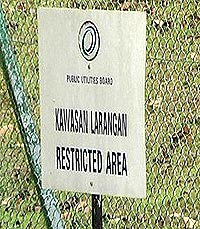 "We don't know if there were any other payments as there is nothing in black and white. We fear that the Linggiu Reservoir area has become a Singapore's 'autonomous area'," he added.
Similar concerns were also raised at the Johor state assembly meeting last year but no satisfactory answers were given by the state government.
Records from the state assembly sitting revealed that the MB had asked for more time to answer questions regarding the reservoir as he needed to collate information from the relevant state agencies.
Malaysiakini has been unable to get any information from the MB's office on this matter.
Singapore's response
Work on the Linggiu Reservoir started in 1988 and was fully completed in 1994. The Singapore government signed a water pact with Johor in 1990 for the supply of water from this reservoir.
The plan for the reservoir was gazetted in 1990, but there are no other state gazettes on the reservoir.
 Johor owns the reservoir but the construction and operational costs were borne by Singapore. These sums are on top of the RM320 million paid to Johor in 1990 as compensation.
Singapore also taps water supply from Johor via two other reservoirs - Gunong Pulai and Sungai Johor. There are sufficient public documents on the agreements pertaining to these two reservoirs.
Meanwhile, Singapore's state agency Public Utilities Board - which manages and maintains the Linggiu Reservoir - rejected any claims of the reservoir playing a role in last year's floods.
"Linggiu Reservoir is not a contributory cause to the flooding. In fact, a reservoir helps to hold back rainwater within its catchment," said Fam Sui Ling, the PUB general manager in charge of the reservoir.
"PUB did not release any extra water from Linggiu Reservoir on Dec 18, 2006 or thereabouts," he added in an e-mail communique.
He also denied that the reservoir belonged to Singapore.
"The Linggiu Reservoir is owned by the Johor state government. PUB operates the reservoir under the 1990 Agreement between the Johor state government and PUB," he said.
Tomorrow: The lost city in Linggiu
Click below to watch six-minute video


Report this comment
Are you sure you want to delete this comment?
This action cannot be undone.