




Q&A: They have let me down
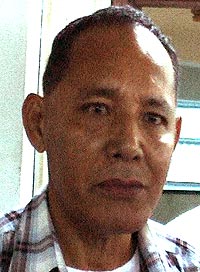
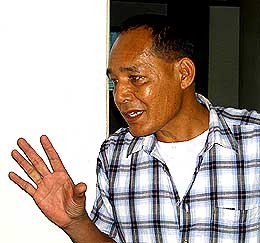
Mohd Ramli Abdul Manan believes it was the ex-PM who ordered him to be transferred out of Sabah, where he was then the agency's state chief.
Malaysiakini: What was your role in the Kasitah Gaddam probe?
Ramli: I was the director of operation.
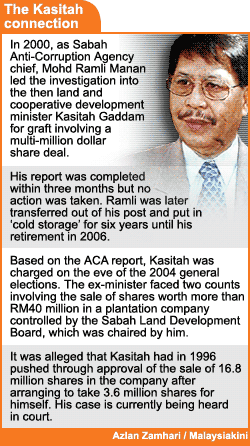
(Former land and cooperative minister Kasitah Gaddam has been charged for abusing his position in 1996 as executive chairman of the Sabah Land Development Board in approving share transaction in which he had an interest. His case is currently being heard in court. See chart below)
How did the Kasitah case come to you?
We received information and we sensed something was rotten, so we went in. We work (based) on information. From (where the) information (comes from) we don't care, as long as the information raises a reasonable suspicion that there is a commission of an offence. You don't have to have to come to the office (to lodge a report), or anything.
Mohd Ramli Abdul Manan believes it was the ex-PM who ordered him to be transferred out of Sabah, where he was then the agency's state chief.
Malaysiakini: What was your role in the Kasitah Gaddam probe?
Ramli: I was the director of operation.
(Former land and cooperative minister Kasitah Gaddam has been charged for abusing his position in 1996 as executive chairman of the Sabah Land Development Board in approving share transaction in which he had an interest. His case is currently being heard in court. See chart below)
How did the Kasitah case come to you?
We received information and we sensed something was rotten, so we went in. We work (based) on information. From (where the) information (comes from) we don't care, as long as the information raises a reasonable suspicion that there is a commission of an offence. You don't have to have to come to the office (to lodge a report), or anything.
Did you get it from Kasitah's political rivals?
It came from the (news)papers. This thing (Kasitah's case) was raised in the state assembly. They (the politicians) knew something was wrong already.
 How long did you investigate the case?
Three months only. In the Kasitah's case, (there were) about 15 people (in the investigation team).
Was the ACA happy with the investigation?
They were not happy because a lot of political figures and a government company were involved.
What happened after you finished your investigation?
We file it to the ACA headquarters.
Who gave the orders to move you out of Sabah?
I think (it was ex-Prime Minister Dr) Mahathir (Mohamad) because when I ask them (ACA officers), they said it was orders from high up. That was in 2000.
A few Sabah ministers went to see Mahathir but I have no proof (of that). I asked 'why are you all treating me like this', and they said orders from the top. Who else? And they were afraid to put me in an important position (after that). Why were they afraid?
 Like (ACA chief) Zulkipli (Mat Noor), attorney-general Abdul Gani Patail is also from Sabah.
That was what I told the police officer (who was investigating the Zulkipli case). Gani Patail should not be involved in the (Zulkipli) case because they (Abdul Gani and Zulkipli) are quite close.
Both were recruited by Mahathir. At that time, Gani Patail was the deputy public prosecutor (DPP) and Zul was the Special Branch chief in Sabah.
It was reported recently that Zulkipli's term would expire this month. Do you think they'll forget about it after he steps down?
Probably.
Do you still have friends in ACA now that you have become 'persona non grata'?
I don't know. I don't care about the ACA because I felt let down. They should back me up as I was doing my job. When they pulled me out of Sabah, ACA officers, directors or the DG (director-general) should have backed me up because I didn't do anything wrong - I was just doing my job.
You (ACA officers) must tell the chief, "You can't penalise your officers who are performing their job." I'm particularly sore with the senior officers. The junior officers can't do much, but then the DG (director-general) or deputy DG should have backed me up. After all, I was doing my job in Sabah.
When you were in ACA, was the agency independent?
 They have to get Mahathir's permission first. That's why Kasitah Gaddam's case took so many years (before the ex-minister was charged). If Mahathir was around, Kasitah would have been discharged.
This should not be the case because (Abdul Gani) as the AG should look at the evidence. If there is evidence, they should act on it. The decision must be based on the evidence. If the evidence is sufficient, (and the AG can) prove that there is a prima facie case, you cannot withhold consent.
Were there a lot of cases not prosecuted?
The ACA DG once had the power to prosecute but then it was taken away in 1997 with the new Anti-Corruption Act. Now with corruption cases before you can prosecute the person, you must get the consent of the DPP (deputy public prosecutor).
 The consent is like as a certificate to tell the court that, "Yes, I'm a lawyer, I've gone through the evidence and there is sufficient basis to prove the case." With that consent, the court takes cognisance of the offence. Only then the court has the jurisdiction to hear.
Without the consent, the court cannot do anything. If the DPP did not consent, then the ACA DG can consent. That was the check and balance then. Right now only one person can make that decision, that is the AG, which should not be the case.
We (ACA) have a prosecution section. All cases that had been investigated are sent to them. But for most high profile cases, they dare not send them to the prosecution section. They are sent to the AG's Chambers. I think there is an administrative circular on this matter that the ACA cannot make that decision but has to refer these cases to AG's Chambers.
It must be frustrating not seeing action taken after the investigations.
Yes. That's why in the high profile cases, if the DPP feels there is a case then they refer it to the AG. If the DPP says there's no case, then we just close the file.
Of course, I get frustrated. Well, not only me, a lot of ACA people are frustrated.
What recommendations would you give to improve the ACA?
The selection of the DG is very important. If you put a crooked fellow there, then the whole department will be corrupted. That's why I suggest that a few names must be forwarded to the Parliamentary Select Committee on Integrity where they could interview these prospective candidates and they are the ones who make recommendations to the PM. That should be the case. Otherwise, the PM could select the wrong person.
The ACA should also be given the power to prosecute and must be given the right to decide and take action for ourselves rather than referring to the AG.
Besides the ACA chief, do you have any information on other high-profile individuals?
I have so many. I have files against ministers, ex-ministers. Once a report has been filed, it must be investigated. If you don't do it, you are committing an offence. Zul is committing an offence,
Like Rafidah Aziz?
 Yes, you look at Rafidah and her APs (approved permits). That case was not taken up.
How do you feel about corruption in Malaysia?
You can base this on the Transparency International report and the talk of the public regarding this matter. You look at the Internet. (When) the ACA is mentioned, many negative words are hurled against it. That shows the people are not happy with the ACA.
Even (former police chief) Tun Hanif Omar has been writing on the ACA many times. The purpose of my letter was to rebut him (Hanif). If you put an officer like that (Zulkipli), how can you expect the ACA to perform? That is your officer, you go and do something-lah. Go and see the PM and (ask him) to get somebody better.
Did you initiate investigations yourself, say from something you had read in the newspapers?
Yes, most of the time we do that. With the case against Mahathir, I picked it up from (ex-deputy premier) Anwar (Ibrahim)'s interview.
Was the situation better when you first worked for ACA?
Better (nods). So much better. So many times better. In 1978, you hardly hear of a minister who was corrupt.
That time was before Mahathir. In those days, ministers are scared, but now they know that they can get away. Now, it (corruption) is nothing to them.
Why did you decide to sue the Star ?
I asked for an apology and they didn't want (to give it). I got my lawyers to sent them letters. The Star should have verify the information with me before they ran the story. (Because they didn't) that's defamatory.
They've created such a negative impression amongst ordinary people that I was an indisciplined officer and that I've gone AWOL, but that was not the case.
What are you doing now?
I'm helping my colleague (in a law firm) with criminal cases because I know this better than them. I also contribute to their corruption cases.
 Should whistleblowers be protected?
ACA officers don't need whistleblowers because we can always get information anonymously, The most important thing is the value of the information - the accuracy and the veracity of the information.
You see, we don't work like the police. For the police, if you want to start an investigation, there must be a police report. We are different. They have wrongly interpret the Criminal Procedure Code. I don't know how they do that.
Normally whistleblowers are penalised. Like putting them in cold storage. Sometimes I don't think people can stand it if their boss puts them in cold storage. I did it for six years. I think even for one year, nobody can stand it. Some people just walk out.
How does it feel to work for an organisation like that? You go to work, you conduct an investigation but no action is taken.
You will have to work to beat the system. You will have to go against the system.
But that is difficult to do...
You must try. Somebody has to fight the system. You have say, "look what you're doing is wrong." If the system is not benefitting the organisation, you have to do something.
Do you still have confidence in the ACA?
No.
'Dr M punished me for Kasitah probe'
Part 1
ACA whistleblower tells all


Report this comment
Are you sure you want to delete this comment?
This action cannot be undone.