




Defence lawyer: Sirul 'absolutely confused'
Corporal Sirul Azhar Umar is an "absolutely confused man."
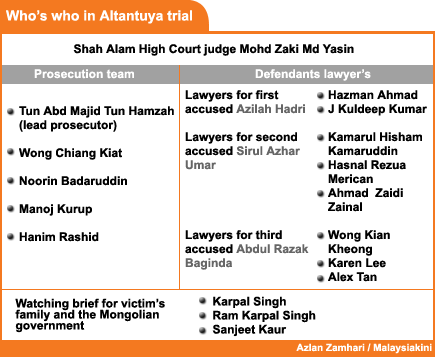
This is how his lawyer, Kamarul Hisham Kamaruddin, described the second accused in the Altantuya Shaariibuu murder trial.
Corporal Sirul Azhar Umar is an "absolutely confused man."
This is how his lawyer, Kamarul Hisham Kamaruddin, described the second accused in the Altantuya Shaariibuu murder trial.
 Kamarul (
right
) told the Shah Alam High Court today that his client, who is attached with the police's elite Special Action Squad (UTK), can be easily confused.
Kamarul (
right
) told the Shah Alam High Court today that his client, who is attached with the police's elite Special Action Squad (UTK), can be easily confused.
He then submitted five points as to why Sirul's confession was inadmissable, including that it was made involuntarily.
"Our client can be confused by the simplest question. He is not a calculative witness. He was a man who has been described as a 'robot' with an anxious state of mind then.
"He even contradicted himself four times when I was cross examining him, and I am the one that is representing his interest," Kamarul told judge Mohd Zaki Md Yasin.
Last week, Sirul, 36, contradicted his own statements numerous times during a trial within trial on whether he had confessed or not to UTK deputy commander ACP Mastor Mohd Ariff during their flight from Bangkok to Kuala Lumpur on Nov 6 last year.
Kamarul said that Sirul's confession was made under "oppressive" circumstances and should not be admitted for that and other reasons.
The defence lawyer told court the officer was "in a distraught state under severe mental anxiety" when he made the confession.
"Sirul's confession, if admitted, would be a very strong factor for the court to take into consideration in finding his guilt. It would weigh heavily on the court," the lawyer later told reporters.
Kamarul's five points are summarised as follows:
- Prosecution failed to discharge burden of proof
The prosecution failed to discharge their burden of proof that the confession was made voluntarily. The prosecution has categorically failed to call every witness that is material in the sense that they have come into contact with the accused within the relevant period of time.
There were three people - sergeant Jelima Tasiran, corporal Zamri Abu Bakar and Mastor who were with the accused persons at all material time. That puts both of the other two UTK officers (Jelima and Zamri) in the position as material witnesses. But they were not called to testify by the prosecution.
It was an arrest because Sirul's personal liberty was restrained and he was being constantly guarded and watched. Caution was not given by Mastor and this is not factually disputed.
From the moment Sirul was picked up in Islamabad, Pakistan, he was under arrest because Sirul's personal liberty was restrained and he was watched and guarded at all times. That being so, the obligatory caution under Section 113 Criminal Procedure Code (CPC) was not given.
Hence, whatever statement made by the accused to Mastor, unless the court is satisfied that caution was made, is not admissible. He added that the confession was not properly recorded, given that Sirul was in police custody at the time.
(Sirul was on duty in Pakistan escorting Prime Minister Abdullah Ahmad Badawi).
If the court does not find him to be under arrest, he was in fact under the custody of police officers. Therefore, there can be no confession unless it is made to a magistrate or a sessions judge following Section 26 Evidence Act.
When Mastor sat beside Sirul (on the flight from Bangkok to Kuala Lumpur) asking questions with a view of extracting a confession, at the point of making that statement he (Sirul) submits himself to custody. Mastor had said the accused was under his "custody and control." That very act is submission to custody. If he submits to custody, the confession is not admissible.
Under Section 24 of the Evidence Act, there are three categories of involuntariness - inducement, threat and promise. It is not our burden to show these three. We only show suspicious circumstances. If it appears that there are suspicious circumstances of these three, case law establishes not just these three categories, but also of oppressive circumstances.
When Sirul got on the plane, Mastor had said to him that he had killed a woman. He had said that he was confused of the allegations towards him. Mastor gave instructions to spill all in a commanding voice. Sirul was clearly not gifted with the mental ability to work out its repercussion. He was facing a grave oppression.
We are arguing if Sirul was not under arrest, the moment Mastor attempted to extract anything incriminating from the accused, he (Mastor) had stepped into the role of an investigating officer and it is therefore under Section 112 of the Criminal Procedure Code that it must be recorded in writing. Accused must be given the right to read, make corrections and sign. Failure to do so is not worth it being stated.
 Mastor went to Islamabad with the intention to ask questions and extract a confession. It was deliberate and purposeful therefore Mastor is a police officer who stepped into the role of an investigating officer.
The confession needs to be taken down in writing and signed by the person making it or affixed with his thumb print as the case may be, after it has been read to him in the language in which he made it and after he has been given an opportunity to make any corrections he may wish.
Induced to confess
Political analyst Abdul Razak Baginda's counsel Wong Kian Kheong also submitted and said Sirul was induced to confess when Mastor told him (Sirul) that (first accused chief inspector) Azilah Hadri had revealed everything during interrogation and that he has nothing to hide..
"If that was not inducement, I don't know what is," he added to his submission that Sirul's confession was inadmissable.
The court was then adjourned at 1.20pm to break for lunch. The hearing resumed shortly after 2.30pm with Azilah's counsel Hasman Ahmad submitting his points. [See related report]
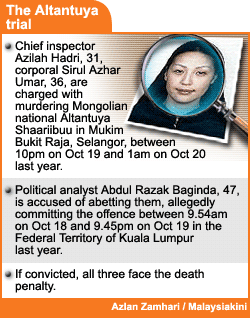
Sirul and Azilah, 30, are charged with the murder of the Mongolian national which allegedly took place between 10pm on Oct 19 and 1am on Oct 20 last year.
Abdul Razak, 47, is charged with abetting them. All three accused face the death penalty if convicted.


Report this comment
Are you sure you want to delete this comment?
This action cannot be undone.