




'If I don't accept, I'll be sacked'
Why did former lord president Hamid Omar refuse to withdraw from chairing a tribunal that led to the removal of his boss, Salleh Abas, during the 1988 judicial crisis ?
Why did former lord president Hamid Omar refuse to withdraw from chairing a tribunal that led to the removal of his boss, Salleh Abas, during the 1988 judicial crisis ?
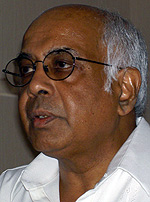 The answer was revealed by Param Cumaraswamy - the immediate past president of the Bar Council during the 1988 crisis - at a forum in Kuala Lumpur on Saturday.
In 1988, Salleh, the former lord president, was found guilty of judicial misconduct by a special tribunal chaired by Hamid. At that time, Hamid was acting lord president and next in line to succeed Salleh.
Strong objections, especially from the Bar Council, were raised then over Hamid's role in the tribunal.
At Saturday's forum, attended by some 250 people, Param disclosed what had transpired at a meeting between a Bar Council delegation led by him and Hamid.
"We went to see Hamid to advise him not to accept the position for the obvious reason that he was next in line. I advised Hamid 'please don't (accept), you will cause a very ugly embarrassment to the judiciary," he said.
"His (Hamid's) response was 'Param, if I don't accept, I will be sacked. If I am sacked, will you or your Bar Council compensate my losses of remuneration?'" he added.
He further quoted Hamid as telling him, "Param, if you want, you can go and advise the King."
Param, who is also the former UN special rapporteur on the independence of judges and lawyers, said he retorted by telling Hamid that the latter was in a better position to advise the King.
According to him, this conversation with Hamid was never made public or documented until now.
Judges axed
He also explained that the Bar Council president at the time, Raja Aziz Addruse, could not be part of the delegation in the meeting with Hamid since the latter was representing Salleh.
Param was one of the four speakers at the forum titled 'From Nurin to chief justice: A collapse of law and order?'. It was organised by the Institute for Policy Research.
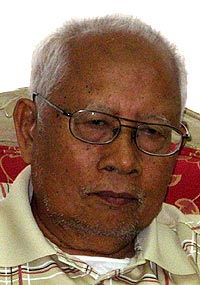 The sacking of Salleh (
photo
) in 1988 has been described as the darkest moment in Malaysia's judicial history.
The sacking of Salleh (
photo
) in 1988 has been described as the darkest moment in Malaysia's judicial history.
Former prime minister Dr Mahathir Mohamad had then set up the special tribunal which tried Salleh on charges of misconduct and for questioning the constitutional amendments that seriously eroded the powers of the judiciary.
Two of five supreme court judges - George Seah and Wan Sulaiman Pawan Teh - who had ruled that the tribunal was convened unconstitutionally were also sacked.
The supreme court, which has been renamed as the Federal Court, was then the highest court in the country.
After an 18-year silence, Salleh broke his silence in August last year and came out strongly to support the Bar Council's call for a review of the 1988 judicial crisis.
However, the government has rejected this.


Report this comment
Are you sure you want to delete this comment?
This action cannot be undone.