




The domino effect - how it could all play out
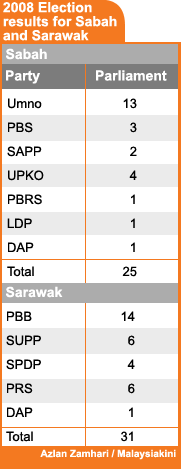
Yesterday, we discussed the possibility and implications of a significant number of Sabah MPs crossing over to Pakatan Rakyat. Today, we want to discuss the process by which Pakatan could form the next government.
Let's assume for the sake of discussion that the ‘domino strategy’ adopted by Pakatan is effective in getting 40 or more MPs from Sabah, Sarawak and Peninsular Malaysia to cross over. How then will Pakatan seek to form the next government? Who will be prime minister? Finally, how will Barisan Nasional respond to such a scenario?
Yesterday, we discussed the possibility and implications of a significant number of Sabah MPs crossing over to Pakatan Rakyat. Today, we want to discuss the process by which Pakatan could form the next government.
Let's assume for the sake of discussion that the ‘domino strategy’ adopted by Pakatan is effective in getting 40 or more MPs from Sabah, Sarawak and Peninsular Malaysia to cross over. How then will Pakatan seek to form the next government? Who will be prime minister? Finally, how will Barisan Nasional respond to such a scenario?
With 40 or more MPs crossing over, Pakatan would then command a majority in parliament (with at least 55% of parliamentary seats). Two things could happen. It could call for a vote of no confidence in Prime Minister Abdullah Ahmad Badawi, mainly as a means to publicly demonstrate its parliamentary strength, and then to go on and ask the king for consent to form the next government. Alternatively, it could skip the no-confidence vote and just go straight to the king for consent to form the next government.
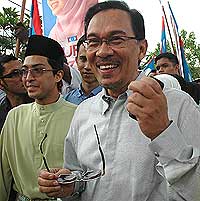 Once royal consent is given, there are two obvious candidates to take the position of PM. Anwar Ibrahim would be the obvious choice but he'd have to be in parliament first for this to happen. If Anwar wants to move quickly to form the next government, which increasingly looks to be the case, there is little time for him to get back into parliament by the way of a by-election.
For that matter, Anwar might not even want to take the risk of standing in a by-election, with the BN still in control of the various instruments of the state and able to still make good use of the so-called 3Ms – money, machinery and media. Unlike a general election where its resources and energies are dispersed throughout the country, a by-election is a very focused event. BN could and would spare no effort nor expense to ensure Anwar loses.
Wan Azizah to be interim PM
In light of this, Anwar might opt instead to let PKR president Wan Azizah Wan Ismail, become the interim PM. He might get a cabinet position – perhaps a minister in the PM's Department – via the senator route.
 Once Pakatan is firmly in control of the government, only then would he ask a Pakatan MP, probably Khalid Ibrahim (menteri besar of Selangor and MP for Bandar Tun Razak) to step down, thus forcing a by-election but this time with BN no longer in control of the various instruments of the state and with its 3Ms weakened. We believe in a fair fight, Anwar would almost be assured of a victory, paving the way for him to take over as PM from Wan Azizah.
This scenario does not take into account the possible counter measures which may be taken by Umno. Most political analysts and observers would general agree that if Dr Mahathir Mohamad were still the PM, he would not hesitate to carry out draconian measures to ensure that Pakatan could never form the next government. But would Abdullah – who is generally less belligerent, authoritarian and repressive – take similar measures?
 With the possibility that a Pakatan government might uncover large-scale corruption within BN and use this information to prosecute its leaders, the stakes are incredibly high. This makes it difficult to rule out the possibility that even Abdullah or some other Umno warlords would resort to drastic action to prevent Pakatan from forming the next government.
The high-stakes nature of this political tussle makes the role of the king critical. One move Abdullah could take if 40 or so MPs cross over is to ask the king to dissolve parliament and call for a fresh election. While this might not necessarily thwart Anwar's ability to form a new government, it certainly throws a spanner in the works. The king however could view Pakatan as having sufficient MPs to form a government and refuse to dissolve parliament.
The consent of the king is also needed if Abdullah decides that there are grounds to declare an emergency. He could argue, for example, that Anwar is trying to destabilise the government and the country. But again, if the king feels that there is insufficient grounds to declare an emergency, that avenue will be shut off for the BN.
Will there be Ops Lalang II?
What about the ISA? Couldn't the government arrest Pakatan leaders on the basis that they are threatening national stability? It probably could but trying to do an Ops Lalang II would be a big mistake. It's one thing to round up opposition leaders when they constituted less than one-third of parliament. It's quite another when the opposition controls five states and have 82 MPs.
Use of the ISA on an Ops Lalang-scale would not only lead to massive street demonstrations, it would trigger international rebuke and possibly even economic sanctions, which would ruin a country like Malaysia which is so dependent on foreign investment and trade. This is not 1969. This is not even 1987. It's a highly globalise world we live in.
If repressive action is used to thwart a Pakatan takeover, it would eventually result in BN being overthrown eventually, and worse still, it would cast BN into the doldrums for several decades as the Internet-enabled public will not ‘mudah lupa’ (easily forget). Blogs, YouTube and the likes of Malaysiakini will make sure of that.
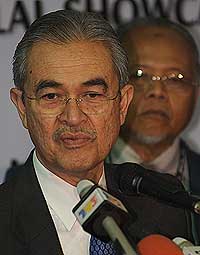 If, on the other hand, Abdullah takes the high road and allows Pakatan to form the next government, assuming it has the numbers to do so, there is a chance BN could come back and win the next election, especially if Pakatan messes up in its maiden attempt at running the country.
We've gone on record as saying we are against party-hopping. We also think Anwar should not rush to form a new government. However, it appears he is now bent on taking over by September 16. In light of that, we hope if push comes to shove, Abdullah will do the right thing and be as gracious in accepting a change in government as he was in accepting the fall of five states and the loss of two-thirds control of parliament.
ONG KIAN MING is a PhD candidate in political science at Duke University and OON YEOH is a writer and new media analyst. You can listen to both of them discuss this topic in their Realpolitik podcast .
Yesterday: The domino effect - Sabah crossovers


Report this comment
Are you sure you want to delete this comment?
This action cannot be undone.