




Pump price at 'market levels by August'
The government, which will announce the framework for its revamped fuel subsidy scheme tomorrow, has set the goal of raising the pump price to market levels by August, a minister said.
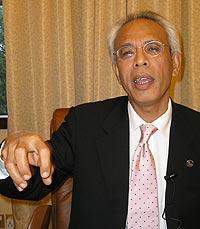
"The prime minister will announce on Wednesday an indication of where we are going in terms of a fuel subsidy system," Domestic Trade Minister Shahrir Samad told AFP .
"We have worked out the details of the subsidy plan and after the inflation committee meets today, it will have to be approved by cabinet (which will be meeting tomorrow)," he said.
 Malaysia is moving to cut the spiralling bill for its extensive petrol, diesel and gas subsidies, which is expected to cost RM56 billion this year.
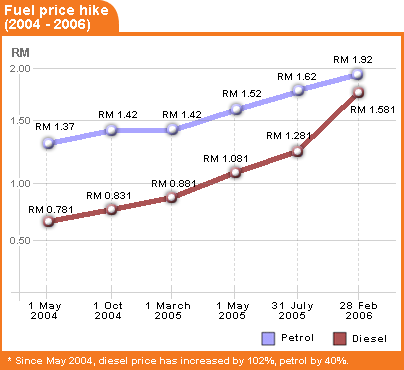
Currently petrol sells for about RM1.92 a litre, among the cheapest in the region.
If petrol is to be sold at full market prices, it could be as high as almost RM4 a litre - about 100 percent above current levels.
Shahrir said the details and implementation method of the new subsidy scheme would be thrashed out by August, when the full plan is scheduled to be in place.
Gov't target: Market prices for petrol
"There are many smaller economic factors and issues that need to be sorted out so I don't think the full fuel subsidy plan can be delivered to the public today or tomorrow," he said.
"What we are targeting for when the full plans are announced is that the price at the pumps throughout the country will be at market prices, so until the full plan is delivered, we will not be able to do this."
Shahrir said the new subsidies would be a needs-based system, rather than the current arrangement which lowers the cost of petrol for all users no matter what their income.
He told state news agency Bernama that the government was considering mechanisms including offering cash payments or setting quotas.
The government is initially targeting Singaporeans and Thais who make day-trips across the border to fill their tanks with fuel that is substantially cheaper here.
On Monday, it shut off petrol sales to Thais on its northern border and will also ban sales of petrol to visiting Singaporeans in Johor from June 9 as an interim measure ahead of the new subsidy mechanism.
The government is braced for a public backlash over any further fuel price hikes, in a country where public transport is poor and many people are dependent on their cars.
Since 2004, fuel prices have increased between 40 and 100 percent [see chart below].
The ruling coalition suffered its worst ever results in March 8 elections, losing five states and a third of parliamentary seats in a setback partly credited to anger over high prices of food and fuel.
- AFP


Report this comment
Are you sure you want to delete this comment?
This action cannot be undone.