




Oil price hike: An economically-necessary move
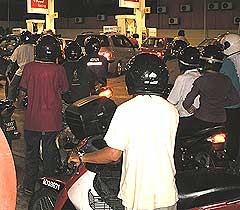
The public outcry over the hike in petrol prices from RM1.92 per liter to RM2.70 per liter, an increase of 40%, has already begun. It won't be too long before the long queues last night for a last taste of RM1.92 petrol translates into street demonstrations.
The public outcry over the hike in petrol prices from RM1.92 per liter to RM2.70 per liter, an increase of 40%, has already begun. It won't be too long before the long queues last night for a last taste of RM1.92 petrol translates into street demonstrations.
While we expect the opposition to fully capitalise on this issue, we actually support Prime Minister Abdullah Ahmad Badawi's decision to reduce oil subsidies, an economically-necessary move.
Even with the price hike, petrol in Malaysia is still comparatively cheap. Petrol in the United States, an oil producer, costs between RM3.50 and RM4.00. In Singapore, it's more than RM4 liter and in many European countries it's well above RM5 per liter.
 Decreasing these subsidies is part of a larger move towards removing distortions from the economy. It allows the government to shift expenditure from petrol to other areas which can bring long-term benefits such as improving schools and public infrastructure.
Having a cap on petrol prices was sustainable when the price of a barrel of oil was at the US$20 mark. Now that the price of a barrel of oil is almost touching US$140, the oil subsidies would have eaten up almost a third of the national budget and was projected to cost somewhere between RM50 to RM60 billion (including foregone taxes) this year if prices had remained the same.
It's understandable why many people feel petrol prices should be lower given that we are a net oil exporting country. However, there are economically-sound reasons why the oil subsidies cannot be fully borne by Petronas.
Half of Petronas' gross profits are already paid into federal coffers in the form of taxes, dividends and royalties. The other half is used to reinvest in research and development in oil fields in and outside Malaysia. If all of its profits were to be used to subsidise domestic fuel consumption, we might end up becoming a domestic net importer sooner rather than later.
Furthermore, Petronas controls only 30% of the local retail market. This means that any subsidy ends up being paid to foreign oil companies and this cost will only increase as international oil prices go up.
Two reasons why it’s hard to swallow
There are two key factors that make petrol price hikes difficult for the Malaysian public to swallow.
Firstly, Malaysians have long been spoiled by subsidies which keep the price of certain items artificially low. In many ways, our domestic economic system is built upon price controls for certain food items such as chicken and rice and for utilities like electricity and water. And, of course, there's petrol, which has always been relatively cheap in Malaysia.
These are part and parcel of the populist policies embraced by the Barisan Nasional to win public support decade after decade. They also explain why price increases are always greeted with outrage and protests. In an economy where prices are allowed to fluctuate according to market forces, the public would be more used to increases in the price of items based on supply and demand.
Secondly, public anger is compounded by the widespread perception that many politicians benefit financially from crony and corrupt deals and that the savings obtained from cleaning up the system could be channeled towards subsidising petrol.
 While this view may have some merit, it's questionable if 'cleaning up the system' can translate into the huge sums needed to subsidise petrol. As corrupt as the system may be, it's hard to imagine that cleaning it up would save the government RM50 billion a year, for example.
Had Abdullah done more to stamp out corruption and fulfill many of the promises he made in 2004, the public would be more forgiving if he had to increase petrol prices. There would still be anger but the difference is that Abdullah would have had political capital to spend. Today, he simply has none.
Why did Pak Lah raise prices?
Given the political backlash that is bound to ensue, why did he go ahead with the price hikes?
The fiscal pressures were just too strong for him to resist. If he had not done this, the budget deficit would balloon to almost 10% of GDP which could result in a run on the ringgit. Then interest rates would have to rise dramatically. The economic repercussions of that would arguably be worse than the prospect of public protests over the petrol price hike.
We expect the opposition to fully capitalise on this unpopular move by partnering up with other civil society groups to organise street demonstrations. This would be a continuation of the opposition's pre-election strategy to ‘out-populist’ the BN, which we argue was already too populist when it came to bread and butter issues.
Indeed, no politician has made more noise on the issue of petrol prices than Pakatan Rakyat's leader Anwar Ibrahim who had promised to lower petrol prices if he ever were to become the prime minister. This was effective political rhetoric but it does not make much economic sense given the unsustainability of high subsidies for petrol.
We seldom find ourselves agreeing with anything Umno Youth deputy chief Khairy Jamaluddin says but we concur with his view that it was disingenuous of Anwar to highlight the fact that petrol prices had almost doubled after he was out of government, suggesting that the price rise had something to do with him being out of office rather than the fact that world oil prices had risen dramatically.
It would be very instructional to see what Anwar has to say about the latest petrol hike. For sure he would condemn it. But would he go as far as to say he would reduce petrol prices if Pakatan comes to power? If so, by how much exactly? Less than RM2.70? Or perhaps less than RM1.92? It would also be interesting to see what opposition leaders in DAP and PAS have to say. Will they promise to reduce petrol prices if Pakatan comes to power?
We do find it ironic that Abdullah's first truly brave move post-election may very well be the tipping point that turns the broader public irreversibly against the government, giving Pakatan the psychological boost it needs to fulfill Anwar's dream of toppling the government sooner rather than later.
ONG KIAN MING is a PhD candidate in political science at Duke University and OON YEOH is a writer and new media analyst. You can listen to both of them discuss this topic in their Realpolitik podcast .


Report this comment
Are you sure you want to delete this comment?
This action cannot be undone.