




Q&A: Private and public health can grow in tandem
Nutritionist turned politician Liow Tiong Lai was appointed the new health minister after the March election and he has been a busy man since.
However, he still obliged to a 70-minute long interview with Malaysiakini at his office in Kuala Lumpur during the parliament session lunch break.
Nutritionist turned politician Liow Tiong Lai was appointed the new health minister after the March election and he has been a busy man since.
However, he still obliged to a 70-minute long interview with Malaysiakini at his office in Kuala Lumpur during the parliament session lunch break.
Barely three months on the job, Liow appears to be well-versed with his new portfolio as he gave a preview of his plans ahead to improve the healthcare system in the country.
The soft-spoken Liow also opined that the burgeoning private healthcare system would complement the government's effort to improve healthcare in general.
Here are excerpts of the interview:
Can you summarise some of your achievements since your appointment as health minister?
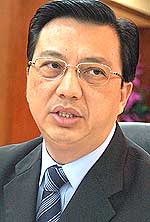 I'm very happy with the performance of the ministry over these first 100 days. To me this is an important task. It is something which I have to deliver to the rakyat, to make sure the health system in this country continues to improve.
For the first 100 days, I have made some important announcements including extending working hours for hospitals and clinics, giving heart operation treatment overseas and ways to improve the health delivery system. Waiting time has been reduced to 30 minutes. For the first one month, 50 percent of clinics achieve that target.
Hospitals have yet to improve. Only 33 percent achieved the 30- minute target. This didn't deter me, I will work harder to have more strategies and cooperation with the private sector and private doctors to find ways to reduce the work load in government hospitals.
The number of doctors we have is about 13,000. For private hospitals, we have about 8,000. In terms of doctor-population ratio, it is about 1:1,145. We are not too far from developed countries. Developed countries have 1:600. We have still need to work harder.
In Kuala Lumpur, the ratio is 1:345. (In that sense) we are much better than a developed country. But because the doctors are not evenly distributed throughout the country, we are at 50 percent filled capacity in Peninsula Malaysia. We are only 40 percent filled in Sabah and Sarawak. There is a serious shortage there.
My main challenge in the Ministry of Health is manpower, specialist doctors in particular. I have to make sure that we train enough doctors and also to reach the targets that we aim for.
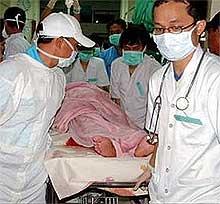 We have about 300 doctors and 50 specialist leaving us a year. But we train about 1,500 doctors every year. These are some of the constraints that we have.
I take it differently. Government and private sectors should work together. Because the doctors that we train are for the nation, irrespective of (whether they work for the) government or private. Doctors are serving the people. In Malaysia, 41 percent of our population go to private hospitals and clinics and 59 percent go to public health institutions.
Therefore, the private sector is playing an important role to ease the burden and also the workload in government hospitals. That's why I'm saying that the most important thing is that we train more doctors and specialists.
What would be your number 1 priority as health minister?
My number one priority is to deliver an efficient and accessible quality health service to the rakyat. I know I can do it, because Malaysia is very fortunate to have good infrastructures. Every three to five kilometre throughout the country, there is a clinic. Our infrastructure - water and electricity - is well in place. Now, my job is to put in the 'software' such as manpower and efficiency.
How does the government plan to deal with soaring cost for medical treatment?
In the Health Ministry, we didn't increase our fees since the 1970s. It is RM1 to see a doctor and RM5 to see a specialist. Even a third-class ward is very cheap, about RM50. So it is very low cost.
When I first joined the ministry, they were contemplating increasing the fees in government hospitals. I said no. As far as the government is concerned, this (maintaining low fees) is the responsibility of the government.
Ninety-eight percent of the cost (in government hospitals) is subsidised by the government. Only 2 percent is collected from our patients. Annually, the ministry's budget is RM12.9 billion.
Times are hard now. We expect even more people to come to government hospitals. Definitely we are under pressure. Our resources are limited but we will go all out to be more prudent.
We will not cut down on the healthcare delivery system, in fact we aim to do better. We can cut wastage and improve efficiency.
How can the governm nt help the people afford cheaper private healthcare?
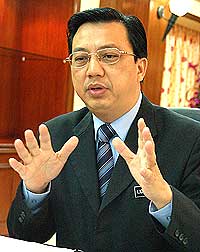 I would like to say that we regulate the doctors' fees. All the professional fees are regulated under the Medical Act. We have the Private Hospital Facilities Services Act. This act also regulate all the private hospitals to provide good quality services. In terms of fees, we have set up a channel of complaints.
Any patient who feel that they have been charged exorbitantly, they can complain to the public relations department of all the hospitals. Or they can go direct and complain to the Ministry of Health. They can go to our website and straight away lodge complaints or call our hotlines. The channels are there to allow the public to complain.
Has Malaysia failed in bring back doctors who are practicing overseas?
We have launched a scheme to attract them back since 2001. So far only about 250 specialists returned from overseas. This number is not very encouraging. When I came in as health minister, I directed my director-general to set up a special channel, a sort of fast lane.
We already have a special agency, a one-stop centre, under the Ministry of Human Resources. But Malaysian doctors still complain that when they want to come back, they are still sent in circles. Now, I directed my ministry to take up such cases - bring the doctors to the one-stop centre and resolve everything for them.
We also make it more flexible for those over 45 years of age and had served more than 10 years overseas. So when they come back, they don't have to do compulsory service for the government. Last time, irrespective (of their experience) they must serve the government hospitals for three years before they can go private.
I was thinking that those who are 45 years and below, they can (perhaps) do some community service and (those) above 45, we can exempt them from government service.
What kind of specialists is Malaysia seriously lacking in?
We're short of oncologists, cardiologists - we only have 12 cardiothoracic surgeons handling too many heart cases - we're short (of specialists). In the whole country, we only have 1,800 specialists, private and government.
We're engaging a lot of foreign (specialist) doctors now. In fact we have taken in about 500 specialists.
Are locals preferring foreign specialists over local ones?
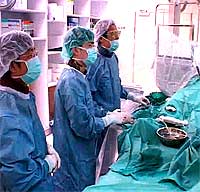 It depends on the areas of speciality. Some prefer certain countries because they know the specialists there. Sometimes when it comes to medical health it's very personal. In Malaysia, our doctors are very qualified … in terms of medical tourism, many medical tourists are coming to Malaysia.
We are not only good in terms of quality, we are also low cost. These two factors are the key in attracting the medical tourism boom in the last one or two years. The patients are not just coming from Indonesia or Vietnam. They are coming from Australia and USA (as well). The waiting time for elective surgery in Australia (for example) is five to six months. In Malaysia, we are much better.
The Health Ministry is trying to keep doctors in public hospitals, yet there are two private hospital chains owned by the government entities - Kumpulan Perubatan Johor and Khazanah. Are these two government-owned entities undermining your ministry?
No. The public always look at it as a zero-sum game - private versus government - that the government would lose out. I look at it differently, so does the government. The way we see it, as long as we can continue to upgrade the quality of healthcare, overall, our country gains.
If we have good private healthcare system, many foreigners will come for treatment in Malaysia. This is good for the economy. Medical tourism is an advantage to Malaysia. In fact, we can actually direct our private hospitals to give social services to the poor.
On one hand, the hospitals are profitable, on the other, the specialist doctors are obliged to provide national service and give certain quota to the poor people, and they are doing it now. Private hospitals are not always about dollars and cents. They have to do some social obligation.
I would say that the government and private hospitals can grow in parallel. We actually help each other out. In a lot of operating theatres, when their theatres or facilities fail, we do sent patients to private hospitals for assistance. We do have these kinds of linkages and cooperation.
I don't see it as a zero-sum game. We are working hard to upgrade our services.
Won't those who cannot afford private healthcare see it as a zero-sum game?
 Our private hospitals must be able to sustain (themselves). How can they sustain? They must be able to earn enough money from foreign patients. We don't allow them to charge local patients so high, so what do you expect? They have to charge the foreign patients.
If they charge foreign patients and subsidise local patients, I think this is something that we can agree upon. If you look at it, it is profitable and beneficial for our nation.
For government hospitals, we cannot handle 100 percent of the patients. We have to share (them) with private hospitals. Those who can afford, can go to private hospitals. So definitely, don't think it is a zero-sum game. In fact, it is the government which comes up with the most money with sponsorship to train doctors.
In one year, my ministry is spending RM450 million, on training - nurses, hospital attendants, doctors, specialists - all kinds of courses. It is a lot of money in terms of training. If you check the number of specialist in the market, most are government trained. For us, it's okay. It is our duty.


Report this comment
Are you sure you want to delete this comment?
This action cannot be undone.