




Revisiting the '88 judiciary crisis
Two decades have passed since the 1988 judiciary crisis. But the effects still linger.
Two decades have passed since the 1988 judiciary crisis. But the effects still linger.
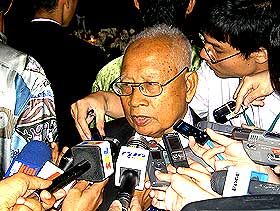 The phrase 'judiciary crisis of 1988' is generally understood as relating to the suspension and sacking of Supreme Court judges including the then Lord President Salleh Abas.
The crisis in fact went beyond that to include a besieged constitution and the erosion of the important principle governing democracies - the separation of powers.
In a special report, Malaysiakini revisits the events that led to the day the judges were removed and along with them, the confidence in the independence of the judiciary.
Since independence in 1957, the Malaysian judiciary was always held in high esteem throughout the Commonwealth for being reputably independent and impartial.
The attacks on the judiciary began in 1986 when the Supreme Court decided in the 'Berthelsen case' that the immigration director-general was wrong to revoke the work permit of Asian Wall Street Journal correspondent John Bethelson because he was not given a chance to explain himself when the decision was made.
Then prime minister Dr Mahathir Mohamad subsequently expressed concerns that the judiciary might not be interpreting the law as how Parliament and the Executive intended it to.
He also moved amendments to the Police Act and the Printing Presses and Publications Act where scathing attacks were made against the judiciary.
However, the most contentious amendment to the law was when Article 121(1) of the federal constitution - originally vesting the judicial power in the courts - was replaced by "jurisdiction and powers as may be conferred by or under federal law."
This effectively removed the independence of the judiciary and subjected the courts to be subservient to federal law made by Parliament.
The 'Umno 11' case
Meanwhile in the courts, more cases which showed judges were capable of departing from government policies arose but none was more controversial than the 'Umno 11 case'.
In the 1987 Umno party elections, Mahathir won by a very slim majority of 43 votes against Tengku Razaleigh Hamzah for the party presidency in 1987.
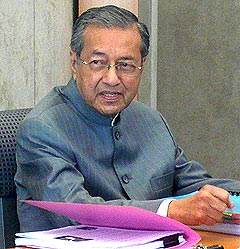 Eleven Umno members then challenged the validity of this election, which resulted in then High Court judge Harun Hashim declaring that Umno was an unlawful society.
The plaintiffs appealed to the Supreme Court and Salleh had fixed the hearing on June 13, 1988 by a full bench of nine Supreme Court judges.
It was apparent that the political survival of Umno and Mahathir was at stake and many people interpreted this as the reason for the judicial crisis that was to follow.
In light of the judiciary losing its judicial powers and Mahathir’s outbursts against judges in Parliament, Salleh met with 20 other judges and wrote a letter to the King and the state rulers on March 26, 1988 expressing hope that "the baseless remarks (against the judiciary) will cease."
On May 27, 1988, Salleh was summoned to Mahathir’s office and was told that the King - Sultan Iskandar Al-Haj of Johor - wished him to retire as Lord President because of the said letter. He also received his letter of suspension that was backdated to May 26.
The following day, Salleh sent a letter of resignation but withdrew it and held a press conference. On June 9, 1988 the prime minister told the King that Salleh committed further misconduct for using the press to demand for a public hearing of the tribunal made up of high judicial officers.
A tribunal to try Salleh was quickly set up and the dates to hear the ‘Umno 11' appeal was vacated upon his suspension at the instructions of acting Lord President Hamid Omar.
Six tribunal members were appointed pursuant to the federal constitution by the King on June 11. They were acting Lord President and chairperson Abdul Hamid Omar, former Federal Court judge Abdul Aziz Mohamed Zain, Dewan Rakyat speaker Mohamed Zahir Ismail, Singapore Supreme Court judge TS Sinnathuray, Sri Lankan Chief Justice KAP Ranasinghe and Chief Justice of Borneo Lee Hun Hoe.
The list of charges against Salleh include making critical statements against the government on several occasions, falsely claiming that the letter written to the King was on behalf of the judges and giving untrue information to the media that discredited the government.
The tribunal commenced its hearing on June 29 and Salleh was absent throughout but his counsels led by Raja Aziz Addruse were present.
Meanwhile, the tribunal was assisted by then attorney-general Abu Talib Othman who submitted there was enough evidence to recommend Salleh's removal from office.
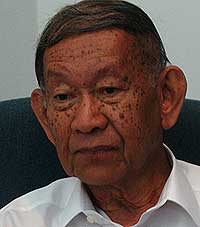 Salleh through his counsel Raja Aziz (right), who was the Bar Council president then, had applied for an interim stay against the tribunal but High Court judge Ajaib Singh refused it.
Raja Aziz went to see Wan Suleiman Pawanteh, the most senior judge at that time about this matter and the latter convened a special sitting of the Supreme Court on Saturday, July 2 1988.
Raja Aziz had argued that the tribunal members were unconstitutional and invalid and the five Supreme Court judges - Wan Suleiman, George Seah, Eusoffe Abdoolcader, Mohd Azmi Kamaruddin and Wan Hamzah Mohamed Salleh - unanimously granted the ex parte order.
Salleh wanted to challenge the constitution of the tribunal members and needed the order to halt the tribunal proceedings from carrying on in Parliament.
Several incidents including the then chief registrar Haidar Mohd Noor hiding the court seal and locking the court doors as well as the Parliament gates being locked led to criticisms that there was a ploy to prevent anything from disrupting the tribunal.
The final blow
Two days after the order was given, the five judges were suspended from their duties without a reason. With six Supreme Court judges suspended, it effectively suspended the Supreme Court which meant the challenge toward the legality of the tribunal could not be heard.
The tribunal finished its report on July 7, 1988. It recommended that Salleh be removed from office on the grounds of his misbehaviour which indicated his inability to discharge his duties and function as Lord President properly.
Based on this, Salleh was removed as Lord President on Aug 8, 1988 by the King based on the recommendation of the tribunal. Hamid became Lord President soon after.
It is also interesting to note that the ‘Umno 11' appeal was heard the same day and dismissed the following day.
Salleh’s dismissal led the Bar Council to pass a resolution in an extraordinary general meeting refusing to recognise Hamid as the new Lord President.
Meanwhile, a second tribunal chaired by judge Edgar Joseph Jr - the 13th most senior judge out of 28 High Court judges - was set up to look into the conduct of the five suspended Supreme Court judges.
The last blow to the judiciary was dealt by Edgar who found Wan Suleiman and George Seah guilty of misconduct and the King on Oct 4, 1988 ordered for their dismissal.
The other three - Eusoffe, Azmi and Wan Hamzah were reinstated but the judiciary was never the same again.
With the Supreme Court incapacitated and the amended constitution limiting the judiciary’s powers to only as much that Parliament might grant it - this period became known as the ‘blackest days’ in Malaysia’s history.
Tomorrow: Malaysiakini will focus on lawyer Param Cumaraswamy’s final speech as Bar Council chairperson in March 1988 and his thoughts on the judiciary today.


Report this comment
Are you sure you want to delete this comment?
This action cannot be undone.