




Q&A: Concerted effort to run down judiciary
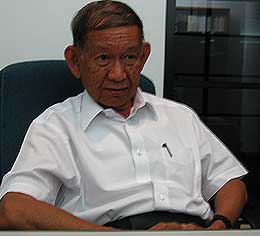
Raja Aziz Addruse was lucid in describing how there was a concerted effort - from the then prime minister to the media - to run the judiciary down.
Raja Aziz Addruse was lucid in describing how there was a concerted effort - from the then prime minister to the media - to run the judiciary down.
The senior lawyer who led Salleh's defence team in the tribunal in 1988, recollected how he first heard about former Lord President Salleh Abas’ suspension.
In Part I of the interview, the former Bar Council chairperson also told Malaysiakini in an exclusive interview the impact of the constitutional amendments and Salleh’s reaction to the suspension.
Can you recount the events that led to the judiciary crisis in 1988?
Raja Aziz: If you're going to learn about the way the judiciary came into what it became today, you have to read the history before that. You will see that prior to that, the judges had become more brave and you have the decision in what we call the Berthelsen case where there was a reporter from Asian Wall Street Journal.
 He had a permit to come to this country but the government withdrew the permit. The courts held that it was not correct because he should have been given a chance to explain on the principle that there is legitimate expectation that once you give a permit, it should be for a certain period, just can’t withdraw it at anytime you like.
So that was the beginning of the judiciary getting in line that is not acceptable or agreeable to the government. And then there was the decisions in the UEM and Lim Kit Siang and Karpal Singh case. The decision then was 3-2 in favour of the government. But there were indications that there were judges who were quite independent in their thinking.
Then what finally I think was found unacceptable was when Karpal was charged (held) under the ISA (Internal security Act) and the decision by Justice Peh Swee Chin (to grant Karpal’s habeas corpus application), that was not acceptable to the government. It was more or less blasted by the prime minister (Dr Mahathir Mohamad) at that time and this is when he said that we have the law worded in certain way, we expect it to be translated and interpreted in a way that we want it to be interpreted and judges are trying to interfere with the working of the legislators and so on.
I’m not sure if I’m saying this in the exact way but you can find this all in Salleh’s book, May Day for Justice . At that time, Mahathir wanted to run down judges in Parliament and there is a provision in the Standing Orders that you cannot discuss the conduct of judges in Parliament except in what they call a substantive motion, that somebody must come along and say we want to discuss this matter.
You can’t discuss this say during the Budget, it must be through a proper motion to chastise judges. But he didn’t (file such a motion) and the Speaker allowed it. At that time it (the speaker) was Dr Mohamed Zahir Haji Ismail and because of this attacks on judges, Salleh wrote a letter to the Yang di-Pertuan Agong.
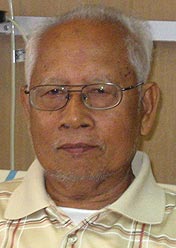 I think at that time Salleh (
right
) was just about to leave for America for a visit or something and he did not deliver the letter himself, he dispatched it. The King took umbrage at that and got angry. This, according to Mahathir, was the reason why the King wanted Salleh dismissed.
I think at that time Salleh (
right
) was just about to leave for America for a visit or something and he did not deliver the letter himself, he dispatched it. The King took umbrage at that and got angry. This, according to Mahathir, was the reason why the King wanted Salleh dismissed.
I was then the chairman of the Bar Council, I had just come in, in April, I think. One day, two Bar Council members told me that Salleh has been suspended and that was the first time that I heard it. So we decided that we would go to the Supreme Court which was then the clock tower at the Sultan Abdul Aziz building to see Salleh and confirm whether he had been suspended.
As we were coming up the steps of his office, his orderly said that Salleh was not in and that we cannot see him. So we said it did not matter, we will go and wait in his office anyway, when he comes in, we will see him. The orderly appeared reluctant to let us in so we sat down and his PA (personal assistant) comes along and he said Salleh’s not in. So we waited. About half an hour later Abu Talib Othman, the then AG came out of his room. So we thought, "This is funny. Why should Talib come out if Salleh isn’t there?"
I think a few minutes later, his PA came along and said Salleh will see us now. He was in all the time and he was there with (another Supreme Court judge) Eusoffe Abdoolcader. Apparently there were some discussion that Salleh will be offered some post in some Middle East country or something. So we asked Salleh whether he was really suspended, he said, "No we’re not talking about it now. We will see what happens."
Apparently there was this discussion that there was this arrangement for Salleh. So that was the end of it and we told Eusoffe that we will accept what they say, even if they said nothing, but if we learn something from the reporters outside, then we will a make our own statement. It was a Friday I think, I’m not sure.
That night I was at a dinner but I came back, quite late about 1.30am, there was a message from KC Vohrah. He was a judge in Kuala Lumpur at that time saying that I was to call Salleh urgently. So I rang Vohrah up and asked him what this was all about and he said Salleh wanted to see me the following day in his office at the SAS building but it was closed. I was told to go to his house.
Eventually, both of us ended up with the PA at Salleh’s office and that was the first time that he said he wanted to be represented and that he wanted me to act for him. It turned out that he had sent a letter to the prime minister to say all sorts of things and that he had changed his mind over the arrangement and that he had made a mistake.
That was when we wrote that letter to say that he was not resigning and I think Mahathir subsequently came out and blasted him saying that Salleh can’t keep changing his mind or something. And that was the beginning of the events in 1988 and the rest is history, which you can read.
Who were you with when you visited Salleh at his office the first time?
I was with GTS (Tara) Sidhu and the late Ronnie Khoo of Shearn Delamore. In fact I think Tara was the one who said that he heard Salleh had been suspended and decided we should go because they were very senior members of the Bar, very much more senior to me but I was the chairman so it was the three of us. After that, things happened.
The newspapers started to write all sorts of things and there was this concerted effort to run down the judiciary. And that’s the events of 1988 which the American lawyers subsequently termed it as ‘the assault on the judiciary’.
Did you eventually find out what Abu Talib was doing there?
I don’t know whether Salleh told me himself or it was in the book, that there was this offer of being appointed to some position in some bank in Saudi Arabia or somewhere in the Middle East.
So the offer was from the government?
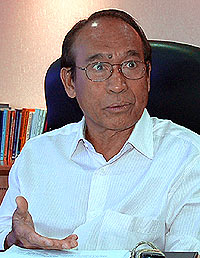 I should think so. Talib (
left
) wouldn’t do it on his own. There must have been some sort of carrot being dangled in front of him (Salleh) to accept the resignation. Around that time there was also Umno’s general assembly where the post of the president was contested by Tengku Razaleigh and that was when Mahathir won by 42 or 43 votes and then there were some facts disclosed that many of those attending the meeting were in fact elected by divisions that had phantom members.
I should think so. Talib (
left
) wouldn’t do it on his own. There must have been some sort of carrot being dangled in front of him (Salleh) to accept the resignation. Around that time there was also Umno’s general assembly where the post of the president was contested by Tengku Razaleigh and that was when Mahathir won by 42 or 43 votes and then there were some facts disclosed that many of those attending the meeting were in fact elected by divisions that had phantom members.
So there was an attempt to question the validity of that election by 11 people and (High Court judge) Harun Hashim held that Umno was an unlawful assembly. That was just before Salleh was suspended. We appealed for the 11 people and I think Salleh was going to appoint a full bench to hear the appeal.
In the meantime, Harun was promoted to the Supreme Court and he would’ve been disqualified. There were 10 of them in the Federal Court and Harun could not sit because he decided the first application so nine judges was just right. It was because of this feeling that Salleh was going to appoint this bench of nine judges that there was some alarm on the part of Mahathir then - that he wasn’t sure which judges are for whom. And some people think that was the reason why he removed Salleh. Soon after Salleh was suspended, the case did not go on.
The Supreme Court that was to hear this case became five judges instead of nine. One of the judges was Hamid (Omar) who chaired the tribunal that dismissed Salleh, I think two Supreme Court judges and if I am not mistaken, two High Court judges. So you see straightaway, the benefit of the removal of Salleh was there. This coram was headed by Hamid, that is a reason for 1988.
During that period, was there an inkling within the legal fraternity that Mahathir had judges within his grasp?
I don’t think there were judges within his control but there are judges that are generally very conservative. You will not want to go against the government unless it is very necessary. But I don’t think they would support the government at all cost. They won’t be dictated to by the prime minister nor will the prime minister at that time be dictated to by any judge.
But it is of course up to a judge to decide to be sympathetic to the government or not and there have been cases where judges have not been sympathetic but there was nothing to it. A judge can decide in one way or another but nobody makes a big thing out of it because you’ve got your appeal. But during this time when judges decided in a certain way, that was not acceptable, they were taken to task so that was the beginning of a change in the way the judiciary was being treated.
What are your views on the role of the King on this matter?
The role of the King is to accept whatever Salleh was going to say and then give it to his Cabinet and say why are you attacking the judiciary? They must explain. It’s no point to say "sack Salleh because he did not send the letter by hand personally to me" and as it turned out, that might not be the reason because if I remember correctly, apparently the letter that was produced was not even the letter that was written to the Sultan of Johor. I’m not sure if it was the Sultan of Johor who wanted Salleh sacked.
How was the Bar Council's reaction to this then?
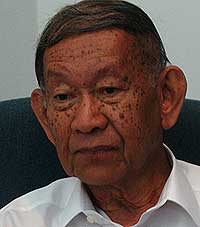 When I was acting for Salleh, the Bar Council was very concerned and we had an EGM (extraordinary general meeting) and we passed a very strong resolution to condemn Hamid Omar then, who was the chief justice of Malaya, to condemn him for his part in accepting the appointment of chairman of the tribunal.
It was strongly worded, to say we have no confidence in him and that he ought to be removed as a judge. Over the years when he became Lord President, he tried to set aside the resolution. There were two or three attempts but on each occasion, it failed. So that resolution is still there.
What are your views on the constitutional amendments that took place then?
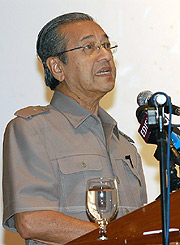
The constitutional amendments were a result of what I mentioned earlier where Mahathir said, "We draft the law, we want it interpret in this way, judges are interfering with the interpretation, they are making laws" or something. He was using some funny expression that the judges were laying down the law instead of Parliament or something like that.
When he moved the bill, he made it clear that the amendments was to make sure that laws are to be interpreted according to what Parliament wants the interpretation to be. But the affect of Article 121 is far reaching in a sense that it is now for Parliament to determine the jurisdiction of the High Courts. Article 121 is very questionable itself, in terms of its constitutionality but it was not seriously considered to be challenged because the judiciary at that time was already not in the position to be independent anymore.
So it was the view of many people that when the time came it should be challenged. Unfortunately recently, the Federal Court suddenly took upon the Article 121 and said that because of the amendment there is no separation of powers which is absurd because Article 121 was bad, it was not constitutional, it should be removed, we should go back. According to the original constitution, there was separation of powers, that was the purpose.
So we are in that position at the moment. The amendment to Article 121 is very bad for democracy, there is no independent judiciary anymore by the admission of the chief justice himself, recently.
What was the situation like when you represented Salleh in 1988?
Salleh and lawyers were never close. He was an aloof person. We represented him not because he was our friend but because we thought that it was not right that the executive, particularly the PM to dictate to the judiciary. It was wrong for him to use Parliament to run down judges for example.
So we defended him on that basis. In fact I am not sure whether you could look at it as if we are very close to him and that’s why we defended him. That is not the case at all. It was a matter of principle.
What was Salleh’s reaction to the whole thing from your observations?
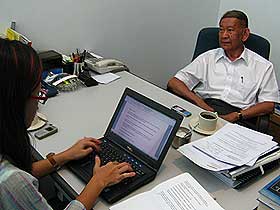 I think he was shocked that the government - whom he thought was doing the right things all these years - suddenly became like this. That judges were treated in a very shabby way. So I think they were taken aback.
What are your views about what Mahathir did?
I think it was wrong. I think he did not know anything about law, just like (Pakistan president General Pervez) Musharraf. He thought, "Why should I have all these judges? I will dismiss them and have those that would confirm my appointment remain." That was democracy to him. Mahathir didn’t do it in a blatant way like Musharraf but that’s a fact.
Q&A Part 2: Raja Aziz speaks about the state of the judiciary today and his views on the political will to resolve the crisis.


Report this comment
Are you sure you want to delete this comment?
This action cannot be undone.