




Q&A: 'Don't blame judges, they are scared'
After what happened in 1988, judges became scared because the chief justice, attorney-general and chief secretary did not raise a finger to defend the judiciary.
After 1988, judges grew scared because the chief justice, attorney-general and chief secretary did not raise a finger to defend the judiciary.
This was the conclusion by former Supreme Court judge Mohamad Azmi Kamaruddin after having gone through the judiciary crisis 20 years ago.
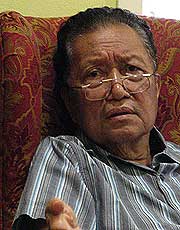
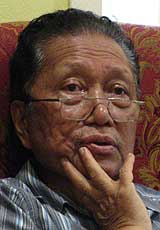
Looking relaxed in a grey striped shirt in the reception area of his Ampang residence, the 75 year-old grandfather told Malaysiakini in an exclusive interview about how he was treated after his suspension.
In the final part of this interview, he also talked about former premier Dr Mahathir Mohamad, the measures needed to restore the judiciary and his ex-gratia payment.
Can you elaborate on your statement to the press recently that you only dealt with 'soft cases' during your remaining years as a judge?
You see the rule in the Commonwealth until today which we should have followed, which the Attorney General (Abu Talib Othman) ought to have known and ought to advise the government that members in the highest court in any country in the Commonwealth should not be suspended. If he has done anything wrong, you don’t suspend, you just call the tribunal as a matter of formality and you dismiss him!
 A judge may be in the highest court but if he committed corruption or crime he should not be retained even for one day. What’s the use of suspending him? Once you suspend him, his name is tarnished. He can’t go back. No matter how much the public believes in him, his credibility will not be the same anymore. So I hope in the future, unlike the other judges, members of the highest courts if they commit any crime to be sacked straightaway with the necessary tribunal.
I suffered. I suffered the most because I happened to be young. When I became a High Court judge, I was among the youngest to be appointed. When I was appointed as a Supreme Court judge, I was among the youngest. So I had to stay on for 10 years. I was suspended and reinstated in 1988 after being found not guilty. Then I went back (to work) and everybody was saying, "It’s okay lah at least you got your job back." But that’s not the point. The point is that when I went back, I don’t have the same image as before.
There is still that inkling (in people’s minds) that he might be guilty, you know (laughs). We have been serving the judiciary for years, we give our life to the judiciary. So it is very unfair to suspend us at that stage in our life where we have reached the highest level. You suspend us, what for? If we have done anything wrong, just dismiss us.
When did you retire?
I retired at the normal age at 65 through normal causes in 1998. Whereas Eusoffe (Abdoolcader) and Wan Hamzah (Mohamed Salleh) they were eight or nine years older than me. So after they were restored, they retired two years later. So I was left alone, it was really lonely without them, you know? The others were too young and they are, well not scared of me through loyalty or respect, they didn’t want to be near me so much.
It is always officious, then only they will come and see me. I was so lonely that I didn’t know what to do. I remember my late mother gave me a six acre land in Hulu Langat - old rubber trees so I cut them all and I started planting [...] with my bare hands, with my children. So I use a cangkul (hoe) that whenever I cangkul , I cangkul kepala Hamid (hoe Hamid’s head), the AG’s head, the chief secretary’s (Sallehuddin Mohamed) head. I was angry. There was nothing you can do.
As a former judge, what do you think of the judiciary today?
They - although I don’t think they would admit it - have no security. They have no laws to defend them in case something happens. In case the executive or Parliament is not happy over their judgment ... because we can’t have both sides happy that’s the problem. That’s the trouble working in the courts - somebody wins and somebody loses. So only one person can be happy with you. The loser will scold us, celaka punya hakim (damn judges). So all the time we make enemies. Every time we make judgment, one will praise us, the other one will scold us. That’s normal in our work.
I don’t blame the judges because they are scared. After what happened to us, they are scared because the CJ does not defend them, the AG does not defend them, the chief secretary to the Cabinet did not raise a finger. In fact when Salleh (Abas) was called by the Sultan of Johor who wanted to forgive him and pardon him. So the poor chap he went there by plane early in the morning to see the Sultan.
 We knew about it, we were very happy about it. Then you know who went? These three stooges - the AG, the chief secretary, the IGP Hanif (Omar). They went by a faster plane, they arrived there first and I don’t know what they told the Sultan of Johor and the Sultan did not allow Salleh (
right
) to enter the palace and closed the gates. That was a very sad day because we thought that would be the D-Day for us.
We knew about it, we were very happy about it. Then you know who went? These three stooges - the AG, the chief secretary, the IGP Hanif (Omar). They went by a faster plane, they arrived there first and I don’t know what they told the Sultan of Johor and the Sultan did not allow Salleh (
right
) to enter the palace and closed the gates. That was a very sad day because we thought that would be the D-Day for us.
I'm told that Salleh used to have a house here were you see the weeds. It’s a nice house. So Salleh was telling me he had no money so he had to sell his house. Poor chap, he was forced to sell it. So at that time, he wanted RM1 million which I think was a fair price but nobody wanted to buy because they thought if they bought it, Mahathir would get angry.
Those who were rich were afraid to buy it because they were scared it would affect their business. They are all scared of Mahathir, business people particularly because he was like God. Today you can be a millionaire, the next day you are a pauper. He was such a powerful man.
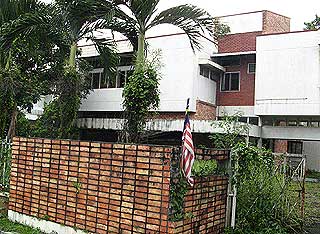 Then suddenly one day Salleh received an offer to buy the house at RM2 million. So he quickly accepted, got his lawyers and signed the documents. Then he found out that the buyer never came to see the house (
photo
) until today. Who bought it? The Sultan of Johor. So that shows to me the Sultan of Johor knew Salleh was not guilty. This was three to four years after he was sacked.
Then suddenly one day Salleh received an offer to buy the house at RM2 million. So he quickly accepted, got his lawyers and signed the documents. Then he found out that the buyer never came to see the house (
photo
) until today. Who bought it? The Sultan of Johor. So that shows to me the Sultan of Johor knew Salleh was not guilty. This was three to four years after he was sacked.
What were your thoughts on then prime minister, Dr Mahathir Mohamad at that time?
I never liked Mahathir. The moment he wanted to convince the people of Kelantan, he even carried their houses because they don’t build new houses, they shift their old ones. So he wanted to please the people, he did that but he still lost in the elections.
So I’ve been saying that only the people in Kelantan can teach Mahathir a lesson. People from other states are useless. Kelantan bagus (good). Although they look stupid, but I have respect for the people in Kelantan because they have principles. There are certain things they won’t do.
Have you seen Mahathir since your suspension?
Yes, sometimes at functions. The last time I happen to be in the same lift as him. But his wife is very nice so I salam (greeted) her. Mahathir looked at me, I didn’t salam him (laughs). Not that he cares.
Do you still hold grudges against him? Are you still angry over the whole thing?
 I feel more disappointed than angry that the PM of Malaysia could do such a thing. I feel that by doing that, by not having separation of powers, he is the enemy of Malaysians. I always use this simile; when you go to court, it’s like watching a football or a hockey match. So you have a referee. The referee must enforce the law - if the ball hits the hand, you must give a penalty. If you don’t enforce the law, the audience know a bit about football, they are not stupid. So it’s the same thing in our courts - people who sit in or read the papers, they know.
There is nothing wrong with our judges. They are all qualified. The only thing is that they don’t write judgments. That one depends on the head. I was shocked to read that (former chief justice) Ahmad Fairuz openly said in the papers that you don’t need to write judgments. Just write guilty or not guilty, you don’t need to write other things. If that’s the case then a child can be a judge. If you ask a judge like this, he’ll say "I think he’s guilty but I don’t know why." How can you accept this? This is why writing judgments is part of the judge’s work. A judge must not only state guilty or not guilty, they must give reasons.
Is there a reason why you are more vocal about this issue now?
Because I have nothing else better to do (laughs). I’ve got nothing else to lose. But really I’m doing all this for the sake of this country. I love this country, the people. I think highly about Malaysians. This is the best country to live in. We are alright but when it comes to politics, problem lah. The Malays special rights, the Indian and Chinese being immigrants - this is all history. We should not be talking about it anymore.
What do you think needs to be done to restore the judiciary back to its glory days?
First, we must amend Article 121, go back to the old one. Make sure the separation of powers are there. I just found out that Mahathir was very clever. When he amended Article 121, taking away the judicial power from the judiciary, his explanation if I’m not mistaken from Hansard, at that time was that the Malays were not happy with the state of the religious courts so they wanted a higher standard of Syariah court.
The Islamic community in this country was getting more sophisticated and global so they found out that the other races could get justice from the ordinary courts, and we are forced to go to Syariah courts who’s judges at that time were hopeless to say the least. So slowly the Islamic community demanded justice in the Syariah courts.
That’s the beginning of how Mahathir was making use of these demands by telling the villagers that they can’t do it now because the constitution (doesn’t provide for it). That’s why half of the federation agreed with the amendment not because of a separation of powers because this was kept away from them.
 Mahathir also pretended not to know about the separation of powers. The AG also suddenly forgot his law not until he became chairman of Suhakam (Human Rights Commission of Malaysia), in one of his speeches, he started talking about how important it is to have separation of powers.
I think PM and (de facto law minister) Zaid Ibrahim - his law is quite good - he will be able to separate the issue on separation of powers and the very important issue of improving Syariah courts for the Malay community in this country. Unless the separation of powers is spread out as out before or improved, then there is little chance.
You can have as many commissions of inquiry that you want or advisory boards as far as appointment of judges are concerned, but if this separation of powers is not restored, I don’t think we can bring back the judiciary to the standard that it used to enjoy in 1988. That’s my honest and personal view.
Has the ex-gratia payment made any difference?
To me it’s great because at last people realised that we did not do anything wrong. That’s very important. For the last 20 years, there are still people who think I have committed an offence.
So the ex-gratia payment is a form of recognition that you are innocent?
Yes.
Tomorrow: Malaysiakini summarises the events from 20 years ago and the problems plaguing the judiciary today


Report this comment
Are you sure you want to delete this comment?
This action cannot be undone.