




Who can PAS trust?
Critical in the how PAS evolves ahead will be how the party resolves the ongoing personality debate over who outside the party it can trust. As the media reports have highlighted, center stage was PAS’s relationship with PKR de facto leader Anwar Ibrahim.
Party leaders and members have been regularly asking themselves whether they should trust Anwar to lead. The main issues raised among delegates included Anwar’s leadership style, his record in government, his character and his Islamic credentials.
The answers run the gamut within the party, with those expressing anxiety about Anwar’s leadership of the opposition to those strongly advocating unquestioning support. As is well known, the PAS muktamar debate in Ipoh last week and party president Abdul Hadi Awang’s speech professed a strong support in Pakatan Rakyat and support for Anwar as the leader of the opposition coalition, but stopped at giving him carte blanche to hold national power.
Critical in the how PAS evolves ahead will be how the party resolves the ongoing personality debate over who outside the party it can trust. As the media reports have highlighted, center stage was PAS’s relationship with PKR de facto leader Anwar Ibrahim.
Party leaders and members have been regularly asking themselves whether they should trust Anwar to lead. The main issues raised among delegates included Anwar’s leadership style, his record in government, his character and his Islamic credentials.
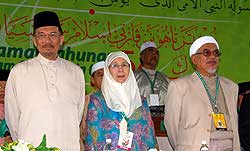 The answers run the gamut within the party, with those expressing anxiety about Anwar’s leadership of the opposition to those strongly advocating unquestioning support. As is well known, the PAS muktamar debate in Ipoh last week and party president Abdul Hadi Awang’s speech professed a strong support in Pakatan Rakyat and support for Anwar as the leader of the opposition coalition, but stopped at giving him
carte blanche
to hold national power.
The answers run the gamut within the party, with those expressing anxiety about Anwar’s leadership of the opposition to those strongly advocating unquestioning support. As is well known, the PAS muktamar debate in Ipoh last week and party president Abdul Hadi Awang’s speech professed a strong support in Pakatan Rakyat and support for Anwar as the leader of the opposition coalition, but stopped at giving him
carte blanche
to hold national power.
There clearly remain some reservations among PAS members about Anwar’s leadership. PAS’s red line of support goes back to long-standing distrust among many within the party from the 1970s
For some, they cannot forget Anwar’s attacks on PAS from Abim (Malaysian Islamic Youth Movement) and later from his years in Dr Mahathir Mohamad’s government. Those in PAS without the memories of bitter acrimony and those primarily influenced by events in the post-1999 reformasi have greater faith in Anwar’s leadership.
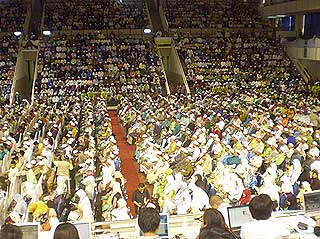 The issue of trust is not just about personality. PAS members are also concerned that the rapid rise of an alternative party with Malay support could cut into its own political base. They feel that this will only exacerbate further if Anwar attains his professed goal of the premiership. They are unwilling to forego their hard work in building up its own machinery for another party. Many feel they have already given up enough in the seat allocations in March.
This has contributed to the congealing of a third group within the party, those wanting to go it alone. PAS’s current position reflects an attempt to maintain consensus among different positions, and reach a compromise over these differences.
Interestingly, the issue of trust goes beyond Anwar, to Prime Minister Abdullah Ahmad Badawi and Umno. The fact that the Umno option is on the table has raised the issue of what sort of alliance would evolve between traditional arch rivals.
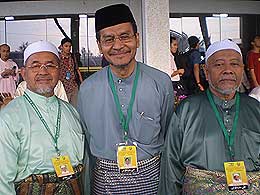 Here Abdullah’s ulama family roots have come into play to sway support toward him, as history continues to affect current dynamics. This is counterbalanced with the raw negative emotions expressed over Umno’s use of PAS in the 1970s.
Ironically, many of the same old-timers within PAS have similar bitter memories of the interregnum when PAS joined the BN, are the same people who distrust Anwar. This has divided leaders in the party and contributed to the mixed signals sent to the party base. There is growing uncertainly over how the party will maintain and strengthen its base in the evolving ever-changing political environment.
Problems with decision making
Giving up power is never easy, and in joining Pakatan, PAS has opted to play second fiddle in the opposition. It is inherently a difficult position to be in. The muktamar’s discourse and debate shows that the party is facing difficult growing pains. These will only intensify in that they also involve structural reforms within the party.
What the debate pointed to was pressure on the traditional means of decision-making within the party. PAS’s hallmark – consensus decision-making – is much harder. PAS has chosen by the electorate to play greater governing roles. Taking the time to reach consensus on ongoing policy decisions is no longer viable. Representatives within Pakatan have to reach agreement with new partners in geographically disparate settings.
Newly elected PAS representatives have been forced to forge common positions in different state governments in different political configurations. Diversity in action is reigning, as the new representatives are in their own way trying to articulate their individual views of their public mandate.
There is a tension between traditional consensus decision-making and individual action, a similar tension between listening to party leaders’ directives and individual perceptions of public opinion. To date, individual interpretations for action are winning out.
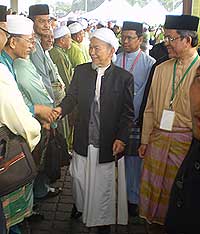 Importantly, this has meant that the ulama council no longer has the same decision-making influence of earlier years. This issue came up at the muktamar and shows that some in the party recognise that in the new national political terrain, a new mechanism for formulating party policy needs to evolve. Part of this new mechanism has to include a more robust voice for non-Muslims within the party, beyond the largely symbolic role of the supporters club.
The rejection of this club as a contributing member to party discourse in the muktamar is telling of the internal divisions. No question, greater expertise in solving non-religious problems needs to be honed. As yet, many (although clearly not all) newly elected PAS leaders on their own have not shown an ability to present solutions to national problems, particularly in areas of economic policy. The issue of economic management has been PAS’s national weakness. Sadly, the muktamar debate was devoid of any policy solutions to Malaysia’s current challenges.
Voices of discontent
The gains PAS has made in the last year have been significant and impressive. PAS made these gains by mobilising its base and working together in the opposition. Its young dynamic leaders helped to bring about these critical electoral gains. It was by far the most organised in the 2008 election, and offered capable and talented representatives to hold office.
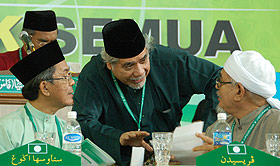 Yet, the muktamar shows blatantly that navigating the national terrain has not been easy. There are voices within PAS of discontent. Differences over ideology, personality, trust and structural reform have created multi-layered hurdles that will require resolution within the party before it can be an effective national partner.
Time will tell whether the decisions will stunt or spur growth in the party. Surprisingly, the delegate discourse on the muktamar floor showed more insight into the challenges ahead than the president’s speech.
Yesterday:
Growing pains in PAS
DR BRIDGET WELSH is assistant professor in Southeast Asian studies at John Hopkins University-SAIS, Washington DC. She was at the 54th PAS muktamar.
See also


Report this comment
Are you sure you want to delete this comment?
This action cannot be undone.