




Quit BN: Gerakan has another option
A few weeks ago, we argued that Gerakan's only realistic political option was to remain within the Barisan Nasional and hope that Opposition Leader Anwar Ibrahim takes over power at the federal level pushing the BN into the opposition.
A month later, circumstances have changed and Gerakan finds itself increasingly under pressure to seriously consider leaving BN. We now argue that Gerakan should take its destiny into its own hands and 'temporarily' leave the BN without joining Pakatan Rakyat.
What has changed in the past month which made us change our minds? Two things.
A few weeks ago, we argued that Gerakan's only realistic political option was to remain within the Barisan Nasional and hope that Opposition Leader Anwar Ibrahim takes over power at the federal level pushing the BN into the opposition.
A month later, circumstances have changed and Gerakan finds itself increasingly under pressure to seriously consider leaving BN. We now argue that Gerakan should take its destiny into its own hands and 'temporarily' leave the BN without joining Pakatan Rakyat.
What has changed in the past month which made us change our minds? Two things.
Firstly, the ability of an Umno division chief, namely Ahmad Ismail, to not only single-handedly kill off any hopes for the BN to regain the non-Malay vote but also his vehement criticism of Gerakan leader, Dr Koh Tsu Koon.
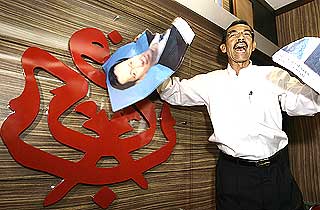 Although he was later suspended for three years from Umno, the damage was already done. (One wonders if Umno leaders and members would have been satisfied with such a punishment if a Gerakan or MCA leader had similarly criticised Prime Minister Abdullah Ahmad Badawi). The reputation of Gerakan and of Koh had been maligned by a mere Umno division chief.
Secondly, the ISA arrests of blogger Raja Petra Kamarudin, opposition politician Teresa Kok and Sin Chew journalist Tan Hoon Cheng made a mockery of Gerakan's public stance against the ISA. While Ahmad Ismail was left free to roam about, the journalist who reported his remarks at a ceramah was arrested under the ISA, supposedly for her own 'protection'.
Dr Mohd Khir Toyo, former menteri besar of Selangor, who instigated false charges against Kok, was left free while the victim of those false accusations was arrested under ISA.
These actions have not only infuriated the non-Malay voters which form Gerakan's base but also Gerakan's own grassroots members, who are now clamouring for the party to seriously consider leaving the BN.
Time for unprecedented moves
We still think that Gerakan would not survive the political wilderness if it leaves the BN permanently nor will it be in any sort of bargaining position for posts and seats if it joins Pakatan. But there is another option available. Gerakan can choose to 'temporarily' leave the BN as a matter of principle until the BN changes its position on the core issues which Gerakan cares about which includes reforming or abolishing the ISA and getting rid of government corruption.
This would be an unprecedented move, but unprecedented times call for unprecedented moves. No matter how much Gerakan leaders shout and scream against the actions of the government (of which they are supposedly a part of), it will not be taken seriously by Umno, as evidenced by the most recent events.
And anyone within Gerakan who still thinks that Abdullah can actually implement his 'reform' agenda (or DPM Najib Abdul Razak, for that matter) is seriously delusional. The only way in which Gerakan can make a strong statement about its intentions is to leave the BN.
They can still make a claim that they still hold strong to the founding ideals of inter-ethnic accommodation that is supposed to be part and parcel of the BN by not joining the opposition. If they declare that they are 'temporarily' leaving the BN, they are also not exposing themselves to the possibility of fighting electoral battles on their own (besides, BN probably won't call a snap election anytime soon).
Even though Gerakan only has two MPs, the psychological impact of Gerakan temporarily leaving the BN would be greater than its parliamentary representation. It is one of the key founding members of the reconstituted Alliance, renamed the BN, after the riots of May 13, and one of the few parties within the BN outside of Umno to hold a chief minister position.
It might even be one of the links which will eventually lead to the fall of the BN government at the federal level, something which we have argued is actually beneficial for Gerakan's political future.
In other words, Gerakan can take its own destiny into its own hands, instead of hoping beyond hope that somehow the opposition will fall apart and the BN can somehow regain the non-Malay vote by the next election, which is what staying within the BN will entail.
It has little to lose at this point in time (only two deputy ministers compared to the four ministers which MCA has to sacrifice if it were to leave to the BN). True, Gerakan runs the risk of having some of its seats redistributed to MCA and MIC if it leaves the BN but surely such a risk is worth taking when there is little hope that Gerakan can win these seats given the current political environment.
Risk of being politically irrelevant
Gerakan can take a page out of former de facto law minister Zaid Ibrahim's playbook who resigned his ministerial position after the recent ISA arrests and whose move has been portrayed as a principled stance by many, including Kok.
But given the conservative thinking that predominates the current Gerakan leadership, it is likely that they will not seriously consider such an option, despite the incessant clamouring from many grassroots members.
 Since the unhappy grassroots members do not have a national leader who may push for Gerakan to leave the BN (such as Dr Toh Kin Woon [
photo, left
] or Dr Tan Kee Kwong, both of whom have left the party), it is likely that the current sentiment of staying within the BN amongst Gerakan's leadership will prevail.
Since the unhappy grassroots members do not have a national leader who may push for Gerakan to leave the BN (such as Dr Toh Kin Woon [
photo, left
] or Dr Tan Kee Kwong, both of whom have left the party), it is likely that the current sentiment of staying within the BN amongst Gerakan's leadership will prevail.
Gerakan runs a real risk of being seen as politically irrelevant amongst its voter base, its supporters and even some of its own grassroots. A bold, unprecedented move such as temporarily leaving the BN until some of its conditions are met would be one small but significant step towards regaining some of the credibility and support which Gerakan has lost in droves over the past six months and is still continuing to lose.
ONG KIAN MING is a PhD candidate in political science at Duke University and YUN YANG is a writer and new media analyst. You can listen to both of them discuss this topic in their Realpolitik podcast .


Report this comment
Are you sure you want to delete this comment?
This action cannot be undone.