




MCA-Umno - A doomed partnership
The MCA party elections have come and gone and while there is a fresh set of faces at the top of the leadership ranks within the party, we do not think that MCA can effectively check the power of Umno within the Barisan Nasional and regain any of the non-Malay votes it lost in the March general election.
While it is very likely that MCA and Gerakan will not be silent after another keris-waving incident at an Umno general assembly, those who are hoping for the demands of MCA to be translated into actual policy are likely to be disappointed.
MCA was certainly vocal during its recent general assembly by calling for a deputy BN chairman position and possibly even a deputy prime minister position. But no matter how much MCA complains, these complaints will only fall on the deaf ears of Umno leaders. In other words, this relationship is doomed for failure.
The MCA party elections have come and gone and while there is a fresh set of faces at the top of the leadership ranks within the party, we do not think that MCA can effectively check the power of Umno within the Barisan Nasional and regain any of the non-Malay votes it lost in the March general election.
While it is very likely that MCA and Gerakan will not be silent after another keris-waving incident at an Umno general assembly, those who are hoping for the demands of MCA to be translated into actual policy are likely to be disappointed.
MCA was certainly vocal during its recent general assembly by calling for a deputy BN chairman position and possibly even a deputy prime minister position. But no matter how much MCA complains, these complaints will only fall on the deaf ears of Umno leaders. In other words, this relationship is doomed for failure.
It is doubtful as to the extent MCA is willing to push Umno to accede to its demands. Some of this new hopefulness on the part of the MCA may be influenced by the election of Ong Tee Keat as the new party president.
While Tee Keat's reputation as a maverick, helped by the support of many MCA leaders, may have helped him to beat Chua Jui Meng for MCA's top post, we have our doubts as to Tee Keat's ability to extract concessions from Umno or to get Umno to accede to a major MCA demand such as granting the ruling coalition’s second biggest party a deputy BN chairman position.
Don’t expect Tee Keat to be assertive
We have expressed before that Tee Keat's maverick reputation extends only as far as his willingness to criticise his own MCA leaders rather than openly criticising Umno leaders for their rhetoric which was unpopular among the non-Malay community.
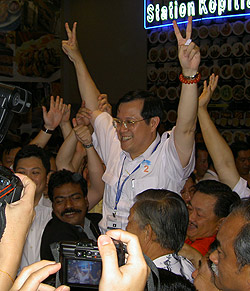 We have not seen or heard anything yet that would convince us that Tee Keat would be as assertive in criticising Umno leaders as he was against his own MCA leaders. Indeed, one may actually say that Chua Soi Lek was much more assertive in his promises to challenge the dominance of Umno especially during the debate against Donald Lim Siang Chai.
MCA's ability to regain support among the non-Malay community is an especially uphill task given that Umno leaders are still reluctant to admit that their arrogance and racial rhetoric was largely responsible for the large-scale desertion from the BN by non-Malay voters.
Whenever MCA complains about Umno's arrogance, Umno leaders predictably respond by asking the Chinese-based party to stop complaining about the election results, practically absolving themselves from any blame in regard to the election outcome.
Umno has not taken any steps whatsoever after the disastrous election results to regain non-Malay support and has further alienated it by some ill-advised moves including arresting opposition MP Teresa Kok under the ISA and banning Hindraf.
Umno's popularity has dived so low, especially among the non-Malay community, that MCA-owned The Star group editor-in-chief Wong Chun Wai wrote in his column 'On the Beat' that Umno is not only unpopular, it is resented.
Umno not likely to make concessions
There is no sign that Umno will take a moderate turn anytime soon. If anything, a Najib Abdul Razak administration, with former premier Dr Mahathir Mohamad backing him, will be more hardline than before. Najib cannot afford be seen as weak especially in the run-up to the Umno elections.
A good indication of a future hardline stance among Umno can be seen from some of Mahathir's blog posts, including one which questioned the need for Umno to apologise to the non-Malays.
Mahathir's philosophy is that you need a strong BN to lead the country and the only way in which you can have a strong BN is to have a strong Umno. It is unlikely that Najib will depart from this philosophy.
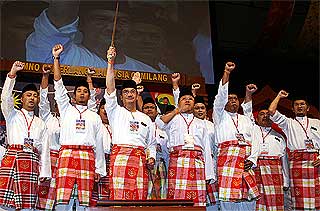 If there is another keris-waving incident or its equivalent during the next Umno general assembly, the presidents of MCA and Gerakan will have no choice but to come out hard against this kind of behaviour.
While Umno will try to manage expectations by advising its speakers and leaders to tone down their rhetoric, with the plethora of media organisations - including online media - expected to cover the event, any remarks which can be interpreted as incendiary will be fodder for news.
If MCA and Gerakan complain, this will probably create a backlash from Umno which may lead to a spiral of recriminations, accusations and counter-accusations.
There are still some within the MCA, especially among the old guard, who thinks that Umno can only be charitable when they are strong and cannot afford to be charitable when they are weak.
Nothing could be further from reality. Umno did not make any concessions in 1999 when they were weak and Umno did not do so in 2004 when they were strong. They might be charitable when it comes to loosening cultural and educational controls as was the case in the 1990s but Umno will never compromise in terms of power-sharing within the BN. Umno only knows how to govern from a position of almost absolute dominance.
As such, no matter how much MCA shouts or rails against Umno, publicly or privately, these empty words are not likely to be translated into actual policy actions, at least for now.
MCA’s ‘battered wife syndrome’
The only way for the power balance to have a possibility of being reconfigured is if the BN falls out of power. Only then can MCA and some of the other component party members contemplate leaving the BN as a way to renegotiate the terms of power-sharing with Umno.
As it stands, MCA leaders have too much to lose from leaving the BN. None of them spoke about the possibility of leaving the BN, something which was openly discussed among some Gerakan leaders during its general assembly. They have too many ministerial and deputy ministerial and state exco positions at stake. This probably partly explains why MCA is not leveraging the power of its 15 MPs effectively.
MCA is suffering what is often referred to as the "battered wife syndrome". It's like an abused wife who cannot leave an abusive husband who will not listen to her pleas. Which is why this relationship is doomed to failure – to the detriment of the battered wife.
Postscript: After the recording of this podcast, MCA together with Gerakan and MIC had a perfect opportunity to put its beliefs into action. All these parties have come out to say that the ISA needs to be abolished or significantly reformed.
They could have shown their sincerity on this issue by signing the petition organised by the DAP to discuss the motion to abolish the ISA in parliament. The very least these component party leaders could have done was to instruct some of its backbenchers to sign this petition.
Of all these parties, MCA has the most number of backbenchers. They failed this test miserably and it was left to a real lone ranger, Billy Abit Jol, Hulu Rajang MP and vice-president of Parti Rakyat Sarawak, to stand up and be counted as the sole BN signatory of that petition.
ONG KIAN MING is a PhD candidate in political science at Duke University and YUN YANG is a writer and new media analyst. You can listen to both of them discuss this topic in their Realpolitik podcast .


Report this comment
Are you sure you want to delete this comment?
This action cannot be undone.