




Police force has improved, claims Suhakam
To those skeptical of the Human Rights Commission’s (Suhakam) ability to bring changes, commissioner Khalid Ibrahim said they have only to contrast the past - and improvements made since - with the present situation.
To those skeptical of the Human Rights Commission’s (Suhakam) ability to bring changes, commissioner Khalid Ibrahim said they have only to contrast the past - and improvements made since - with the present situation.
Obviously, there remains ample space for improvements in terms of the protection and promotion of human rights.
But comparing the past treatment by the police and the Federal Reserve Unit (FRU) of demonstrators - such as those at the Kesas Highway gathering Nov 5, 2000 - to more recent incidents, that improvements have occurred cannot be denied, he said.
Suhakam does not seek credit for all the improvements, Khalid said. But it also cannot be doubted that the commission has affected some changes to the human rights situation and positively influenced the law enforcement agencies, he added..
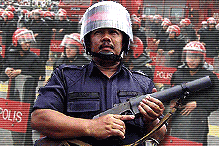 “There has been a little bit improvement (compared) with the (police’) previous (behavior) at the Kesas Highway,” he told a press conference at the launch of the commission’s report on the
Bandar
Mahkota Cheras (BMC) fracas of May 27, 2008.
“There has been a little bit improvement (compared) with the (police’) previous (behavior) at the Kesas Highway,” he told a press conference at the launch of the commission’s report on the
Bandar
Mahkota Cheras (BMC) fracas of May 27, 2008.
“I don't want to say that it was because of our recommendations, but our recommendations did have a strong impact on that score,” he added.
Excessive force by police, FRU
Khalid was addressing suggestions that Suhakam’s latest findings - that police and FRU personnel had used excessive force against two individuals during the BMC incident and recommended action against those responsible - would remain shelved and ignored by the government.
In comparison to the Kesas Highway gathering and the Bloody Sunday incident of 2006 - in both of which the police was found to have employed force beyond what was necessary to maintain law and order - Khalid said recent demonstrations have seen considerably less violence on the part of the police.
He also noted that there have been several demonstrations since the Kesas gathering that have not seen police violence.
Asked about criticisms of Suhakam being a ‘toothless tiger’, Khalid said: “We can see improvements from the previous ones to the (more recent) ones.”
Also at the press conference was Suhakam commissioner Zaitoon Othman who, to a questions on whether the report would have any effect on the government, said: “We can only present our recommendations. We are not in a position to know what the authorities are going to do.”
'Not fair to zero in on whole group'
“But as long as we continue making our observations...and recommendations, we hope they will be taken up,” she added.
Asked whether any senior police officer - or the force as a whole - should be held responsible for the actions of those personnel who had used excessive force, Zaitoon said: “It’s not fair to zero in on the whole group of the police force, when there’s only one or two who had committed the offence.”
Contacted later for comments on the resolve by the two victims of police at the BMC fracas to sue the police force, Khalid said the move was completely within their rights to do so.
Suhakam, however, has fulfilled its mandate as contained in the Suhakam Act 1999 by investigating the allegations against the police that they had used excessive force and issuing its recommendations to the government to prevent its recurrence, he said.
Khalid said the Suhakam Act prohibits the organisation’s involvement in the case if the two persons decide to go ahead with legal suits.


Report this comment
Are you sure you want to delete this comment?
This action cannot be undone.