




Thoughts on the elections, Part 1
Malaysia’s 12th general election saw the Barisan Nasional (BN) coalition severely mauled. Now leaner and hopefully wiser and less arrogant, it is left to gather the pieces and carry on with what is left.
While the government lasts, there is much to do. Apart from the usual development agenda, it should also reassess its past actions and inactions and try to put things right.
It remains to be seen if the leaders have learned a lesson and comprehend what it is that the people want, or don’t want - whether it is only development, development and development, or something they consider a lot more important.
Malaysia’s 12th general election saw the Barisan Nasional (BN) coalition severely mauled. Now leaner and hopefully wiser and less arrogant, it is left to gather the pieces and carry on with what is left.
While the government lasts, there is much to do. Apart from the usual development agenda, it should also reassess its past actions and inactions and try to put things right.
It remains to be seen if the leaders have learned a lesson and comprehend what it is that the people want, or don’t want - whether it is only development, development and development, or something they consider a lot more important.
 Sabah was truly the “fixed deposit state” of BN to use coalition deputy head Najib Abdul Razak’s description of Sabah. Sabahans can be excused for wanting to rub the point in a bit, and not entirely without glee - that BN could have been consigned to the opposition benches in Parliament, or at best teetered precariously in a hung Parliament, if Sabah and Sarawak had not bucked the trend.
Despite Sabah’s life-saving contribution, the new cabinet does not really reflect any recognition of its importance. Sabah MPs could have been given more important positions, but Prime Minister Abdullah Ahmad Badawi showed that he would rather appoint ministers via a senatorship than bring in MPs from Sabah and Sarawak.
 It is especially sad that a senior Sabah MP like Bernard Dompok wasn’t given a more important portfolio than some nondescript duties as before. At very least, Abdullah could have appointed a deputy minister of home affairs from the KDM community to show the federal government’s seriousness and sincerity in wanting to tackle the
pendatang tanpa izin
problem that has afflicted Sabah more than any other state.
It is especially sad that a senior Sabah MP like Bernard Dompok wasn’t given a more important portfolio than some nondescript duties as before. At very least, Abdullah could have appointed a deputy minister of home affairs from the KDM community to show the federal government’s seriousness and sincerity in wanting to tackle the
pendatang tanpa izin
problem that has afflicted Sabah more than any other state.
That little show of appreciation for the people of Sabah would have been a thoughtful gesture in return for their strong support.
Perhaps BN Sabah’s apparent popularity is peculiar to Sabah at this particular stage of the state’s development. After decades of neglect, the federal government finally ploughed back some of the wealth it got from Sabah into its development, although probably only a small part of the billions of ringgit that Petronas got out of the oil reserves.
Anyway, the upsurge of development activities under the 8th and 9th Malaysia Plans was in positive contrast to the doldrums in previous years. That had a big impact, and understandably so, for it is a lot easier for BN to gladden the hearts of Sabahans with a road here and a bridge there and with promises of poverty eradication than it is to impress folks in the peninsula.
Even though the BN government’s political stock-in-trade in Sabah has not changed, the packaging is more sophisticated now. Like advertising, it uses catch phrases and nuances that evoke an unthinking response. The innocuous word “corridor” that gained currency and popularity from multimedia super corridor was exploited to the full.
When you think about it, the RM105 billion allocation for the 18-year Sabah Development Corridor, spread over 18 years, works out to about RM25 billion per Malaysia plan, which is not much more than the budget for the 9th Plan. But by launching it and making it more than life-size just before the election, the PM appears to have succeeded in making Sabahans think that it was indeed a big deal.
In reality it was really like taking out an overdraft of RM105 billion worth of popularity all in one big dollop up front before the election, to be repaid by installments over 18 years. It was actually borrowing popularity from the future! The federal allocation for Sabah’s Development Corridor is the smallest among all the other development corridors. Sarawak’s allocation is RM334 billion, more than three times that for Sabah.
Discouraging cross-overs
It is a pity that the British left behind the first-past-the-post, winner-takes-all system to people all over their colonial empire, who didn’t take long to see the liquidity potential of the seats they occupy. We would have been much better off with proportional representation, as such seats are less marketable..
It is a pity too that Sabah’s anti-hop law was demolished by the Federal Court on the ground that it infringed the constitutional provision on freedom of association, although a similar law is alive and well in India, the world’s largest democracy.
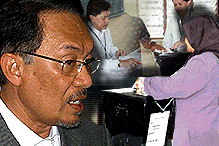 Interestingly, when commenting about the alleged attempt by PKR
de facto
leader Anwar Ibrahim
(photo)
to draw BN MPs to the opposition camp, Abdullah postulated the idea that a
wakil rakyat
elected on a party ticket has a contractual obligation to stay with that party, and that the legislative seat is not the personal cartel to do as he/she pleases.
Interestingly, when commenting about the alleged attempt by PKR
de facto
leader Anwar Ibrahim
(photo)
to draw BN MPs to the opposition camp, Abdullah postulated the idea that a
wakil rakyat
elected on a party ticket has a contractual obligation to stay with that party, and that the legislative seat is not the personal cartel to do as he/she pleases.
If that is in fact what he meant, it is a pity he did not expound this point to Dr Mahathir Mohamad when BN laid siege to the lone PBS government and engineered the repeal of Sabah’s anti-hop law to open the escape hatch for PBS MPs. Now when there is a possibility of a reverse defection taking place, the point about contractual commitment has suddenly become relevant. That is most revealing.
In any event, I think trying to get people to defect is not a very honourable thing to do. It shouldn’t be condoned even though some people might like to see Umno et al paid back in their own coin at some point.
 Incidentally, on another occasion Abdullah also said BN would welcome opposition representatives who wish to cross over. That sounds ominous as it portends the kind of age-old tribal practice that the people of Sabah still remember so well.
Will MPs in the peninsula feel inclined to take a page out of Sabah’s political history? I suppose much depends on how the DAP, PKR and PAS leaders (especially the DAP) conduct themselves vis-à-vis the Malays.
Softly, softly approach
The ill-timed, ill-considered utterances by Penang Chief Minister Lim Guan Eng about doing away with the New Economic Policy (NEP) have triggered quite a stir that many fear would make some less committed Malay elected representatives scurry back to Mother Umno. The demonstrations in Penang and Kelantan may have been just a start. There are signs that the storm-troopers of Umno have gone into overdrive to make sure there will be more protests.
Lim’s statement was just what the BN needed to make defections by Barisan Rakyat MPs all over the country seem like a very honourable thing to do in the interest of the Malay race! It remains to be seen if the Barisan Rakyat MPs are made of sterner stuff.
 Lim should have left the NEP and DAP’s other favourite polemics alone for now at least and concentrated on gaining the
rakyat’s
confidence across the entire ethnic spectrum. If he had to say something smart about the NEP to impress non-Malays, he could have said the state government under his leadership would enhance the NEP to include all the have-nots in Penang, regardless of ethnicity.
Lim should have left the NEP and DAP’s other favourite polemics alone for now at least and concentrated on gaining the
rakyat’s
confidence across the entire ethnic spectrum. If he had to say something smart about the NEP to impress non-Malays, he could have said the state government under his leadership would enhance the NEP to include all the have-nots in Penang, regardless of ethnicity.
He could even outdo the PM by coining a new term: NEP Hadhari, if this does not clash with the Islam Hadhari . The Malays cannot fault him for such a policy. The new generation of Malay intelligentsia might even support him whole-heartedly. He does not have to rob Peter to pay Paul.
If the new Penang government is as all-encompassing as it claims to be, the NEP has a ready-made framework for Lim’s administration to work in, albeit with a little adaptation and adjustment which he need not shout out so loud as to raise suspicion.
As for the PKR-DAP-PAS trying to attract BN MPs to their camp, this looks like a futile attempt indeed. Weakened though BN may now be as a result of its election setbacks, it is still a formidable force and the political dynamics have not changed so much that any of the BN MPs would consider it profitable to go for broke with the Barisan Rakyat group.
One should bear in mind that being in control of the federal government, Abdullah still has both the stick and the carrot to make sure the BN representatives behave. This enables him to retain power for as long as he wishes, unless thrown out by voters. This is why it is so important for Malaysia to have a two-party system.
But the question remains: will the elected representatives stay with their parties? Few would bet their bottom dollar that they would not be open to persuasion.
It may be a tall order to expect either side to do the right thing in confining themselves to their refined role of loyal opposition in between elections.
STAN YEE is a retired government officer and an ad hoc newspaper columnist.


