




Teoh's death not solely a Chinese issue
Mourning the passing of a life so young and promising, I in fact do not know if Teoh would want the public to grieve his passing with a massive outpour of pain and sorrow.
The "sudden death", as the police calls it, practically ended all the humiliation that Teoh was made to suffer unnecessarily.
In death, he has regained his human dignity.
Mourning the passing of a life so young and promising, I in fact do not know if Teoh would want the public to grieve his passing with a massive outpour of pain and sorrow.
The "sudden death", as the police calls it, practically ended all the humiliation that Teoh was made to suffer unnecessarily.
In death, he has regained his human dignity.
The tragic death of Teoh has now become a tricky issue.
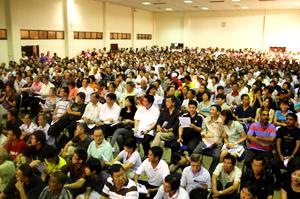 On one hand, Chinese Malaysians must not see it as a microcosm of their fate in this country, while on the other hand, details of the interrogation process revealed by Tan Boon Hwa clearly indicate that institutional racism is still alive and kicking in Malaysia.
The tactics of fear and intimidation employed by the Malaysian Anti-Corruption Commission (MACC) officers are just part and parcel of the psychological warfare to weaken the spirit and the morale of those under probe, not dissimilar from the underhanded measures adopted by the much discredited Malaysian police force.
While Teoh's has become a prominent victim of institutional injustice, he certainly was not the first person to have tasted the uninhibited abuse of power by unruly MACC officers.
In January this year, chairman of the Umno division in Maran, Pahang, lodged a report against the MACC, claiming that he had been manhandled during interrogation into allegations of corruption.
Strangely, the interrogating officers threatened to also bring his wife if he refused to confess.
Flawed procedures
In the case of Tan, the Kajang councillor was told that the authorities would take away his wife and there would be no one left to care for his children.
The two men's testimonies go to show that there are now serious flaws and irregularities in the interrogation procedures.
But there have been many other deaths in detention and police custody over the years.
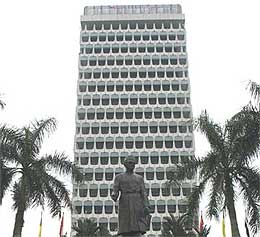 Last year in Parliament, Wan Ahmad Farid, then deputy home minister, told the Dewan Rakyat that there were 1,535 deaths in prisons, rehabilitation centres and detention centres between 2003 and 2007, averaging 383.75 deaths per year.
Meanwhile, Abdullah Ahmad Badawi, the former prime minister, admitted that 108 persons died in police custody between 2000 and 2006, the majority of whom were Indians.
That thousands of Indian youths took to the streets in KL in November 2007 in answering the calls by Hindraf was not a coincidence.
Teoh's death remains shrouded in mystery.
Being merely a political aide, he was lacking in experience yet spotlessly clean, like a blank sheet of paper.
On the several occasions that I met him, he looked so innocent that his childlike laughter over political jokes almost bordered on naivety.
Perhaps this was why the public uproar over his death was so overwhelming, forcing the Umno-controlled press, from Utusan Malaysia, Berita Harian to the New Straits Times, to come to the government's and the MACC's defence.
However, Teoh's tragedy does not obscure the fact that the 1,000 plus innocent deaths in police custody and detention deserve an equal measure of public sympathy and attention.
Many of the victims may have been foreigners or undocumented persons, but the injustice that they experienced speaks volumes of the decay of our moral fibre.
They were not Chinese, hence the limited concerns for them by the Chinese community. But again, it is our indifference that is partly to blame for the increasing violent tendencies of our law enforcement agencies.
‘Flagrant and habitual abuse'
Therefore, for those on both sides of the political divide to call for a royal commission to inquire into Teoh's death alone is not enough.
The tragedy itself has its origins in the flagrant and habitual abuse of power in Malaysia's public institutions and Teoh's passing presents us with an opportunity to re-examine all the past cases in their totality in order to compel the government to reform the excessively bloated yet opaque public institutions.
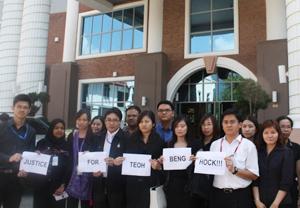 In this perspective, Teoh's death has nothing to do with race, for the tentacles of unrestrained powers extend far and wide regardless of ethnicity and religion.
Be so as it may, the interrogation process as recounted by Tan was inundated with racism, and the verbal insults - such as ‘ Cina bodoh ' - that were hurled at the victim, were meant to make him feel guilty of being Chinese.
It could work very well on those who happen to be less fluent in Malay, and there is evidence to suggest the blatant institutional racism often targets poor Indians, lowly-educated Chinese, undocumented persons and other marginalized groups.
When Najib launched his so-called 1Malaysia concept upon taking over the administration, the mainstream press - including the best-selling Chinese newspapers, the China Press and Sin Chew Daily - was in haste to applaud it.
I then cautioned the prime minister's effort to realise a more equal and just-minded society would end in failure had Najib chosen not to reform the public service and stem institutional racism at the same time.
More than 100 days later, the prime minister has shown himself to be merely interested in packaging and spinning, albeit in a way that is more subtle than his immediate predecessor.
Najib has devoted very little time to dealing with institutional racism, while the reaction of Utusan Malaysia to the public furore over Teoh's death runs counter to the 1Malaysia concept.
In accusing the opposition parties of questioning the capability of the public service made up predominantly of Malays, Utusan has again turned the public concerns into a racial issue in an attempt to fool the Malay community and divide the people.
Don't make a mockery of 1Malaysia
No, Teoh's dying young and the ensuing public anger are not about the capability of the Malays, yet the serious concerns over the integrity and professionalism of our public institutions can no longer be brushed aside.
As head of government, Najib must not expect to enjoy positive news coverage and commentaries of his leadership, while pretending all is fine with the Umno-controlled media.
Most importantly, he cannot afford to distance himself from the violent and racist behaviour of the MACC officers if he truly hopes to win back public trust in him.
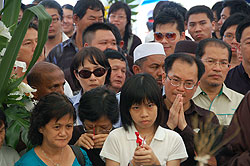 Teoh's tragedy is not a Chinese issue; rather, it symbolises the cruel persecution against a young Malaysian whose only guilt was merely to contribute his strength to make his motherland more democratic.
It was reported that Oh Ei Sun, assistant to Prime Minister Najib Abdul Razak, visited the Teoh family last Sunday in Alor Gajah, Malacca, as a personal emissary.
A wreath was also sent in the name of the PM's Department as a token of condolences.
It was indeed kind of the prime minister to offer his personal condolences to Teoh's grieving parents, but he should seize this opportunity to eradicate the culture of violence within all the law enforcement agencies and to root out institutional racism at all costs.
Otherwise, all the banners and posters across the country to celebrate 1Malaysia will only make a mockery of Najib's sincerity as many grow fonder of Teoh's tender face.


